


 Cart
Cart
 sales@molnova.com



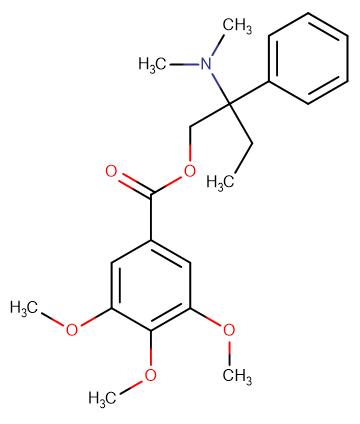
Trimebutine
CAS No. 39133-31-8
Trimebutine( —— )
Catalog No. M14347 CAS No. 39133-31-8
Trimebutine is a drug with antimuscarinic and weak mu opioid agonist effects.
Purity : >98% (HPLC)
 COA
Datasheet
HNMR
HPLC
MSDS
Handing Instructions
COA
Datasheet
HNMR
HPLC
MSDS
Handing Instructions
| Size | Price / USD | Stock | Quantity |
| 1 mL x 10 mM in DMSO | 28 | In Stock |


|
| 100MG | Get Quote | In Stock |
|
| 200MG | Get Quote | In Stock |
|
| 500MG | Get Quote | In Stock |
|
| 1G | 28 | In Stock |
|
Biological Information
-
Product NameTrimebutine
-
NoteResearch use only, not for human use.
-
Brief DescriptionTrimebutine is a drug with antimuscarinic and weak mu opioid agonist effects.
-
DescriptionTrimebutine is a drug with antimuscarinic and weak mu opioid agonist effects.Trimebutine is an agonist of peripheral mu, kappa and delta opiate receptors, used as spasmolytic agent for treatment of both acute and chronic abdominal pain.
-
In Vitro——
-
In Vivo——
-
Synonyms——
-
PathwayEndocrinology/Hormones
-
TargetOpioid Receptor
-
RecptorOpioid Receptor
-
Research AreaMetabolic Disease
-
Indication——
Chemical Information
-
CAS Number39133-31-8
-
Formula Weight387.47
-
Molecular FormulaC22H29NO5
-
Purity>98% (HPLC)
-
SolubilityDMSO: 50 mg/mL (129.04 mM)
-
SMILESCCC(COC(=O)C1=CC(OC)=C(OC)C(OC)=C1)(N(C)C)C1=CC=CC=C1
-
Chemical Name——
Shipping & Storage Information
-
Storage(-20℃)
-
ShippingWith Ice Pack
-
Stability≥ 2 years
Reference
1.Prescrire Int. 2013 Oct;22(142):241-2.
molnova catalog



related products
-
(20R)-Protopanaxdiol
Protopanaxdiol has the effect of anti-tumor through increasing the activity of body immunity, inhibiting tumor interstitial microvascular density and its proliferation activity.
-
Enadoline
Enadoline (CI 977;PD 129290) is a potent, selective κ-opioid receptor (KOR) agonist with Ki of 0.11 nM.
-
Calenduloside E
Calenduloside E exhibits hypoglycemic activities by suppressing the transfer of glucose from the stomach to the small intestine and by inhibiting glucose transport at the brush border of the small intestine in oral glucose-loaded rats.
