


 Cart
Cart
 sales@molnova.com



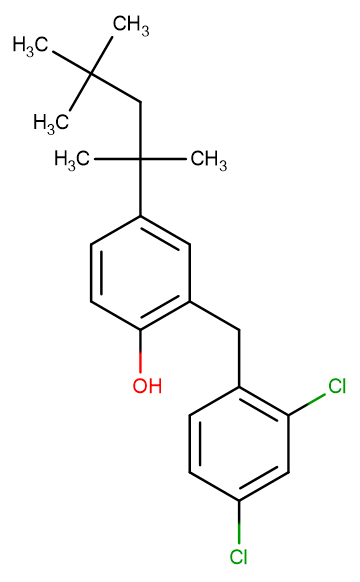
Clofoctol
CAS No. 37693-01-9
Clofoctol( —— )
Catalog No. M14300 CAS No. 37693-01-9
Clofoctol is a bacteriostatic antibiotic. It is used in the treatment of respiratory tract and ear, nose and throat infections caused by Gram-positive bacteria.
Purity : >98% (HPLC)
 COA
Datasheet
HNMR
HPLC
MSDS
Handing Instructions
COA
Datasheet
HNMR
HPLC
MSDS
Handing Instructions
| Size | Price / USD | Stock | Quantity |
| 1 mL x 10 mM in DMSO | 48 | In Stock |


|
| 25MG | 36 | In Stock |
|
| 50MG | 49 | In Stock |
|
| 100MG | 69 | In Stock |
|
| 200MG | Get Quote | In Stock |
|
| 500MG | 215 | In Stock |
|
| 1G | Get Quote | In Stock |
|
Biological Information
-
Product NameClofoctol
-
NoteResearch use only, not for human use.
-
Brief DescriptionClofoctol is a bacteriostatic antibiotic. It is used in the treatment of respiratory tract and ear, nose and throat infections caused by Gram-positive bacteria.
-
DescriptionClofoctol is a bacteriostatic antibiotic. It is used in the treatment of respiratory tract and ear, nose and throat infections caused by Gram-positive bacteria.
-
In VitroCell Viability Assay Cell Line:Prostate cancer cell lines: LNCaP, DU145, PC3, LAPC4, CWR22Rv1 and C42BConcentration:0-100 μMIncubation Time:72 h Result:Inhibited cell growth with IC50 values ranging from 10 to 15 μM.Cell Viability Assay Cell Line:PC3 Concentration:0, 10 and 20 μM Incubation Time:24 h Result:Induced a G1 arrest.RT-PCRCell Line:PC3 Concentration:0, 5, 10, 15, 20 and 30 μM Incubation Time:24 h Result:Increased the splicing of XBP-1 mRNA in PC3 cells in a dose-dependent manner. Dose-dependently decreased PstI digestion products from XBP-1 mRNA.Western Blot Analysis Cell Line:PC3 Concentration:0, 5, 10, 15, 20, 25 and 30 μM Incubation Time:0, 0.5, 1, 3, 6 and 9 h or 24 h (cell cycle)Result:Dose- and time-dependently increased the level of phosphorylated eIF2α, up-regulated CHOP expression, and increased the expression of BiP. Led to a dose-dependent decrease in the levels of cyclin A and cyclin D1.
-
In VivoAnimal Model:Male athymic nude mice (BALB/c, nu/nu-NCr) aged 4–6 weeks, human prostate cancer xenograft modelDosage:175 mg/kg Administration:Intraperitoneal injection, daily for 37 days Result:Significantly inhibited PC3 tumour growth, tumour weight was also reduced by 60%.Animal Model:K18-hACE2 transgenic C57BL/6J mice with SARS-CoV-2 infection Dosage:62.5 mg/kg Administration:Intraperitoneal injection, 1h and 8h post-infection Result:Induced body weight loss, reduced the viral load in the lungs. The expression of transcripts encoding IL-6, TNFα, IL12p40, IFNβ, IFNγ and the interferon-stimulated genes (ISG) Mx1, Ifi44 and ISG15 was markedly reduced.Animal Model:8–10 week-old female C57BL/6J miceDosage:62.5mg/kg Administration:Intraperitoneal injection, once (Pharmacokinetics) Result:Reached concentrations up to 61 μM in the lungs and remained above this level for almost 4h as early as 30 min after injection.
-
Synonyms——
-
PathwayOthers
-
TargetOther Targets
-
RecptorOthers
-
Research AreaInfection
-
Indication——
Chemical Information
-
CAS Number37693-01-9
-
Formula Weight365.35
-
Molecular FormulaC21H26Cl2O
-
Purity>98% (HPLC)
-
SolubilityDMSO: 10 mM
-
SMILESCC(C)(C)CC(C)(C)C1=CC(CC2=C(Cl)C=C(Cl)C=C2)=C(O)C=C1
-
Chemical Name——
Shipping & Storage Information
-
Storage(-20℃)
-
ShippingWith Ice Pack
-
Stability≥ 2 years
Reference
1.Yablonsky F, Simonnet G. J Pharmacol. 1982 Oct-Dec;13(4):515-24.
molnova catalog



related products
-
IPSU
IPSU is an antagonist of OX2 receptor. IPSU Exhibits approximately six-fold selectivity for OX2 versus OX1 receptors.
-
Glychionide A
Glychionide A is a natural product.
-
Ceftriaxone sodium
Ceftriaxone sodium hydrate is an antibiotic useful for the treatment of a number of bacterial infections.
