


 Cart
Cart
 sales@molnova.com



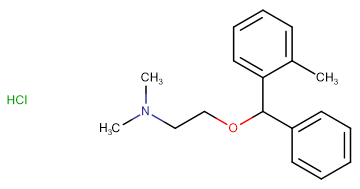
Orphenadrine hydrochloride
CAS No. 341-69-5
Orphenadrine hydrochloride( —— )
Catalog No. M14161 CAS No. 341-69-5
Orphenadrine is an anticholinergic drug of the ethanolamine antihistamine class with prominent central nervous system (CNS) and peripheral actions used to treat painful muscle spasms and other similar conditions, as well as the treatment of some aspects of Parkinson's disease.
Purity : >98% (HPLC)
 COA
Datasheet
HNMR
HPLC
MSDS
Handing Instructions
COA
Datasheet
HNMR
HPLC
MSDS
Handing Instructions
| Size | Price / USD | Stock | Quantity |
| 1 mL x 10 mM in DMSO | 44 | In Stock |


|
| 10MG | 29 | In Stock |
|
| 50MG | 36 | In Stock |
|
| 100MG | 43 | In Stock |
|
| 200MG | 78 | In Stock |
|
| 500MG | 126 | In Stock |
|
| 1G | 182 | In Stock |
|
Biological Information
-
Product NameOrphenadrine hydrochloride
-
NoteResearch use only, not for human use.
-
Brief DescriptionOrphenadrine is an anticholinergic drug of the ethanolamine antihistamine class with prominent central nervous system (CNS) and peripheral actions used to treat painful muscle spasms and other similar conditions, as well as the treatment of some aspects of Parkinson's disease.
-
DescriptionOrphenadrine is an anticholinergic drug of the ethanolamine antihistamine class with prominent central nervous system (CNS) and peripheral actions used to treat painful muscle spasms and other similar conditions, as well as the treatment of some aspects of Parkinson's disease. It is closely related to diphenhydramine. Therefore, it is related to other drugs used for Parkinson's, such as benztropine and trihexyphenidyl, and it is also structurally related to nefopam, which is a centrally acting yet nonopioid analgesic. The combination of anticholinergic effects and CNS penetration make orphenadrine useful for pain of all etiologies, including from: radiculopathy, muscles, and headaches.(In Vitro):Orphenadrine citrate (12 μM; 24.5 h) shows neuroprotective effects on 3-NPA-induced neurotoxicity cerebellar granule cells.(In Vivo):Orphenadrine citrate (10, 20, 30 mg/kg; i.p.; once aday for 3 days) reduces 3-NPA-induced mortality in a dose-dependent manner.Orphenadrine citrate (30 mg/kg; i.p.; once aday for 3 days) shows activity to against 3-NPA-induced neuronal damage in vivo.
-
In VitroOrphenadrine hydrochloride (12 μM; 24.5 h) shows neuroprotective effects on 3-NPA-induced neurotoxicity cerebellar granule cells.Cell Viability Assay Cell Line:CGC cells (7-day-old Sprague Dawley rat)Concentration:6, 12, 24, 48 μM Incubation Time:24.5 h Result:Prevented cells from 3-NPA induced cellular aggregation,volume diminution and neurite fragmentation.
-
In VivoOrphenadrine hydrochloride (10, 20, 30 mg/kg; i.p.; once aday for 3 days) reduces 3-NPA-induced mortality in a dose-dependent manner.Orphenadrine hydrochloride (30 mg/kg; i.p.; once aday for 3 days) shows activity to against 3-NPA-induced neuronal damage in vivo. Animal Model:Adult male Sprague Dawley rats (275-300 g; 3-NPA toxicity model).Dosage:10, 20, 30 mg/kg Administration:Intraperitoneal injection; once aday for 3 days (30 min before 3-NPA )Result:Reduced mortality of 3-NPA toxicity rats to 10-40% (3-NPA-treated animals showed general incoordination, drowsiness and general weakness).Recovered 3-NPA-induced body weight loss, and when at 30 mg/kg reduced the level of PBR and expression of HSP27. (PBR and HSP27 are markers of neuronal damage).
-
Synonyms——
-
PathwayGPCR/G Protein
-
TargetHistamine Receptor
-
RecptorH1 receptor| NMDA receptor| Noradrenaline transporter (Sodium-dependent)| Sodium Channel
-
Research AreaNeurological Disease
-
Indication——
Chemical Information
-
CAS Number341-69-5
-
Formula Weight305.85
-
Molecular FormulaC18H23NO·HCl
-
Purity>98% (HPLC)
-
SolubilityDMSO: 10 mM
-
SMILESCl.CN(C)CCOC(C1=CC=CC=C1)C1=CC=CC=C1C
-
Chemical Name——
Shipping & Storage Information
-
Storage(-20℃)
-
ShippingWith Ice Pack
-
Stability≥ 2 years
Reference
1.Kornhuber J, et al. J Neural Transm Gen Sect. 1995;102(3):237-46.
molnova catalog



related products
-
GSK-239512
GSK-239512 is an antagonist of H3 receptor and can be used in studies about the treatment of cognitive dysfunction in neurodegenerative disorders.
-
Alcaftadine
A H1 histamine receptor antagonist that used for prevention of allergic conjunctivitis.
-
Hydroxyzine Pamoate
Hydroxyzine pamoate is a histamine H1-receptor antagonist.
