


 Cart
Cart
 sales@molnova.com



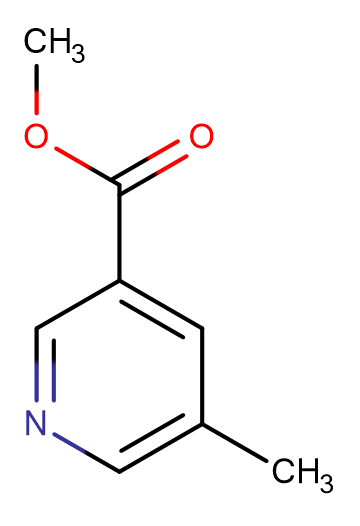
Methyl 5-methylnicotinate
CAS No. 29681-45-6
Methyl 5-methylnicotinate( —— )
Catalog No. M13906 CAS No. 29681-45-6
Used as pharmaceutical intermediates.
Purity : >98% (HPLC)
 COA
Datasheet
HNMR
HPLC
MSDS
Handing Instructions
COA
Datasheet
HNMR
HPLC
MSDS
Handing Instructions
| Size | Price / USD | Stock | Quantity |
| 50MG | 43 | In Stock |


|
| 100MG | 79 | In Stock |
|
| 200MG | 141 | In Stock |
|
| 500MG | Get Quote | In Stock |
|
| 1G | Get Quote | In Stock |
|
Biological Information
-
Product NameMethyl 5-methylnicotinate
-
NoteResearch use only, not for human use.
-
Brief DescriptionUsed as pharmaceutical intermediates.
-
DescriptionUsed as pharmaceutical intermediates.
-
In Vitro——
-
In Vivo——
-
Synonyms——
-
PathwayOthers
-
TargetOther Targets
-
RecptorOthers
-
Research Area——
-
Indication——
Chemical Information
-
CAS Number29681-45-6
-
Formula Weight151.16
-
Molecular FormulaC8H9NO2
-
Purity>98% (HPLC)
-
SolubilityLimited solubility
-
SMILESCOC(=O)C1=CC(C)=CN=C1
-
Chemical Name——
Shipping & Storage Information
-
Storage(-20℃)
-
ShippingWith Ice Pack
-
Stability≥ 2 years
Reference
1.Katzman M, et al. Neuropsychopharmacology. 2003 Oct; 28(10): 1846-5
molnova catalog



related products
-
Thalidomide-O-C6-NH2...
Thalidomide-O-C6-NH2 hydrochloride is a synthesized E3 ligase ligand-linker conjugate.
-
Decuroside I
Decuroside I shows weak inhibiting activity against the primary and secondary wave aggregation of human platelet.
-
Ac-Arg-Gly-Lys(Ac)-A...
Ac-Arg-Gly-Lys(Ac)-AMC is a substrate for HDAC.
