


 Cart
Cart
 sales@molnova.com



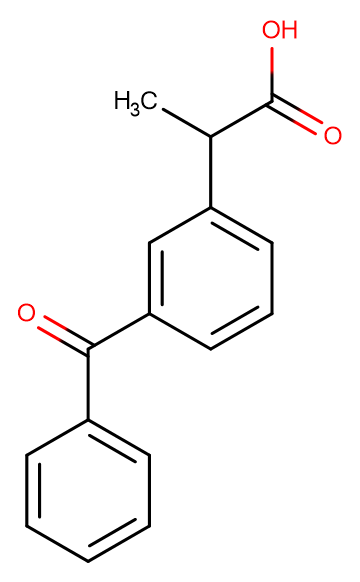
Ketoprofen
CAS No. 22071-15-4
Ketoprofen( 2-(3-benzoylphenyl)propionic Acid | Ketoprofen | (RS)-Ketoprofen )
Catalog No. M13518 CAS No. 22071-15-4
Ketoprofen is a non-selective NSAID with IC50 of 0.5 μM and 2.33 μM for human recombinant COX-1 and COX-2, respectively.
Purity : >98% (HPLC)
 COA
Datasheet
HNMR
HPLC
MSDS
Handing Instructions
COA
Datasheet
HNMR
HPLC
MSDS
Handing Instructions
| Size | Price / USD | Stock | Quantity |
| 1 mL x 10 mM in DMSO | 48 | In Stock |


|
| 100MG | Get Quote | In Stock |
|
| 200MG | Get Quote | In Stock |
|
| 500MG | 42 | In Stock |
|
| 1G | 49 | In Stock |
|
Biological Information
-
Product NameKetoprofen
-
NoteResearch use only, not for human use.
-
Brief DescriptionKetoprofen is a non-selective NSAID with IC50 of 0.5 μM and 2.33 μM for human recombinant COX-1 and COX-2, respectively.
-
DescriptionKetoprofen is a non-selective NSAID with IC50 of 0.5 μM and 2.33 μM for human recombinant COX-1 and COX-2, respectively.(In Vitro):Ketoprofen inhibits COX in LPS-stimulated monocytes isolated from human blood, with IC50 values of 2 nM (COX-1) and 26 nM (COX-2).Ketoprofen (2.5 mg /mL, 3-24h) decreases the mRNA level of immune factors (TNFα, IL-8, SAA and COX-2) and PTGES in LPS-stimulated bovine mammary epithelial cells. (In Vivo):Ketoprofen (Oral administration, 10 mg/kg, three times a week for 10 weeks, HFD-induced obese C57BL/6 mice) decreases in relative body weight (15.41%), the iWAT mass (approximately 41%), and leptin (58.68%) and resistin (12.88%).Ketoprofen (50 mg/kg, LPS-treated dairy cows) lowers the increase of somatic cell count (SCC), serum albumin (SA), IgG and lactate dehydrogenase (LDH) activity in milk induced by LPS.
-
In VitroKetoprofen inhibits COX in LPS-stimulated monocytes isolated from human blood, with IC50 values of 2 nM (COX-1) and 26 nM (COX-2).Ketoprofen (2.5 mg /mL, 3-24h) decreases the mRNA level of immune factors (TNFα, IL-8, SAA and COX-2) and PTGES in LPS-stimulated bovine mammary epithelial cells.RT-PCRCell Line:LPS (0.2 μg/mL)-stimulated bovine mammary epithelial cells Concentration:2.5 mg /mL Incubation Time:3, 6, 24 h Result:Decreased the mRNA level of TNFα, IL-8, SAA, COX-2 and PTGES.
-
In VivoKetoprofen (Oral administration, 10 mg/kg, three times a week for 10 weeks, HFD-induced obese C57BL/6 mice) decreases in relative body weight (15.41%), the iWAT mass (approximately 41%), and leptin (58.68%) and resistin (12.88%).Ketoprofen (50 mg/kg, LPS-treated dairy cows) lowers the increase of somatic cell count (SCC), serum albumin (SA), IgG and lactate dehydrogenase (LDH) activity in milk induced by LPS. Animal Model:HFD-induced obese C57BL/6 mice Dosage:10 mg/kg Administration:Oral administration, three times a week for 10 weeks Result:Decreased in relative body weight, the iWAT mass, and the level of leptin and resistin.Animal Model:LPS (0.2 μg/mL)-treated dairy cows Dosage:50 mg/kg Administration:Injection (Milk samples were taken every 30 min until 6 and 9 h)Result:Lowered the increase of somatic cell count (SCC), serum albumin (SA), IgG and lactate dehydrogenase (LDH) activity in milk.
-
Synonyms2-(3-benzoylphenyl)propionic Acid | Ketoprofen | (RS)-Ketoprofen
-
PathwayChromatin/Epigenetic
-
TargetCOX
-
RecptorCOX-1| COX-2| MRAP4
-
Research AreaInflammation/Immunology
-
Indication——
Chemical Information
-
CAS Number22071-15-4
-
Formula Weight254.28
-
Molecular FormulaC16H14O3
-
Purity>98% (HPLC)
-
SolubilityEthanol: 51 mg/mL (200.56 mM); DMSO: 51 mg/mL (200.56 mM)
-
SMILESCC(C1=CC=CC(C(C2=CC=CC=C2)=O)=C1)C(O)=O
-
Chemical Name2-(3-benzoylphenyl)propanoic acid
Shipping & Storage Information
-
Storage(-20℃)
-
ShippingWith Ice Pack
-
Stability≥ 2 years
Reference
1.Parsadaniantz SM, et al. J Neuroendocrinol. 2000 Aug; 12(8):766-73.
molnova catalog



related products
-
Oxaprozin
Oxaprozin is a non-narcotic, non-steroidal anti-inflammatory drug (NSAID) used to relieve the inflammation, swelling, stiffness, and joint pain associated with osteoarthritis and rheumatoid arthritis.
-
ATB 346
ATB-346 is a novel hydrogen sulphide-releasing derivative of naproxen with markedly reduced toxicity.
-
Celecoxib
Celecoxib is a non-steroidal anti-inflammatory drug (NSAID) used in the treatment of osteoarthritis, rheumatoid arthritis, acute pain, painful menstruation and menstrual symptoms.
