


 Cart
Cart
 sales@molnova.com



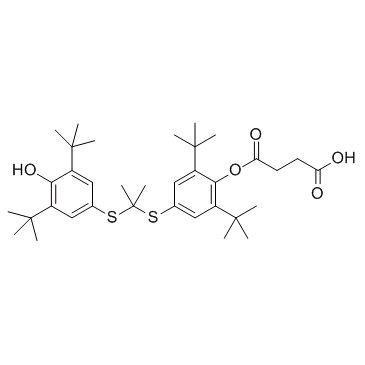
AGI-1067
CAS No. 216167-82-7
AGI-1067( Succinobucol | AGI 1067 | AGI1067 )
Catalog No. M13448 CAS No. 216167-82-7
AGI-1067 (Succinobucol) is a potent inhibitor of TNF-α-inducible expression of VCAM-1, MCP-1 and E-selectin (IC50=6,10 and 25 uM).
Purity : >98% (HPLC)
 COA
Datasheet
HNMR
HPLC
MSDS
Handing Instructions
COA
Datasheet
HNMR
HPLC
MSDS
Handing Instructions
| Size | Price / USD | Stock | Quantity |
| 1 mL x 10 mM in DMSO | 36 | In Stock |


|
| 5MG | 29 | In Stock |
|
| 10MG | 46 | In Stock |
|
| 25MG | 93 | In Stock |
|
| 50MG | 155 | In Stock |
|
| 100MG | 266 | In Stock |
|
| 200MG | 369 | In Stock |
|
| 500MG | Get Quote | In Stock |
|
| 1G | Get Quote | In Stock |
|
Biological Information
-
Product NameAGI-1067
-
NoteResearch use only, not for human use.
-
Brief DescriptionAGI-1067 (Succinobucol) is a potent inhibitor of TNF-α-inducible expression of VCAM-1, MCP-1 and E-selectin (IC50=6,10 and 25 uM).
-
DescriptionAGI-1067 (Succinobucol) is a potent inhibitor of TNF-α-inducible expression of VCAM-1, MCP-1 and E-selectin (IC50=6,10 and 25 uM) with concurrent antioxidant and lipid-modulating properties; inhibits atherosclerosis in LDL receptor-deficient and apolipoprotein E-deficient mice, also reduces VCAM-1 and MCP-1 mRNA levels in lungs of LPS-stimulated mice; inhibits atherosclerosis not only via its lipid-lowering effects but also by having direct anti-inflammatory effects on the vessel wall.Diabetes Phase 3 Clinical(In Vitro):Succinobucol (10, 50, 100 μM) causes a dose-dependent reduction in collagen-induced platelet aggregation in rabbit whole blood. Succinobucol also causes a significant reduction in whole blood aggregation in response to ADP. Succinobucol (10, 100 μM) significantly lowers the relaxation to X/XO. Succinobucol significantly prevents 3-NP-induced loss of SH-SY5Y cell viability, generation of reactive oxygen species, and decrease of ΔΨm. Succinobucol does not protect against 3-NP-induced inhibition of mitochondrial complex II activity, pointing to the mitigation of secondary events resultant from mitochondrial complex II inhibition. Succinobucol significantly increases (50 %) the levels of GSH in SH-SY5Y cells, which is paralleled by significant increases in glutamate cysteine ligase messenger RNA (mRNA) expression and activity. Succinobucol effectively exhibits superior inhibitory effects on cell migration and invasion activities, VCAM-1 expression and cell-cell binding of RAW 264.7 to 4T1 cells. Succinobucol also shows inhibitory effect on VCAM-1 expression in 4T1 cells and cell-cell binding of RAW 264.7 to 4T1 cancer cells.(In Vivo):Succinobucol (50, 100, and 150 mg/kg, i.v.) has no significant effect on either heart rate or MAP, but the blood removed 15 minutes after the final injection of succinobucol shows significantly less aggregation in response to collagen at both 5 μg/mL and 20 μg/mL in rats. Succinobucol (40 mg/kg) by tail injection significantly reduces the average number of metastatic nodules in lung metastatic breast cancer mice.
-
In VitroSuccinobucol (10, 50, 100 μM) causes a dose-dependent reduction in collagen-induced platelet aggregation in rabbit whole blood. Succinobucol also causes a significant reduction in whole blood aggregation in response to ADP. Succinobucol (10, 100 μM) significantly lowers the relaxation to X/XO. Succinobucol significantly prevents 3-NP-induced loss of SH-SY5Y cell viability, generation of reactive oxygen species, and decrease of ΔΨm. Succinobucol does not protect against 3-NP-induced inhibition of mitochondrial complex II activity, pointing to the mitigation of secondary events resultant from mitochondrial complex II inhibition. Succinobucol significantly increases (50 %) the levels of GSH in SH-SY5Y cells, which is paralleled by significant increases in glutamate cysteine ligase messenger RNA (mRNA) expression and activity. Succinobucol effectively exhibits superior inhibitory effects on cell migration and invasion activities, VCAM-1 expression and cell-cell binding of RAW 264.7 to 4T1 cells. Succinobucol also shows inhibitory effect on VCAM-1 expression in 4T1 cells and cell-cell binding of RAW 264.7 to 4T1 cancer cells.
-
In VivoSuccinobucol (50, 100, and 150 mg/kg, i.v.) has no significant effect on either heart rate or MAP, but the blood removed 15 minutes after the final injection of succinobucol shows significantly less aggregation in response to collagen at both 5 μg/mL and 20 μg/mL in rats. Succinobucol (40 mg/kg) by tail injection significantly reduces the average number of metastatic nodules in lung metastatic breast cancer mice.
-
SynonymsSuccinobucol | AGI 1067 | AGI1067
-
PathwayOthers
-
TargetOther Targets
-
RecptorOthers
-
Research AreaMetabolic Disease
-
IndicationDiabetes
Chemical Information
-
CAS Number216167-82-7
-
Formula Weight616.916
-
Molecular FormulaC35H52O5S2
-
Purity>98% (HPLC)
-
SolubilityDMSO: Soluble ( < 1 mg/ml refers to the product slightly soluble or insoluble )
-
SMILESO=C(O)CCC(OC1=C(C(C)(C)C)C=C(SC(C)(SC2=CC(C(C)(C)C)=C(O)C(C(C)(C)C)=C2)C)C=C1C(C)(C)C)=O
-
Chemical Name4-(4-((1-((3,5-bis(1,1-Dimethylethyl)-4-hydroxyphenyl)sulfanyl)-1-methylethyl)sulfanyl)-2,6-bis(1,1-dimethylethyl)phenoxy)-4-oxobutanoic acid
Shipping & Storage Information
-
Storage(-20℃)
-
ShippingWith Ice Pack
-
Stability≥ 2 years
Reference
1. Sundell CL, et al. J Pharmacol Exp Ther. 2003 Jun;305(3):1116-23.
2. Meng CQ, et al. Bioorg Med Chem Lett. 2002 Sep 16;12(18):2545-8.
3. Tardif JC, et al. Circulation. 2003 Feb 4;107(4):552-8.
4. Kunsch C, et al. J Pharmacol Exp Ther. 2004 Mar;308(3):820-9.
molnova catalog



related products
-
Magnoflorine chlorid...
Magnoflorine has anti-inflammatory activity, it can inhibit inflammations.
-
Turtle Polypeptide I
Turtle Polypeptide I
-
Swertiamarin
Extracted from Gentianaceae Swertia L. Swertia mussotii Franch.
