


 Cart
Cart
 sales@molnova.com



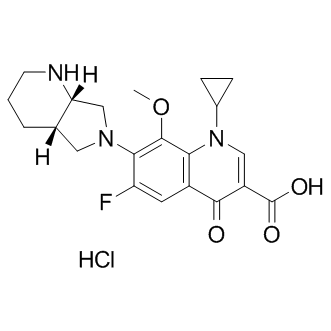
Moxifloxacin hydrochloride
CAS No. 186826-86-8
Moxifloxacin hydrochloride( BAY 12-8039 )
Catalog No. M12886 CAS No. 186826-86-8
A fourth-generation synthetic fluoroquinolone, broad-spectrum antibacterial agent that is active against both Gram-positive and Gram-negative bacteria.
Purity : >98% (HPLC)
 COA
Datasheet
HNMR
HPLC
MSDS
Handing Instructions
COA
Datasheet
HNMR
HPLC
MSDS
Handing Instructions
| Size | Price / USD | Stock | Quantity |
| 1 mL x 10 mM in DMSO | 37 | In Stock |


|
| 25MG | 34 | In Stock |
|
| 50MG | 48 | In Stock |
|
| 100MG | 75 | In Stock |
|
| 200MG | Get Quote | In Stock |
|
| 500MG | 176 | In Stock |
|
| 1G | Get Quote | In Stock |
|
Biological Information
-
Product NameMoxifloxacin hydrochloride
-
NoteResearch use only, not for human use.
-
Brief DescriptionA fourth-generation synthetic fluoroquinolone, broad-spectrum antibacterial agent that is active against both Gram-positive and Gram-negative bacteria.
-
DescriptionA fourth-generation synthetic fluoroquinolone, broad-spectrum antibacterial agent that is active against both Gram-positive and Gram-negative bacteria; inhibits DNA gyrase and topoisomerase IV.Bacterial Infection Approved(In Vitro):The in vitro activities of Moxifloxacin Hydrochloride (BAY 12-8039) and Amoxicillin are compared by time-kill curve and inhibition of intracellular growth experiments by using a model of bone marrow-derived mouse macrophages infected by L. monocytogenes EGDe. Moxifloxacin acts much more rapidly, beginning to exert its effects in the first 3 h and achieving complete broth sterilization within 24 h of incubation. Moxifloxacin appears to have a protective effect against macrophage lysis, as many cells are still viable after 24 h of incubation.(In Vivo):Moxifloxacin (BAY 12-8039; 12 mg/kg; intravenous injection; once-three times per day; for 7 days; white male Wistar rats) treatment every 8 hours is accompanied by longer survival. Tissue cultures 30 hours after bacterial challenge shows considerably less bacterial overgrowth in the spleens and lungs of moxifloxacin-treated than in salinetreated animals and without being toxic.
-
In VitroThe in vitro activities of Moxifloxacin Hydrochloride (BAY 12-8039) and Amoxicillin are compared by time-kill curve and inhibition of intracellular growth experiments by using a model of bone marrow-derived mouse macrophages infected by L. monocytogenes EGDe. Moxifloxacin acts much more rapidly, beginning to exert its effects in the first 3 h and achieving complete broth sterilization within 24 h of incubation. Moxifloxacin appears to have a protective effect against macrophage lysis, as many cells are still viable after 24 h of incubation.
-
In VivoMoxifloxacin (BAY 12-8039; 12 mg/kg; intravenous injection; once-three times per day; for 7 days; white male Wistar rats) treatment every 8 hours is accompanied by longer survival. Tissue cultures 30 hours after bacterial challenge shows considerably less bacterial overgrowth in the spleens and lungs of moxifloxacin-treated than in salinetreated animals and without being toxic. Animal Model:144 white male Wistar rats (18-22 weeks; 300-400 g) infected Stenotrophomonas maltophilia Dosage:12 mg/kg Administration:Intravenous injection; once per day, twice per day, three times per day; for 7 days Result:Showed considerably less bacterial overgrowth in the spleens and lungs and without being toxic.
-
SynonymsBAY 12-8039
-
PathwayGPCR/G Protein
-
TargetAntibacterial
-
RecptorTopoII|TopoIV
-
Research AreaInfection
-
IndicationBacterial Infection
Chemical Information
-
CAS Number186826-86-8
-
Formula Weight437.8923
-
Molecular FormulaC21H25ClFN3O4
-
Purity>98% (HPLC)
-
SolubilityDMSO: ≥ 31 mg/mL
-
SMILESCOC1=C2C(=CC(=C1N3C[C@@H]4CCCN[C@@H]4C3)F)C(=O)C(=CN2C5CC5)C(=O)O.Cl
-
Chemical Name3-Quinolinecarboxylic acid, 1-cyclopropyl-6-fluoro-1,4-dihydro-8-methoxy-7-[(4aS,7aS)-octahydro-6H-pyrrolo[3,4-b]pyridin-6-yl]-4-oxo-, hydrochloride (1:1)
Shipping & Storage Information
-
Storage(-20℃)
-
ShippingWith Ice Pack
-
Stability≥ 2 years
Reference
1. Drlica K, et al. Microbiol Mol Biol Rev. 1997 Sep;61(3):377-92.
2. Alffenaar JW, et al. Clin Infect Dis. 2009 Oct 1;49(7):1080-2.
3. Zhanel GG, et al. Treat Respir Med. 2006;5(6):437-65.
molnova catalog



related products
-
1-Heptadecanol
1-Heptadecanol is a natural product from Solena amplexicaulis leaves with antibacterial activity.
-
Sulfachloropyrazine ...
Sulfachloropyrazine sodium is an antiprotozoalwith antibacterial and anticoccidial effects.
-
Bombinin-Like Peptid...
Bombinin-Like Peptide (BLP-1) is an antimicrobial peptide from Bombina species.
