


 Cart
Cart
 sales@molnova.com



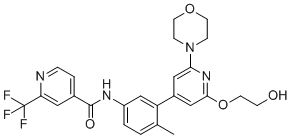
LXH254
CAS No. 1800398-38-2
LXH254( LXH-254 | LXH 254 )
Catalog No. M12736 CAS No. 1800398-38-2
LXH254 (LXH-254, LXH 254) is a novel potent, ATP-competitive pan-RAF inhibitor, binds to Raf proteins and inhibits Raf-mediated signal transduction pathways.
Purity : >98% (HPLC)
 COA
Datasheet
HNMR
HPLC
MSDS
Handing Instructions
COA
Datasheet
HNMR
HPLC
MSDS
Handing Instructions
| Size | Price / USD | Stock | Quantity |
| 5MG | 112 | In Stock |


|
| 10MG | 176 | In Stock |
|
| 25MG | 344 | In Stock |
|
| 50MG | 537 | In Stock |
|
| 100MG | 653 | In Stock |
|
| 200MG | 897 | In Stock |
|
| 500MG | 1368 | In Stock |
|
| 1G | Get Quote | In Stock |
|
Biological Information
-
Product NameLXH254
-
NoteResearch use only, not for human use.
-
Brief DescriptionLXH254 (LXH-254, LXH 254) is a novel potent, ATP-competitive pan-RAF inhibitor, binds to Raf proteins and inhibits Raf-mediated signal transduction pathways.
-
DescriptionLXH254 (LXH-254, LXH 254) is a novel potent, ATP-competitive pan-RAF inhibitor, binds to Raf proteins and inhibits Raf-mediated signal transduction pathways, inhibits proliferation of Raf-overexpressing tumor cells; demonstrates anti-proliferative activity in cell lines that contain a variety of mutations that activate MAPK signaling, blocks mutant RAS-driven signaling and cell proliferation; demonstrates tumor regression in several KRAS-mutant models including the NSCLC-derived Calu-6 (KRAS Q61K) and NCI-H358 (KRAS G12C), exhibits efficacy in numerous MAPK-driven human cancer cell lines and in xenograft tumors representing model tumors harboring human lesions in KRAS, NRAS and BRAF oncogenes.Lung Cancer Phase 1 Clinical(In Vitro):LXH254 (Compound A) is an adenosine triphosphate (ATP)-competitive inhibitor of BRAF (also referred to herein as b-RAF or b-Raf) and CRAF (also referred to herein as c-RAF or c- Raf) protein kinases. Throughout the present disclosure, LXH254 is also referred to as a c-RAF (or CRAF) inhibitor or a C-RAF/c-Raf kinase inhibitor. In cell-based assays, LXH254 has demonstrated anti-proliferative activity in cell lines that contain a variety of mutations that activate MAPK signaling. Moreover, LXH254 is a Type 2 ATP -competitive inhibitor of both B-Raf and C-Raf that keeps the kinase pocket in an inactive conformation, thereby reducing the paradoxical activation seen with many B-Raf inhibitors, and blocking mutant RAS-driven signaling and cell proliferation.LXH254 (0-10 μM, 1 h) inhibits both monomeric and dimeric RAF and promotes RAF dimer formation.LXH254 has reduced ability to suppress MAPK signaling driven by ARAF and further that the contribution of ARAF to MAPK signaling increases in the absence of CRAF expression.LXH254 shows more sensitivity when cells lack ARAF.(In Vivo):Treatment with LXH254 (Compound A) generates tumor regression in several KRAS-mutant models including the NSCLC-derived Calu-6 (KRAS Q61K) and NCI-H358 (KRAS G12C). LXH254 exhibits efficacy in numerous MAPK-driven human cancer cell lines and in xenograft tumors representing model tumors harboring human lesions in KRAS, NRAS and BRAF oncogenes.LXH254 shows significant antitumor activity in models harboring BRAF mutations either alone or coincident with either activated NRAS or KRAS, and RAS mutants lacking ARAF are more sensitive to LXH254.
-
In VitroLXH254 (Compound A) is an adenosine triphosphate (ATP)-competitive inhibitor of BRAF (also referred to herein as b-RAF or b-Raf) and CRAF (also referred to herein as c-RAF or c- Raf) protein kinases. Throughout the present disclosure, LXH254 is also referred to as a c-RAF (or CRAF) inhibitor or a C-RAF/c-Raf kinase inhibitor. In cell-based assays, LXH254 has demonstrated anti-proliferative activity in cell lines that contain a variety of mutations that activate MAPK signaling. Moreover, LXH254 is a Type 2 ATP -competitive inhibitor of both B-Raf and C-Raf that keeps the kinase pocket in an inactive conformation, thereby reducing the paradoxical activation seen with many B-Raf inhibitors, and blocking mutant RAS-driven signaling and cell proliferation.LXH254 (0-10 μM, 1 h) inhibits both monomeric and dimeric RAF and promotes RAF dimer formation.LXH254 has reduced ability to suppress MAPK signaling driven by ARAF and further that the contribution of ARAF to MAPK signaling increases in the absence of CRAF expression.LXH254 shows more sensitivity when cells lack ARAF.Western Blot Analysis Cell Line:HCT116, MEL-JUSO, Mia PaCa-2, A375(BRAFV600E), and HCT116 (KRASG13D)Concentration:0-10 μM Incubation Time:1 hResult:Promoted B/CRAF heterodimer formation. Displayed similar inhibition of monomeric BRAFV600 and wild-type dimeric RAF (IC50 for p-ERK levels of 59 and 78 nmol/L in A-375 and HCT 116 cells, respectively).Cell Proliferation Assay Cell Line:Two NRAS-mutant melanoma cell lines (MEL-JUSO and SK-MEL-30), three KRAS-mutant cell lines (COR-L23, MIA PaCa-2, and HCT116), and derived variants lacking expression of either ARAF, BRAF, or CRAF.Concentration:0-10 μM Incubation Time:24 h Result:The sensitivity was increased relative to parental cell lines in all models tested by loss of ARAF expression.
-
In VivoTreatment with LXH254 (Compound A) generates tumor regression in several KRAS-mutant models including the NSCLC-derived Calu-6 (KRAS Q61K) and NCI-H358 (KRAS G12C). LXH254 exhibits efficacy in numerous MAPK-driven human cancer cell lines and in xenograft tumors representing model tumors harboring human lesions in KRAS, NRAS and BRAF oncogenes.LXH254 shows significant antitumor activity in models harboring BRAF mutations either alone or coincident with either activated NRAS or KRAS, and RAS mutants lacking ARAF are more sensitive to LXH254. Animal Model:Outbred athymic (nu/nu) female mice and SCID Beige mice; BRAF-, NRAS-, and KRAS-mutant xenograft models, as well as a RAS/RAF wild-type model Dosage:100 mg/kg Administration:Orally, daily Result:Significantly decreased tumor volume in models harboring BRAF mutations either alone or coincident with either activated NRAS or KRAS, slightly decreased tumor volume in KRAS model.
-
SynonymsLXH-254 | LXH 254
-
PathwayMAPK/ERK Signaling
-
TargetRaf
-
RecptorRaf
-
Research AreaCancer
-
IndicationLung Cancer
Chemical Information
-
CAS Number1800398-38-2
-
Formula Weight502.494
-
Molecular FormulaC25H25F3N4O4
-
Purity>98% (HPLC)
-
SolubilityDMSO : ≥ 83.3 mg/mL 165.77 mM
-
SMILESCC1=C(C=C(C=C1)NC(=O)C2=CC(=NC=C2)C(F)(F)F)C3=CC(=NC(=C3)OCCO)N4CCOCC4
-
Chemical NameN-(3-(2-(2-hydroxyethoxy)-6-morpholinopyridin-4-yl)-4-methylphenyl)-2-(trifluoromethyl)isonicotinamide
Shipping & Storage Information
-
Storage(-20℃)
-
ShippingWith Ice Pack
-
Stability≥ 2 years
Reference
1. CAPONIGRO, Giordano, et al. WO 2018051306 A1, Compound A.
molnova catalog



related products
-
Uplarafenib
Uplarafenib (B-Raf IN 10) is a potent BRAF inhibitor with an IC50 of 50-100 nM. B-Raf IN 10 exhibits antitumor activity that may influence cell proliferation and differentiation, making it suitable for studying solid tumors.
-
B-Raf IN 15
B-Raf IN 15 is a BRAF inhibitor that inhibits BRAFWT and BRAFV600E and can be used in the study of melanoma and cancer, and can be optimized for use as a more effective BRA F inhibitor.
-
BGB-283
BGB-283 (Lifirafenib, BGB283) is a potent pan RAF inhibitor of BRAF V600E, wt BRAF, CRAFY340/341D and wt ARAF (IC50=5-40 nM).
