


 Cart
Cart
 sales@molnova.com



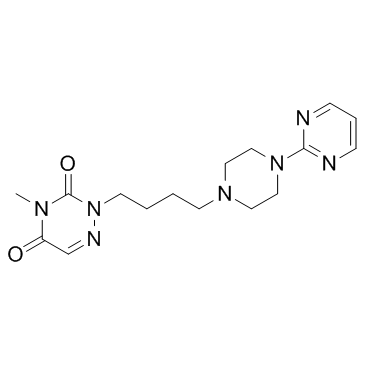
F-11440
CAS No. 179756-58-2
F-11440( Eptapirone )
Catalog No. M12716 CAS No. 179756-58-2
A potent, selective 5-HT1A receptor agonist with Ki of 4.8 nM, pKi of 8.33.
Purity : >98% (HPLC)
 COA
Datasheet
HNMR
HPLC
MSDS
Handing Instructions
COA
Datasheet
HNMR
HPLC
MSDS
Handing Instructions
| Size | Price / USD | Stock | Quantity |
| 1 mL x 10 mM in DMSO | 29 | In Stock |


|
| 10MG | 42 | In Stock |
|
| 25MG | 79 | In Stock |
|
| 50MG | 138 | In Stock |
|
| 100MG | 206 | In Stock |
|
| 200MG | 298 | In Stock |
|
| 500MG | Get Quote | In Stock |
|
| 1G | Get Quote | In Stock |
|
Biological Information
-
Product NameF-11440
-
NoteResearch use only, not for human use.
-
Brief DescriptionA potent, selective 5-HT1A receptor agonist with Ki of 4.8 nM, pKi of 8.33.
-
DescriptionA potent, selective 5-HT1A receptor agonist with Ki of 4.8 nM, pKi of 8.33; shows ≥shows 100-fold higher affinity for the other serotonin receptor subtypes, and has no detectable antidopaminergic activity and antihistaminergic activity; decreases the forskolin-induced increase in AMP in HeLa cells expressing human 5-HT1A receptors; produces anxiolytic- and antidepressant-like effects in animal models.Anxiety Phase 1 Discontinued(In Vitro):The affinity of Eptapirone (F11440) for 5-HT1Abinding sites (pKi, 8.33) was higher than that of buspirone (pKi , 7.50), and somewhat lower than that of flesinoxan (pKi , 8.91).In vivo, Eptapirone (F11440) was 4- to 20-fold more potent than flesinoxan, and 30- to 60-fold more potent than buspirone, in exerting 5-HT1A agonist activity at pre- and postsynaptic receptors in rats (measured by, for example, its ability to decrease hippocampal extracellular serotonin (5-HT) levels and to increase plasma corticosterone levels, respectively). Eptapirone (F11440), shown here to be a potent, selective, high efficacy 5-HT1Areceptor agonist, appears to have the potential to exert marked anxiolytic and antidepressant activity in humans.
-
In VitroThe affinity of Eptapirone (F11440) for 5-HT1Abinding sites (pKi, 8.33) was higher than that of buspirone (pKi , 7.50), and somewhat lower than that of flesinoxan (pKi , 8.91).In vivo, Eptapirone (F11440) was 4- to 20-fold more potent than flesinoxan, and 30- to 60-fold more potent than buspirone, in exerting 5-HT1A agonist activity at pre- and postsynaptic receptors in rats (measured by, for example, its ability to decrease hippocampal extracellular serotonin (5-HT) levels and to increase plasma corticosterone levels, respectively). Eptapirone (F11440), shown here to be a potent, selective, high efficacy 5-HT1Areceptor agonist, appears to have the potential to exert marked anxiolytic and antidepressant activity in humans.
-
In Vivo——
-
SynonymsEptapirone
-
PathwayGPCR/G Protein
-
Target5-HT Receptor
-
Recptor5-HT1A
-
Research AreaNeurological Disease
-
IndicationAnxiety
Chemical Information
-
CAS Number179756-58-2
-
Formula Weight345.3995
-
Molecular FormulaC16H23N7O2
-
Purity>98% (HPLC)
-
SolubilityDMSO: 6 mg/mL (Need ultrasonic)
-
SMILESO=C(N1C)N(CCCCN2CCN(C3=NC=CC=N3)CC2)N=CC1=O
-
Chemical Name1,2,4-Triazine-3,5(2H,4H)-dione, 4-methyl-2-[4-[4-(2-pyrimidinyl)-1-piperazinyl]butyl]-
Shipping & Storage Information
-
Storage(-20℃)
-
ShippingWith Ice Pack
-
Stability≥ 2 years
Reference
1. Koek W, et al. J Pharmacol Exp Ther. 1998 Oct;287(1):266-83.
2. Prinssen EP, et al. Eur J Pharmacol. 2002 Oct 25;453(2-3):217-21.
3. Pauwels PJ, et al. J Pharmacol Exp Ther. 2003 Nov;307(2):608-14.
molnova catalog



related products
-
5HT6-ligand-1
5HT6-ligand-1 is an orally active ligand of 5-HT6 receptor (Ki = 1.43 nM).
-
LY 344864 racemate
LY 344864 (racemate) is an agonist of the 5-HT1F receptor.
-
EMD 56551
EMD 56551 is a selective small molecule 5-HT1A receptor agonist with anxiolytic activity for the study of anxiety disorders.
