


 Cart
Cart
 sales@molnova.com



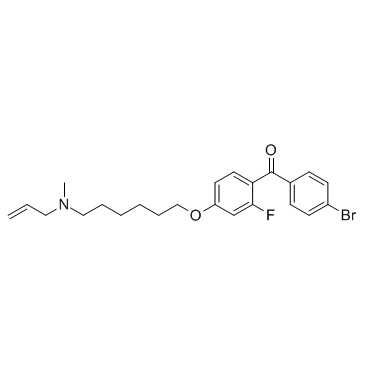
Ro 48-8071
CAS No. 161582-11-2
Ro 48-8071( Ro-488071 )
Catalog No. M12352 CAS No. 161582-11-2
A potent 2,3-oxidosqualene cyclase (OSC) inhibitor with IC50 of 6.5 nM.
Purity : >98% (HPLC)
 COA
Datasheet
HNMR
HPLC
MSDS
Handing Instructions
COA
Datasheet
HNMR
HPLC
MSDS
Handing Instructions
| Size | Price / USD | Stock | Quantity |
| 5MG | 873 | Get Quote |


|
| 100MG | Get Quote | Get Quote |
|
| 200MG | Get Quote | Get Quote |
|
| 500MG | Get Quote | Get Quote |
|
| 1G | Get Quote | Get Quote |
|
Biological Information
-
Product NameRo 48-8071
-
NoteResearch use only, not for human use.
-
Brief DescriptionA potent 2,3-oxidosqualene cyclase (OSC) inhibitor with IC50 of 6.5 nM.
-
DescriptionA potent 2,3-oxidosqualene cyclase (OSC) inhibitor with IC50 of 6.5 nM; 6 times less potent against hamster and Gottingen minipig liver OSC, and 10-times more potent against squirrel monkey liver OSC; blocks human liver OSC and cholesterol synthesis in HepG2 cells in the nanomolar range; triggers the production of monooxidosqualene, dioxidosqualene, and epoxycholesterol.Dyslipidemia Preclinical.
-
In VitroIn HepG2 cells, Ro 48-8071 reduces cholesterol synthesis dose dependently with an IC50 value of appr 1.5 nM. Ro 48-8071 (10 μM) significantly reduces the viability of PC-3 prostate cancer cells, but not normal prostate cells. Ro 48-8071 (10-30 μM) induces apoptosis of both LNCaP and C4-2 cell lines in a dose-dependent manner. And castration-resistant PC-3 and DU145 cells also demonstrate significant levels of apoptosis following 24-hour treatment with Ro 48-8071. Ro 48-8071 (10-25 μM) reduces AR protein expression in a dose-dependent manner. Ro 48-8071 (0.1-1 μM) increases ERβ protein expression dose-dependently in both hormone-dependent LNCaP and castration-resistant PC-3 cells. Using mammalian cells engineered to express human ERα or ERβ protein, together with an ER-responsive luciferase promoter, Ro 48-8071 dose-dependently inhibits 17β-estradiol (E2)-induced ERα responsive luciferase activity (IC50, appr 10 μM), under conditions that are non-toxic to the cells.
-
In VivoRo 48-8071 lowers LDL-C maximally appr 60% at 150 μmol/kg per day, with no further reduction up to 300 μmol/kg per day, leaving HDL-C unchanged at all doses in hamsters. Ro 48-8071 (≥00 μmol/kg per day) increases the amount of MOS in liver of hamsters. Ro 48-8071 (300 μmol/kg per day) remarkedly and significantly reduces VLDL secretion of hamsters. Ro 48-8071 (5 or 20 mg/kg) significantly reduces in vivo tumor growth in mice, without weight loss of the mice. Furthermore, Ro 48-8071 at a concentration of 20 mg/kg, completely eradicates two of the 12 tumors being monitored in the mice in the timeframe tested. Ro 48-8071 (20 mg/day/kg body weight) leads to a rapid and sustained inhibition (>50%) of cholesterol synthesis in the whole small intestine of BALB/c mice. Sterol synthesis is also reduced in the large intestine and stomach.
-
SynonymsRo-488071
-
PathwayOthers
-
TargetOther Targets
-
RecptorOther Targets
-
Research AreaCardiovascular Disease
-
IndicationDyslipidemia
Chemical Information
-
CAS Number161582-11-2
-
Formula Weight448.3684
-
Molecular FormulaC23H27BrFNO2
-
Purity>98% (HPLC)
-
Solubility10 mM in DMSO
-
SMILESCN(CCCCCCOC1=CC(=C(C=C1)C(=O)C2=CC=C(C=C2)Br)F)CC=C
-
Chemical NameMethanone, (4-bromophenyl)[2-fluoro-4-[[6-(methyl-2-propen-1-ylamino)hexyl]oxy]phenyl]-
Shipping & Storage Information
-
Storage(-20℃)
-
ShippingWith Ice Pack
-
Stability≥ 2 years
Reference
1. Morand OH, et al. J Lipid Res. 1997 Feb;38(2):373-90.
2. Peffley DM, et al. Biochem Pharmacol. 1998 Aug 15;56(4):439-49.
3. Liang Y, et al. Onco Targets Ther. 2016 May 30;9:3223-32.
molnova catalog



related products
-
p-Hydroxybenzaldehyd...
p-Hydroxybenzaldehyde glucoside (4-formylphenyl b-d-glucopyranoside) is an inhibitory aspergillus derivative with analgesic activity and can be used to study neurogenic pain.
-
Transdermal Peptide ...
Transdermal Peptide TFA (TD 1 Peptide TFA) is an 11-amino acid polypeptide that binds to Na+/K+ -atpase beta-subunit (ATP1B1) and interacts with the C terminal of ATP1B1.Transdermal Peptide TFA can enhance the transmission of some large molecules in the skin.
-
Scopine
Scopine, the metabolite of anisodine, is an α1-adrenergic receptor agonist used in the therapy of acute circulatory shock.
