


 Cart
Cart
 sales@molnova.com



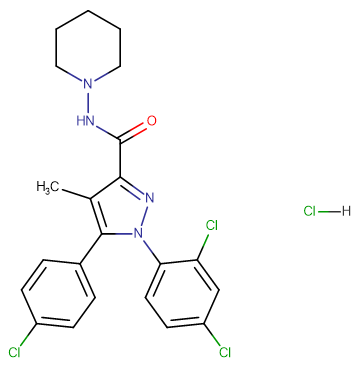
Rimonabant hydrochloride
CAS No. 158681-13-1
Rimonabant hydrochloride( Acomplia )
Catalog No. M12264 CAS No. 158681-13-1
Rimonabant Hcl(SR141716A) is a selective central cannabinoid (CB1) receptor inverse agonist with Ki of 1.8 nM.
Purity : >98% (HPLC)
 COA
Datasheet
HNMR
HPLC
MSDS
Handing Instructions
COA
Datasheet
HNMR
HPLC
MSDS
Handing Instructions
| Size | Price / USD | Stock | Quantity |
| 1 mL x 10 mM in DMSO | 65 | In Stock |


|
| 5MG | 36 | In Stock |
|
| 10MG | 58 | In Stock |
|
| 25MG | 112 | In Stock |
|
| 50MG | 202 | In Stock |
|
| 100MG | 304 | In Stock |
|
| 200MG | Get Quote | In Stock |
|
| 500MG | 728 | In Stock |
|
| 1G | Get Quote | In Stock |
|
Biological Information
-
Product NameRimonabant hydrochloride
-
NoteResearch use only, not for human use.
-
Brief DescriptionRimonabant Hcl(SR141716A) is a selective central cannabinoid (CB1) receptor inverse agonist with Ki of 1.8 nM.
-
DescriptionRimonabant Hcl(SR141716A) is a selective central cannabinoid (CB1) receptor inverse agonist with Ki of 1.8 nM.(In Vitro):Rimonabant could inhibit the growth of Mtb with an MIC of 54 μM. MmpL3, an anti-TB target, is the direct target of rimonabant.Rimonabant itself (10-12-10-3 M, 12 concentrations) inhibits the basal binding of [35S]GTPgS to human cortical membranes in a concentration dependent manner, with a -log IC50 of 4.7±0.2 (IC50 = 20 μM) and a maximal inhibition of 48±2%.(In Vivo):Rimonabant (10 mg/kg by gavage) is fed for 2 weeks to 3-month-old male obese Zucker rats as an impaired glucose tolerance model and for 10 weeks to 6-month-old male obese Zucker rats as a model of the metabolic syndrome. RANTES and MCP-1 serum levels are increased in obese vs lean Zucker rats and significantly reduced by long-term treatment with Rimonabant, which slowes weight gain in rats with the metabolic syndrome. Neutrophils and monocytes are significantly increased in young and old obese vs lean Zucker rats and lowered by Rimonabant. Platelet-bound fibrinogen is significantly enhanced in obese vs lean Zucker rats of both age, and is reduced by Rimonabant .Rimonabant (20 mg daily) exhibits a significant reduction in many cardiometabolic risk factors.
-
In Vitro——
-
In Vivo——
-
SynonymsAcomplia
-
PathwayGPCR/G Protein
-
TargetCannabinoid Receptor
-
RecptorCB1
-
Research AreaMetabolic Disease
-
Indication——
Chemical Information
-
CAS Number158681-13-1
-
Formula Weight500.25
-
Molecular FormulaC22H22Cl4N4O
-
Purity>98% (HPLC)
-
SolubilitySoluble in DMSO
-
SMILESO=C(C1=NN(C2=CC=C(Cl)C=C2Cl)C(C3=CC=C(Cl)C=C3)=C1C)NN4CCCCC4.[H]Cl
-
Chemical Name1H-Pyrazole-3-carboxamide, 5-(4-chlorophenyl)-1-(2,4-dichlorophenyl)-4-methyl-N-1-piperidinyl-, monohydrochloride
Shipping & Storage Information
-
Storage(-20℃)
-
ShippingWith Ice Pack
-
Stability≥ 2 years
Reference



-
GW 833972A
GW 833972A is a selective CB2 receptor agonist that inhibits induced neural depolarization and citric acid-induced cough in an animal model.
-
Pravadoline
Pravadoline is a cannabinoid receptor agonist. Pravadoline inhibited the PGs synthesis in mouse brain and displayed antinociceptive activity in rodents subjected to a variety of thermal, chemical, and mechanical nociceptive stimuli.
-
Tetrahydrocannabivar...
Tetrahydrocannabivarin is a neutral cannabis receptor subtype (CB1) receptor antagonist, it can increases neural responding to rewarding and aversive stimuli, this effect profile suggests therapeutic activity in obesity, perhaps with a lowered risk of depressive side effects. Tetrahydrocannabivarin exhibits anticonvulsant effects in a piriform cortical brain slice model of epileptiform activity.
