


 Cart
Cart
 sales@molnova.com



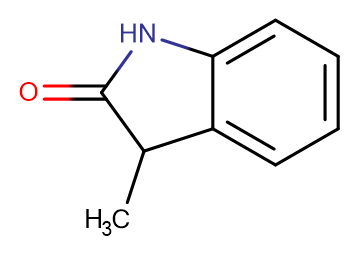
3-Methyloxindole
CAS No. 1504-06-9
3-Methyloxindole( —— )
Catalog No. M12096 CAS No. 1504-06-9
Used as organic synthesis and medicine intermediate.
Purity : >98% (HPLC)
 COA
Datasheet
HNMR
HPLC
MSDS
Handing Instructions
COA
Datasheet
HNMR
HPLC
MSDS
Handing Instructions
| Size | Price / USD | Stock | Quantity |
| 1 mL x 10 mM in DMSO | 28 | In Stock |


|
| 100MG | Get Quote | In Stock |
|
| 200MG | Get Quote | In Stock |
|
| 500MG | Get Quote | In Stock |
|
| 1G | 27 | In Stock |
|
Biological Information
-
Product Name3-Methyloxindole
-
NoteResearch use only, not for human use.
-
Brief DescriptionUsed as organic synthesis and medicine intermediate.
-
DescriptionUsed as organic synthesis and medicine intermediate.
-
In Vitro——
-
In Vivo——
-
Synonyms——
-
PathwayOthers
-
TargetOther Targets
-
RecptorOthers
-
Research Area——
-
Indication——
Chemical Information
-
CAS Number1504-06-9
-
Formula Weight147.18
-
Molecular FormulaC9H9NO
-
Purity>98% (HPLC)
-
SolubilityLimited solubility
-
SMILESCC1C(=O)NC2=CC=CC=C12
-
Chemical Name——
Shipping & Storage Information
-
Storage(-20℃)
-
ShippingWith Ice Pack
-
Stability≥ 2 years
Reference
1.Potchoiba MJ, et al. Am J Vet Res. 1982 Aug; 43(8):1418-23.
molnova catalog



related products
-
Giganteone A
The herbs of Curcuma wenyujin Y.H.Chen & C.Ling.
-
AKOS B018304
AKOS B018304 is an arylalkylidene derivative with polar substitution at para-position.
-
Pteropodine
Pteropodine acts as a positive modulator of muscarinic M(1) and 5-HT(2) receptors. Pteropodine shows antigenotoxic, antioxidant and lymphocyte induction effects, it also shows strong apoptotic effect on acute leukaemic lymphoblasts.
