


 Cart
Cart
 sales@molnova.com



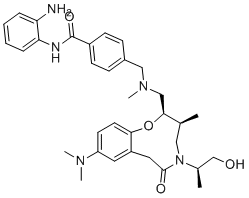
BRD 8430
CAS No. 1482499-16-0
BRD 8430( BRD8430 )
Catalog No. M12045 CAS No. 1482499-16-0
BRD 8430 is a potent, selective class I HDAC inhibitor (HDAC1>2 >3) with IC50 of 69 nM/560/1300 nM for HDAC1/2/3, respectively.
Purity : >98% (HPLC)
 COA
Datasheet
HNMR
HPLC
MSDS
Handing Instructions
COA
Datasheet
HNMR
HPLC
MSDS
Handing Instructions
| Size | Price / USD | Stock | Quantity |
| 100MG | Get Quote | In Stock |


|
| 200MG | Get Quote | In Stock |
|
| 500MG | Get Quote | In Stock |
|
| 1G | Get Quote | In Stock |
|
Biological Information
-
Product NameBRD 8430
-
NoteResearch use only, not for human use.
-
Brief DescriptionBRD 8430 is a potent, selective class I HDAC inhibitor (HDAC1>2 >3) with IC50 of 69 nM/560/1300 nM for HDAC1/2/3, respectively.
-
DescriptionBRD 8430 is a potent, selective class I HDAC inhibitor (HDAC1>2 >3) with IC50 of 69 nM/560/1300 nM for HDAC1/2/3, respectively; shows no activity against other HDACs; decreases viability and induces differentiation of neuroblastoma cell lines.
-
In Vitro——
-
In Vivo——
-
SynonymsBRD8430
-
PathwayCell Cycle/DNA Damage
-
TargetHDAC
-
RecptorHDAC
-
Research Area——
-
Indication——
Chemical Information
-
CAS Number1482499-16-0
-
Formula Weight573.738
-
Molecular FormulaC33H43N5O4
-
Purity>98% (HPLC)
-
Solubility——
-
SMILES——
-
Chemical NameN-(2-aminophenyl)-4-[[[(2R,3S)-9-(dimethylamino)-5-[(2R)-1-hydroxypropan-2-yl]-3-methyl-6-oxo-2,3,4,7-tetrahydro-1,5-benzoxazonin-2-yl]methyl-methylamino]methyl]benzamide
Shipping & Storage Information
-
Storage(-20℃)
-
ShippingWith Ice Pack
-
Stability≥ 2 years
Reference
1. Frumm SM, et al. Chem Biol. 2013 May 23;20(5):713-25.
molnova catalog



related products
-
Detomidine HCl
Detomidine HCl produce dose-dependent sedative and analgesic effects, mediatated by activation of α2 catecholamine receptors.
-
Romidepsin
Romidepsin (FK228, depsipeptide) is a potent HDAC1 and HDAC2 inhibitor with IC50 of 36 nM and 47 nM, respectively.
-
HDAC-IN-4
A histone deacetylase (HDAC) inhibitor.
