


 Cart
Cart
 sales@molnova.com



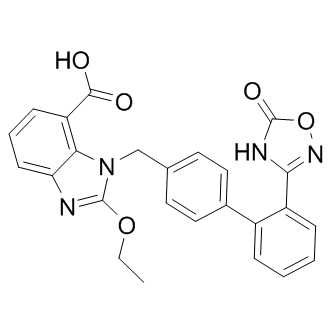
Azilsartan
CAS No. 147403-03-0
Azilsartan( TAK-536 )
Catalog No. M12030 CAS No. 147403-03-0
A specific and potent angiotensin II type 1 receptor (AT1) antagonist with IC50 of 2.6 nM.
Purity : >98% (HPLC)
 COA
Datasheet
HNMR
HPLC
MSDS
Handing Instructions
COA
Datasheet
HNMR
HPLC
MSDS
Handing Instructions
| Size | Price / USD | Stock | Quantity |
| 25MG | 27 | In Stock |


|
| 50MG | 42 | In Stock |
|
| 100MG | 72 | In Stock |
|
| 200MG | 106 | In Stock |
|
| 500MG | 178 | In Stock |
|
| 1G | Get Quote | In Stock |
|
Biological Information
-
Product NameAzilsartan
-
NoteResearch use only, not for human use.
-
Brief DescriptionA specific and potent angiotensin II type 1 receptor (AT1) antagonist with IC50 of 2.6 nM.
-
DescriptionA specific and potent angiotensin II type 1 receptor (AT1) antagonist with IC50 of 2.6 nM, used in the treatment of adults with essential hypertension. Hypertension Approved(In Vitro):Azilsartan (0-200 μM, 0-72 h) decreases the viability of HepG2 cells.Azilsartan (100 μM, 24 h) induces apoptosis in HepG2 cells.Azilsartan inhibits the specific binding of 125I-Sar1-Ile8-AII to human angiotensin type 1 receptors with an IC50 of 2.6 nM.Azilsartan potently inhibits aortic endothelial and vascular cell proliferation in the absence of exogenous Ang II supplementation.Azilsartan enhances adipogenesis and exerted greater effects than Valsartan (HY-18204) on expression of genes encoding peroxisome proliferator-activated receptor-α (PPARα), PPARδ, leptin, adipsin, and adiponectin.(In Vivo):Azilsartan (0-3 mg/kg, Oral gavage, once daily for 5 days) decreases SBP (systolic blood pressure) in obese Koletsky rats at 2 mg/kg.Azilsartan (0-2 mg/kg, Oral gavage, once daily for 21 days) lowers blood pressure and basal plasma insulin concentration.Azilsartan (2 and 4 mg/kg; PO, daily for 9 days) offers protection against ischemia induced secondary brain injury.
-
In VitroAzilsartan (0-200 μM, 0-72 h) decreases the viability of HepG2 cells.Azilsartan (100 μM, 24 h) induces apoptosis in HepG2 cells.Azilsartan inhibits the specific binding of 125I-Sar1-Ile8-AII to human angiotensin type 1 receptors with an IC50 of 2.6 nM.Azilsartan potently inhibits aortic endothelial and vascular cell proliferation in the absence of exogenous Ang II supplementation.Azilsartan enhances adipogenesis and exerted greater effects than Valsartan (HY-18204) on expression of genes encoding peroxisome proliferator-activated receptor-α (PPARα), PPARδ, leptin, adipsin, and adiponectin. Cell Proliferation Assay Cell Line:HepG2 and KDR cells Concentration:5, 25, 50, 100 and 200?μM Incubation Time:24, 48, and 72?h Result:Gradually decreased the viability of HepG2 cells by increasing the incubation time and dose, the inhibitory concentration of Azilsartan (IC 50%) against HepG2 cells was 100?μM for 24?h treatment time point while in KDR epithelial normal cells no significant cytotoxic effect was observed during the similar treatment conditions.Apoptosis Analysis Cell Line:HepG2 cells Concentration:100?μM Incubation Time:24?h Result:Induced 57.2% early and 0.52% late apoptosis respectively after 24?h.
-
In VivoAzilsartan (0-3 mg/kg, Oral gavage, once daily for 5 days) decreases SBP (systolic blood pressure) in obese Koletsky rats at 2 mg/kg.Azilsartan (0-2 mg/kg, Oral gavage, once daily for 21 days) lowers blood pressure and basal plasma insulin concentration.Azilsartan (2 and 4 mg/kg; PO, daily for 9 days) offers protection against ischemia induced secondary brain injury. Animal Model:Male Wistar-Kyoto (WKY) rats, obese Koletsky rats (n=6 per group)Dosage:0, 1, 2 and 3 mg/kg Administration:Oral gavage, once daily (9:00-10:00 hours) for 5 days Result:Decreased SBP (systolic blood pressure) in obese Koletsky rats to that of normal rats at 2 mg/kg, whereas the 3 mg/kg dose elicited hypotension.Animal Model:Obese Koletsky rats (16, n = 8 per group) Dosage:0 and 2 mg/kg Administration:Oral gavage, once daily (9:00-10:00 hours) for 21 days Result:Lowered blood pressure, basal plasma insulin concentration and the homeostasis model assessment of insulin resistance index, and inhibited over-increase of plasma glucose and insulin concentrations during oral glucose tolerance test. Animal Model:Male Wistar Rats (240–280 g)Dosage:0, 2, and 4 mg/kg Administration:Orally, daily for 9 days, starting 7 days before the day of surgery Result:Individual treatments with Azilsartan (2 & 4 mg/kg) and Coenzyme Q10 (HY-N0111) (20 & 40 mg/kg) significantly attenuated the reduction in locomotor activity. Further, combination treatment with azilsartan (2 mg/kg) and Coenzyme Q10 (20 mg/kg) significantly improved the locomotor activity of animals as compared to their effects per se in BCCAO treated animals.
-
SynonymsTAK-536
-
PathwayGPCR/G Protein
-
TargetAngiotensin Receptor
-
RecptorAT1receptor
-
Research AreaCardiovascular Disease
-
IndicationHypertension
Chemical Information
-
CAS Number147403-03-0
-
Formula Weight456.4501
-
Molecular FormulaC25H20N4O5
-
Purity>98% (HPLC)
-
Solubility10 mM in DMSO
-
SMILESCCOC1=NC2=CC=CC(C(O)=O)=C2N1CC1=CC=C(C=C1)C1=CC=CC=C1C1=NC(=O)ON1
-
Chemical Name1H-Benzimidazole-7-carboxylic acid, 1-[[2'-(2,5-dihydro-5-oxo-1,2,4-oxadiazol-3-yl)[1,1'-biphenyl]-4-yl]methyl]-2-ethoxy-
Shipping & Storage Information
-
Storage(-20℃)
-
ShippingWith Ice Pack
-
Stability≥ 2 years
Reference
1. French C, et al. J Cardiovasc Pharmacol. 2011 Aug;58(2):143-8.
2. Kusumoto K, et al. Eur J Pharmacol. 2011 Nov 1;669(1-3):84-93.
3. B?nner G, et al. J Hum Hypertens. 2013 Aug;27(8):479-86.
molnova catalog



related products
-
Brain Natriuretic Pe...
Brain Natriuretic Peptide (BNP) (1-32), rat is a 32 amino acid polypeptide secreted by the ventricles of the heart in response to excessive stretching of heart muscle cells (cardiomyocytes).Brain natriuretic peptide (type B natriuretic peptide) was originally isolated from brain, but is mainly produced in myoendocrine cells of the heart ventricles from which it is released into the circulation.
-
BIBS-39
BIBS-39 is a selective nonpeptide angiotensin II receptor antagonist with Ki of 29 nM and 480 nM for AT1 and AT2 respectively.
-
EMA401
EMA401 (Olodanrigan) is a potent, highly selective angiotensin II type 2 receptor (AT2R) antagonist, inhibits capsaicin responses in cultured neurons of human and rat DRG with IC50 of 10 nM.
