


 Cart
Cart
 sales@molnova.com



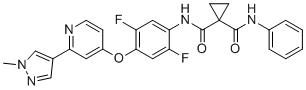
DCC-2618
CAS No. 1442472-39-0
DCC-2618( Ripretinib | DCC2618 )
Catalog No. M11875 CAS No. 1442472-39-0
DCC-2618 (Ripretinib, DCC2618) is a potent, oral inhibitor of singly and doubly mutated KIT with IC50 of WT (IC50=4 nM), V654A (8 nM), T670I (18 nM), D816H (5 nM).
Purity : >98% (HPLC)
 COA
Datasheet
HNMR
HPLC
MSDS
Handing Instructions
COA
Datasheet
HNMR
HPLC
MSDS
Handing Instructions
| Size | Price / USD | Stock | Quantity |
| 1 mL x 10 mM in DMSO | 202 | In Stock |


|
| 2MG | 93 | In Stock |
|
| 5MG | 160 | In Stock |
|
| 10MG | 275 | In Stock |
|
| 25MG | 432 | In Stock |
|
| 50MG | 677 | In Stock |
|
| 100MG | 1097 | In Stock |
|
| 200MG | 1507 | In Stock |
|
| 500MG | Get Quote | In Stock |
|
| 1G | Get Quote | In Stock |
|
Biological Information
-
Product NameDCC-2618
-
NoteResearch use only, not for human use.
-
Brief DescriptionDCC-2618 (Ripretinib, DCC2618) is a potent, oral inhibitor of singly and doubly mutated KIT with IC50 of WT (IC50=4 nM), V654A (8 nM), T670I (18 nM), D816H (5 nM).
-
DescriptionDCC-2618 (Ripretinib, DCC2618) is a potent, oral inhibitor of singly and doubly mutated KIT with IC50 of WT (IC50=4 nM), V654A (8 nM), T670I (18 nM), D816H (5 nM), D816V; also inhibits PDGFRα/β, KDR and cFMS, robustly inhibits exon 17, exon 9/13, exon 9/14, and exon 9/17 KIT mutants, as well as exon 11/17 KIT mutants; inhibits wild type and mutant KIT phosphorylation in cancer cells, demonstrates the potential to treat KIT mutant-driven cancers including GIST, systemic mastocytosis, AML, or melanoma.Gastric Cancer Phase 3 Clinical(In Vitro):Ripretinib (DCC-2618) suppresses phosphorylation of KIT and decreases the expression of phosphosphorylated (p)STAT5, pAKT and pERK1/2 in neoplastic mast cells. Ripretinib inhibits the growth of ROSAKIT K509I cells with an IC50 of 34 ± 10 nM, and also induces apoptosis in these cells. Ripretinib (0.1-1.0 μM) inhibits IgE-dependent histamine release from basophils and spontaneous tryptase release from neoplastic mast cells, and also counteracts growth and survival of leukemic monocytes and blast cells at 0.01-5 μM.Ripretinib (DCC-2618) is a pan-KIT and PDGFRA inhibitor, shows cytotoxic activity against gastrointestinal stromal tumors.
-
In VitroRipretinib (DCC-2618) suppresses phosphorylation of KIT and decreases the expression of phosphosphorylated (p)STAT5, pAKT and pERK1/2 in neoplastic mast cells. Ripretinib inhibits the growth of ROSAKIT K509I cells with an IC50 of 34 ± 10 nM, and also induces apoptosis in these cells. Ripretinib (0.1-1.0 μM) inhibits IgE-dependent histamine release from basophils and spontaneous tryptase release from neoplastic mast cells, and also counteracts growth and survival of leukemic monocytes and blast cells at 0.01-5 μM.Ripretinib (DCC-2618) is a pan-KIT and PDGFRA inhibitor, shows cytotoxic activity against gastrointestinal stromal tumors.
-
In Vivo——
-
SynonymsRipretinib | DCC2618
-
PathwayAngiogenesis
-
Targetc-Kit
-
Recptorc-Kit
-
Research AreaCancer
-
IndicationGastric Cancer
Chemical Information
-
CAS Number1442472-39-0
-
Formula Weight510.367
-
Molecular FormulaC24H21BrFN5O2
-
Purity>98% (HPLC)
-
SolubilityDMSO : 45 mg/mL 88.17 mM
-
SMILESCCN1C2=CC(=NC=C2C=C(C1=O)C3=CC(=C(C=C3Br)F)NC(=O)NC4=CC=CC=C4)NC
-
Chemical Name1-(4-bromo-5-(1-ethyl-7-(methylamino)-2-oxo-1,2-dihydro-1,6-naphthyridin-3-yl)-2-fluorophenyl)-3-phenylurea
Shipping & Storage Information
-
Storage(-20℃)
-
ShippingWith Ice Pack
-
Stability≥ 2 years
Reference
1. Mathias A Schneeweiss, et al. Blood 2016 128:1965.
2. Cancer Discov. 2017 Feb;7(2):121-122. doi: 10.1158/2159-8290.
molnova catalog



related products
-
Masitinib mesylate
A potent tyrosine kinase inhibitor targeting c-Kit and PDGFR with IC50 of 0.15 and 0.05 uM in cell based assays.
-
M4205
M4205 is an inhibitor of c-Kit exhibiting high activity on c-Kit mutations in exons 11, 13, 17.
-
Sitravatinib
A novel, broad spectrum small molecule inhibitor that blocks a wide array of RTKs known to be amplified/overexpressed in sarcomas, including c-Kit, PDGFRβ, PDGFRα, c-Met, and Axl (IC50=1.5-30 nM).
