


 Cart
Cart
 sales@molnova.com



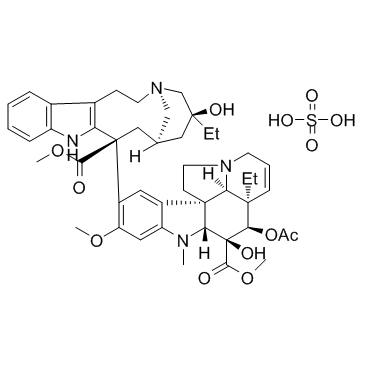
Vinblastine sulfate
CAS No. 143-67-9
Vinblastine sulfate( 29060LE | Alkaban-AQ | Exal | NSC 49842 | Rozevinsulfate | Velban | Velsar )
Catalog No. M11857 CAS No. 143-67-9
Vinblastine sulfate can inhibit the formation of microtubule, it also inhibit nAChR(IC50=8.9 uM).
Purity : >98% (HPLC)
 COA
Datasheet
HNMR
HPLC
MSDS
Handing Instructions
COA
Datasheet
HNMR
HPLC
MSDS
Handing Instructions
| Size | Price / USD | Stock | Quantity |
| 1 mL x 10 mM in DMSO | 60 | In Stock |


|
| 5MG | 48 | In Stock |
|
| 10MG | 51 | In Stock |
|
| 25MG | 61 | In Stock |
|
| 50MG | 78 | In Stock |
|
| 100MG | 90 | In Stock |
|
| 200MG | Get Quote | In Stock |
|
| 500MG | Get Quote | In Stock |
|
| 1G | Get Quote | In Stock |
|
Biological Information
-
Product NameVinblastine sulfate
-
NoteResearch use only, not for human use.
-
Brief DescriptionVinblastine sulfate can inhibit the formation of microtubule, it also inhibit nAChR(IC50=8.9 uM).
-
DescriptionVinblastine sulfate can inhibit the formation of microtubule, it also inhibit nAChR(IC50=8.9 uM).(In Vitro):Vinblastine does not depolymerize spindle microtubules, yet it powerfully blocks mitosis (for example, IC50 0.8 nM in HeLa cells) and cells die by apoptosis. In NB4 cells, vinblastine produces alteration of p53 and DNA fragmentation. Vinblastine treatment has an antiproliferative effect via the induction of apoptosis producing Bax/Bcl-2 imbalance. Vinblastine treatment suppresses NFκB expression and depresses NFκB-DNA binding activity while maintaining JNK activation that subsequently results in apoptotic response through caspase-dependent pathway. Vinblastine is found to trigger apoptosis as evidenced by the loss of mitochondrial membrane potential, the release of both cytochrome c and apoptosis inducing factor, activation of caspase-9 and 3, and cleavage of Poly (ADP-ribose)-Polymerase.(In Vivo):Vinblastine is a widely used anticancer drug with undesired side effects. Its conjugation with carrier molecules could be an efficient strategy to reduce these side effects.
-
In VitroVinblastine does not depolymerize spindle microtubules, yet it powerfully blocks mitosis (for example, IC50 0.8 nM in HeLa cells) and cells die by apoptosis. In NB4 cells, vinblastine produces alteration of p53 and DNA fragmentation. Vinblastine treatment has an antiproliferative effect via the induction of apoptosis producing Bax/Bcl-2 imbalance. Vinblastine treatment suppresses NFκB expression and depresses NFκB-DNA binding activity while maintaining JNK activation that subsequently results in apoptotic response through caspase-dependent pathway. Vinblastine is found to trigger apoptosis as evidenced by the loss of mitochondrial membrane potential, the release of both cytochrome c and apoptosis inducing factor, activation of caspase-9 and 3, and cleavage of Poly (ADP-ribose)-Polymerase.
-
In VivoVinblastine is a widely used anticancer drug with undesired side effects. Its conjugation with carrier molecules could be an efficient strategy to reduce these side effects.
-
Synonyms29060LE | Alkaban-AQ | Exal | NSC 49842 | Rozevinsulfate | Velban | Velsar
-
PathwayEndocrinology/Hormones
-
TargetAChR
-
RecptornAChR
-
Research AreaCancer
-
Indication——
Chemical Information
-
CAS Number143-67-9
-
Formula Weight909.06
-
Molecular FormulaC46H58N4O9·H2SO4
-
Purity>98% (HPLC)
-
SolubilitySoluble in DMSO
-
SMILESCC[C@@]1(C[C@@H]2C[C@@](C3=C(CCN(C2)C1)C4=CC=CC=C4N3)(C5=C(C=C6C(=C5)[C@]78CCN9[C@H]7[C@@](C=CC9)([C@H]([C@@]([C@@H]8N6C)(C(=O)OC)O)OC(=O)C)CC)OC)C(=O)OC)O.OS(=O)(=O)O
-
Chemical Name——
Shipping & Storage Information
-
Storage(-20℃)
-
ShippingWith Ice Pack
-
Stability≥ 2 years
Reference
1. Gigant B, et al. Nature, 2005, 435(7041), 519-522.
molnova catalog



related products
-
Arecoline HBr
Arecoline Hydrobromide is a muscarinic acetylcholine receptor agonist.
-
Apilimod mesylate
Apilimod mesylate is a potent?IL-12/IL-23?inhibitor.
-
Flavoxate hydrochlor...
Flavoxate Hydrochloride(DW-61 Hydrochloride) is a muscarinic AChR antagonist used in various urinary syndromes and as an antispasmodic.
