


 Cart
Cart
 sales@molnova.com



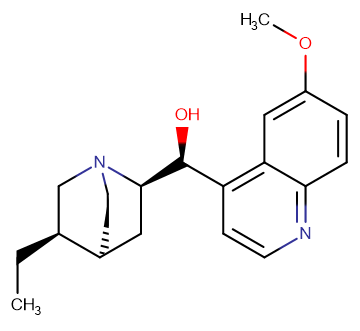
Hydroquinidine
CAS No. 1435-55-8
Hydroquinidine( Dihydroquinidine | (+)-Hydroquinidine )
Catalog No. M11853 CAS No. 1435-55-8
Dihydroquinidine is an organic compound and as a cinchona alkaloid closely related to quinine.
Purity : >98% (HPLC)
 COA
Datasheet
HNMR
HPLC
MSDS
Handing Instructions
COA
Datasheet
HNMR
HPLC
MSDS
Handing Instructions
| Size | Price / USD | Stock | Quantity |
| 1 mL x 10 mM in DMSO | 28 | In Stock |


|
| 100MG | 27 | In Stock |
|
| 200MG | Get Quote | In Stock |
|
| 500MG | Get Quote | In Stock |
|
| 1G | Get Quote | In Stock |
|
Biological Information
-
Product NameHydroquinidine
-
NoteResearch use only, not for human use.
-
Brief DescriptionDihydroquinidine is an organic compound and as a cinchona alkaloid closely related to quinine.
-
DescriptionDihydroquinidine is an organic compound and as a cinchona alkaloid closely related to quinine.
-
In Vitro——
-
In Vivo——
-
SynonymsDihydroquinidine | (+)-Hydroquinidine
-
PathwayCell Cycle/DNA Damage
-
TargetPotassium Channel
-
RecptorPotassium Channel| Sodium Channel
-
Research AreaCardiovascular Disease
-
Indication——
Chemical Information
-
CAS Number1435-55-8
-
Formula Weight326.43
-
Molecular FormulaC20H26N2O2
-
Purity>98% (HPLC)
-
SolubilityDMSO: 47mg/mL
-
SMILESCC[C@H]1CN2CC[C@H]1C[C@@H]2[C@H](C3=C4C=C(C=CC4=NC=C3)OC)O
-
Chemical Name——
Shipping & Storage Information
-
Storage(-20℃)
-
ShippingWith Ice Pack
-
Stability≥ 2 years
Reference
1.Zhou Q, et al. J Chromatogr A. 2012 May 18;1238:60-7.
molnova catalog



related products
-
VU 0134992
VU0134992 is an Kir4.1 blocker with an IC50 value of 0.97 μM.
-
Sulcardine sulfate
Sulcardine sulfate (B-87823) is a multi-ion channel blocker with antiarrhythmic activity, inhibits Na+, K+ and Ca2+ channels, and inhibits hNav1.5 channels in a concentration-dependent and reversible manner.
-
Dronedarone hydrochl...
A multichannel blocker agent that has antiarrhythmic activity.
