


 Cart
Cart
 sales@molnova.com



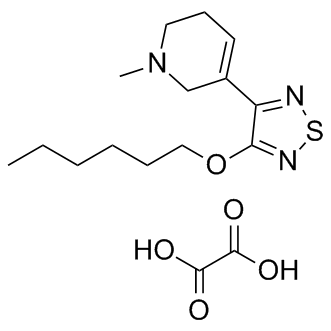
Xanomeline oxalate
CAS No. 141064-23-5
Xanomeline oxalate( LY246708 | LY-246708 | NNC 110232 )
Catalog No. M11712 CAS No. 141064-23-5
Xanomeline oxalate (LY246708, NNC 110232) is a potent, specific M1 muscarinic agonist with functional selectivity for M1 receptor.
Purity : >98% (HPLC)
 COA
Datasheet
HNMR
HPLC
MSDS
Handing Instructions
COA
Datasheet
HNMR
HPLC
MSDS
Handing Instructions
| Size | Price / USD | Stock | Quantity |
| 1 mL x 10 mM in DMSO | 33 | In Stock |


|
| 5MG | 30 | In Stock |
|
| 10MG | 50 | In Stock |
|
| 25MG | 102 | In Stock |
|
| 50MG | 159 | In Stock |
|
| 100MG | 253 | In Stock |
|
| 200MG | 365 | In Stock |
|
| 500MG | Get Quote | In Stock |
|
| 1G | Get Quote | In Stock |
|
Biological Information
-
Product NameXanomeline oxalate
-
NoteResearch use only, not for human use.
-
Brief DescriptionXanomeline oxalate (LY246708, NNC 110232) is a potent, specific M1 muscarinic agonist with functional selectivity for M1 receptor.
-
DescriptionXanomeline oxalate (LY246708, NNC 110232) is a potent, specific M1 muscarinic agonist with functional selectivity for M1 receptor (binding IC50 of 6 pM in the rabbit vas deferens); displays low affinity for M2 receptors in guinea pig atria (EC50=3 uM); xanomeline increases striatal levels of dopamine metabolites, presumably by acting at M1 heteroreceptors on dopamine neurons to increase dopamine release in vivo; inhibits ex vivo binding of muscarinic radioligands to homogenates of brain and the inhibition of ex vivo binding occurred in the same dose range as increases in DOPAC levels; xanomeline is selective agonist for M1 over M2 and M3 receptors in vivo in rats.Alzheimer Disease Phase 3 Discontinued.
-
In Vitro——
-
In VivoAnimal Model:Male CF1 mice weighing 18-20 g are injected [3H]-myoinositol Dosage:8.1-81 μmole/kg Administration:S.c. injections; 1 h prior to killing and 1 h after the administration Result:Increased accumulation in a dose-related manner up to 130%, 75%, 60% above lithium levels in hippocampus, cortex and neostriatum, respectively. And did not increase accumulation of [3H]-IP in the brain stem.Induced salivation, tremor and hypothermia in mice with the ED50 of 13.7±0.8 μmole/kg.Animal Model:Rats are injected [3H]-myoinositol Dosage:2.7-81 μmole/kg Administration:S.c. injections; 1 h prior to killing and 1 h after the administration Result:Increased [3H]-IP formation dose dependently in hippocampus up to 221% above lithium control.
-
SynonymsLY246708 | LY-246708 | NNC 110232
-
PathwayGPCR/G Protein
-
TargetmAChR
-
RecptormAChR
-
Research AreaNeurological Disease
-
IndicationAlzheimer Disease
Chemical Information
-
CAS Number141064-23-5
-
Formula Weight371.5
-
Molecular FormulaC16H25N3O5S
-
Purity>98% (HPLC)
-
Solubility10 mM in DMSO
-
SMILESCCCCCCOC1=NSN=C1C2=CCCN(C2)C.C(=O)(C(=O)O)O
-
Chemical NamePyridine, 3-[4-(hexyloxy)-1,2,5-thiadiazol-3-yl]-1,2,5,6-tetrahydro-1-methyl-, ethanedioate (1:1)
Shipping & Storage Information
-
Storage(-20℃)
-
ShippingWith Ice Pack
-
Stability≥ 2 years
Reference
1. Shannon HE, et al. J Pharmacol Exp Ther. 1994 Apr;269(1):271-81.
2. Sauerberg P, et al. J Med Chem. 1992 Jun 12;35(12):2274-83.
3. Bymaster FP, et al. J Pharmacol Exp Ther. 1994 Apr;269(1):282-9.
molnova catalog



related products
-
Glycopyrronium bromi...
Glycopyrronium bromide (CHF 5259) is a peripherally-acting quaternary ammonium antimuscarinic agent with little or no central nervous system activity.
-
AZD 9164
A novel highly potent, selective, long acting muscarinic receptor M3 antagonist with pIC50 of 9.8, 10-fold selectivity over M2 (pIC50=9.0).
-
Pirmenol hydrochlori...
An orally effective, long-acting antiarrhythmic agent that interacts with cardiac muscarinic receptors.
