


 Cart
Cart
 sales@molnova.com



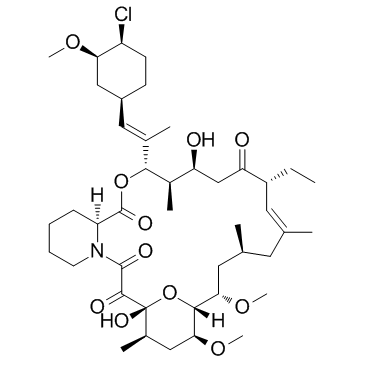
Pimecrolimus
CAS No. 137071-32-0
Pimecrolimus( Elidel | SDZ-ASM 981 )
Catalog No. M11529 CAS No. 137071-32-0
Pimecrolimus, like all ascomycins, is an immunophilin ligand, which binds specifically to the cytosolic receptor, immunophilin macrophilin-12.
Purity : >98% (HPLC)
 COA
Datasheet
HNMR
HPLC
MSDS
Handing Instructions
COA
Datasheet
HNMR
HPLC
MSDS
Handing Instructions
| Size | Price / USD | Stock | Quantity |
| 1 mL x 10 mM in DMSO | 51 | In Stock |


|
| 10MG | 29 | In Stock |
|
| 25MG | 46 | In Stock |
|
| 50MG | 65 | In Stock |
|
| 100MG | 91 | In Stock |
|
| 200MG | Get Quote | In Stock |
|
| 500MG | Get Quote | In Stock |
|
| 1G | Get Quote | In Stock |
|
Biological Information
-
Product NamePimecrolimus
-
NoteResearch use only, not for human use.
-
Brief DescriptionPimecrolimus, like all ascomycins, is an immunophilin ligand, which binds specifically to the cytosolic receptor, immunophilin macrophilin-12.
-
DescriptionPimecrolimus, like all ascomycins, is an immunophilin ligand, which binds specifically to the cytosolic receptor, immunophilin macrophilin-12.(In Vitro):Pimecrolimus (SDZ-ASM 981) (100 nM) targets T-cells and mast cells and inhibits the production and release of cytokines and other inflammatory mediators, as well as the expression of signals essential for the activation of inflammatory T-lymphocytes.Pimecrolimus acts specifically on cells that are crucial for the effector phase of an inflammatory reaction.Pimecrolimus (10 nM; 3 days) inhibits the polyclonal growth of peripheral blood T cells in murine and human mixed lymphocyte reactions.Pimecrolimus inhibits cytokine IL-2, IL-4, IL-10 and interferon-γ release from T-cell clone CFTS4:3.1 with IC50s of 0.28, 0.3, 0.2 and 0.42 nM, respectively after antigen-specific stimulation.(In Vivo):Pimecrolimus (SDZ-ASM 981) (0-0.4%; topical; 10 μL once) inhibits allergic contact dermatitis in mice and pigs.Pimecrolimus (0-90 mg/kg; p.o. or s.c.; twice or once) potently inhibits allergic contact dermatitis in mice and rats.
-
In VitroPimecrolimus (SDZ-ASM 981) (100 nM) targets T-cells and mast cells and inhibits the production and release of cytokines and other inflammatory mediators, as well as the expression of signals essential for the activation of inflammatory T-lymphocytes.Pimecrolimus acts specifically on cells that are crucial for the effector phase of an inflammatory reaction.Pimecrolimus (10 nM; 3 days) inhibits the polyclonal growth of peripheral blood T cells in murine and human mixed lymphocyte reactions.Pimecrolimus inhibits cytokine IL-2, IL-4, IL-10 and interferon-γ release from T-cell clone CFTS4:3.1 with IC50s of 0.28, 0.3, 0.2 and 0.42 nM, respectively after antigen-specific stimulation.Cell Proliferation Assay Cell Line:T-cell clone (TCC), murine and human mixed lymphocyte reactions (MLR)Concentration:0-10 nM Incubation Time:3 days Result:Inhibited proliferation of TCC CFTS 4:3.1 with IC50s of 0.78-2.6 nM. Inhibited murine and human MLR with IC50s of both 1.3 nM.
-
In VivoPimecrolimus (SDZ-ASM 981) (0-0.4%; topical; 10 μL once) inhibits allergic contact dermatitis in mice and pigs.Pimecrolimus (0-90 mg/kg; p.o. or s.c.; twice or once) potently inhibits allergic contact dermatitis in mice and rats. Animal Model:Female NMRl mice, allergic contact dermatitis model Dosage:0.004%, 0.01%, 0.04%, 0.13% and 0.4% in10 μL ethanolic solution Administration:Topical application, once Result:Inhibited oedema formation by 17% at concentration of 0.004%.Animal Model:Female NMRl mice, allergic contact dermatitis model Dosage:10, 30, 90 mg/kg (oral) or 1.5, 4.5, 13.5 mg/kg (subcutaneous) Administration:Oral (twice) or subcutaneous administration (once) Result:Signiticantiy inhibited inflammatory ear oedema formation.
-
SynonymsElidel | SDZ-ASM 981
-
PathwayOthers
-
TargetOther Targets
-
RecptorOthers
-
Research AreaInflammation/Immunology
-
Indication——
Chemical Information
-
CAS Number137071-32-0
-
Formula Weight810.45
-
Molecular FormulaC43H68ClNO11
-
Purity>98% (HPLC)
-
SolubilityEthanol: 100 mg/mL (123.38 mM); DMSO: 100 mg/mL (123.38 mM)
-
SMILESO=C(C(N1CCCC[C@@]1([H])C(O[C@H](/C(C)=C/[C@H]2C[C@@H](OC)[C@@H](Cl)CC2)[C@H](C)[C@@H](O)C3)=O)=O)[C@@](O4)(O)[C@H](C)C[C@H](OC)[C@@]4([H])[C@@H](OC)C[C@@H](C)C/C(C)=C/[C@@H](CC)C3=O
-
Chemical Name(1R,9S,12S,13R,14S,17R,18E,21S,23S,24R,25S,27R)-12-[(1E)-2{(1R,3R,4S)-4-chloro-3-methoxycyclohexyl}-1-methylvinyl]-17-ethyl-1,14-dihydroxy-23,25 dimethoxy-13,19,21,27-tetramethyl-11,28-dioxa-4-aza-tricyclo[22.3.1.0 4,9]octacos-18-ene2,3,10,16-tetraone.
Shipping & Storage Information
-
Storage(-20℃)
-
ShippingWith Ice Pack
-
Stability≥ 2 years
Reference
1.Nghiem P, et al. Am Acad Dermatol, 2002, 46(2), 228-24
molnova catalog



related products
-
Amino-PEG8-amine
Amino-PEG8-amine is a pegylated based PROTAC linker that can be used in the synthesis of PROTACs. It is a conjugate PEG derivative containing two amino (NH2) groups.
-
Lactitol
Lactitol is a agent that acts on the gastrointestinal tract.
-
Dipotassium glycyrrh...
Dipotassium glycyrrhizinate is an anionic surfactant having anti-allergic and anti-inflammatory activities.
