


 Cart
Cart
 sales@molnova.com



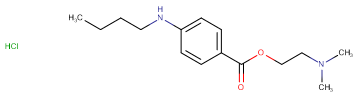
Tetracaine hydrochloride
CAS No. 136-47-0
Tetracaine hydrochloride( —— )
Catalog No. M11504 CAS No. 136-47-0
Tetracaine hydrochloride (Pontocaine) is a hydrochloride salt form of tetracaine which is a potent local anaesthetic and a channel function allosteric inhibitor.
Purity : >98% (HPLC)
 COA
Datasheet
HNMR
HPLC
MSDS
Handing Instructions
COA
Datasheet
HNMR
HPLC
MSDS
Handing Instructions
| Size | Price / USD | Stock | Quantity |
| 100MG | Get Quote | In Stock |


|
| 200MG | 27 | In Stock |
|
| 500MG | Get Quote | In Stock |
|
| 1G | Get Quote | In Stock |
|
Biological Information
-
Product NameTetracaine hydrochloride
-
NoteResearch use only, not for human use.
-
Brief DescriptionTetracaine hydrochloride (Pontocaine) is a hydrochloride salt form of tetracaine which is a potent local anaesthetic and a channel function allosteric inhibitor.
-
DescriptionTetracaine hydrochloride (Pontocaine) is a hydrochloride salt form of tetracaine which is a potent local anaesthetic and a channel function allosteric inhibitor. Tetracaine hydrochloride (Pontocaine) is used to block temporarily the pain "message" that is sent along the nerves that connect the eyes to the brain. Tetracaine hydrochloride (Pontocaine) is mainly used topically in ophthalmology and as an antipruritic, and it has been used in spinal anesthesia. (In Vitro):Tetracaine hydrochloride (Amethocaine hydrochloride) is used to alter the function of calcium release channels (ryanodine receptors) that control the release of calcium from intracellular stores. Tetracaine hydrochloride is an allosteric blocker of channel function. At low concentrations, tetracaine causes an initial inhibition of spontaneous calcium release events, while at high concentrations, tetracaine blocks release completely.
-
In VitroTetracaine hydrochloride (Amethocaine hydrochloride) is used to alter the function of calcium release channels (ryanodine receptors) that control the release of calcium from intracellular stores. Tetracaine hydrochloride is an allosteric blocker of channel function. At low concentrations, tetracaine causes an initial inhibition of spontaneous calcium release events, while at high concentrations, tetracaine blocks release completely.
-
In Vivo——
-
Synonyms——
-
PathwayMembrane Transporter/Ion Channel
-
TargetSodium Channel
-
RecptorSodium Channel
-
Research AreaNeurological Disease
-
Indication——
Chemical Information
-
CAS Number136-47-0
-
Formula Weight300.83
-
Molecular FormulaC15H24N2O2·HCl
-
Purity>98% (HPLC)
-
SolubilityEthanol: 30 mg/mL (99.72 mM); Water: 60 mg/mL (199.45 mM); DMSO: 60 mg/mL (199.45 mM)
-
SMILESCl.CCCCNC1=CC=C(C=C1)C(=O)OCCN(C)C
-
Chemical Name——
Shipping & Storage Information
-
Storage(-20℃)
-
ShippingWith Ice Pack
-
Stability≥ 2 years
Reference
1.Leng T, et al. Mol Pain. 2013 Jun 10;9:27
molnova catalog



related products
-
SM-6586
SM-6586 is a potent calcium channel antagonist with inhibitory effects on Na+/H+ and Na+/Ca2+ exchange channels, and can be used in the study of cerebrovascular disease and hypertension, among other diseases.
-
DS-1971a
DS-1971a is a highly potent and selective NaV1.7 inhibitor. DS-1971a exhibits a favorable toxicological profile and analgesic effects.
-
Levobupivacaine
Levobupivacaine is an amino-amide local anaesthetic drug belonging to the family of n-alkylsubstituted pipecoloxylidide.
