


 Cart
Cart
 sales@molnova.com



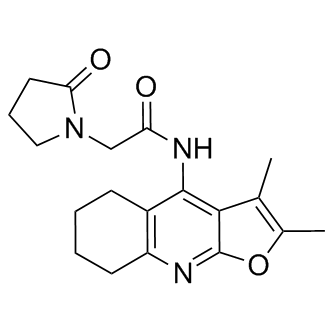
Coluracetam
CAS No. 135463-81-9
Coluracetam( MKC-231 | BCI-540 )
Catalog No. M11445 CAS No. 135463-81-9
A nootropic agent that enhances high-affinity choline uptake.
Purity : >98% (HPLC)
 COA
Datasheet
HNMR
HPLC
MSDS
Handing Instructions
COA
Datasheet
HNMR
HPLC
MSDS
Handing Instructions
| Size | Price / USD | Stock | Quantity |
| 10MG | 29 | In Stock |


|
| 25MG | 45 | In Stock |
|
| 50MG | 58 | In Stock |
|
| 100MG | 68 | In Stock |
|
| 200MG | Get Quote | In Stock |
|
| 500MG | 161 | In Stock |
|
| 1G | 237 | In Stock |
|
Biological Information
-
Product NameColuracetam
-
NoteResearch use only, not for human use.
-
Brief DescriptionA nootropic agent that enhances high-affinity choline uptake.
-
DescriptionA nootropic agent that enhances high-affinity choline uptake; significantly improves the learning deficits in the Morris' water maze of AF64A-treated rats, do not produce any significant side effects (1-10 mg/kg); orally active.Alzheimer's Disease Phase 2 Discontinued.
-
In Vitro——
-
In Vivo——
-
SynonymsMKC-231 | BCI-540
-
PathwayOthers
-
TargetOther Targets
-
RecptorOther Targets
-
Research AreaNeurological Disease
-
IndicationAlzheimer Disease
Chemical Information
-
CAS Number135463-81-9
-
Formula Weight341.4042
-
Molecular FormulaC19H23N3O3
-
Purity>98% (HPLC)
-
Solubility10 mM in DMSO
-
SMILESO=C(NC1=C2C(OC(C)=C2C)=NC3=C1CCCC3)CN4C(CCC4)=O
-
Chemical Name1-Pyrrolidineacetamide, 2-oxo-N-(5,6,7,8-tetrahydro-2,3-dimethylfuro[2,3-b]quinolin-4-yl)-
Shipping & Storage Information
-
Storage(-20℃)
-
ShippingWith Ice Pack
-
Stability≥ 2 years
Reference
molnova catalog



related products
-
SBI-477
SBI-477 is a chemical probe stimulated insulin signaling by deactivating the transcription factor MondoA. SBI-477 coordinately inhibits triacylglyceride (TAG) synthesis and enhances basal glucose uptake in human skeletal myocytes.
-
4-Nitrophenyl β-D-Ga...
4-Nitrophenyl β-D-Galactopyranoside is a β-D-galactopyranoside derivative that is a substrate for β-galactosidase and can be used to measure β-galactosidase activity, which can be used in the study of lysosomal storage diseases, obesity, and mucopolysaccharides storage diseases.
-
Nardoguaianone J
Nardoguaianone J, a guaiane-type compound, can be isolated from Nardostachys chinensis roots. Nardoguaianone J can enhance SERT activity.
