


 Cart
Cart
 sales@molnova.com



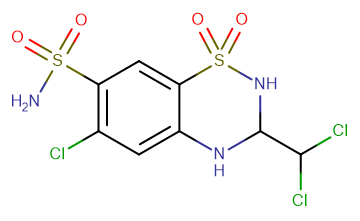
Trichlormethiazide
CAS No. 133-67-5
Trichlormethiazide( BRN 0629145 | Trichlormethiazide | Diurazida | Diurese )
Catalog No. M11346 CAS No. 133-67-5
Trichlormethiazide is a thiazide diuretic with properties similar to those of hydrochlorothiazide.
Purity : >98% (HPLC)
 COA
Datasheet
HNMR
HPLC
MSDS
Handing Instructions
COA
Datasheet
HNMR
HPLC
MSDS
Handing Instructions
| Size | Price / USD | Stock | Quantity |
| 1 mL x 10 mM in DMSO | 48 | In Stock |


|
| 100MG | Get Quote | In Stock |
|
| 200MG | Get Quote | In Stock |
|
| 500MG | Get Quote | In Stock |
|
| 1G | 31 | In Stock |
|
Biological Information
-
Product NameTrichlormethiazide
-
NoteResearch use only, not for human use.
-
Brief DescriptionTrichlormethiazide is a thiazide diuretic with properties similar to those of hydrochlorothiazide.
-
DescriptionTrichlormethiazide is a thiazide diuretic with properties similar to those of hydrochlorothiazide. It is usually administered for the treatment of oedema (including that which is associated with heart failure, hepatic cirrhosis and corticosteroid therapy) and hypertension. (In Vivo):Trichlormethiazide (1 mg/kg; p.o.; once) increases urinary volume, sodium and potassium excretion in rats.Trichlormethiazide (10 mg/kg, i.v.; daily for 5 days) significantly reduces mean arterial pressure (MAP) within 24 h in high salt intake (HS) rats receiving angiotensin II, but does not affect MAP in any other group.
-
In Vitro——
-
In VivoTrichlormethiazide (1 mg/kg; p.o.; once) increases urinary volume, sodium and potassium excretion in rats.Trichlormethiazide (10 mg/kg, i.v.; daily for 5 days) significantly reduces mean arterial pressure (MAP) within 24 h in high salt intake (HS) rats receiving angiotensin II, but does not affect MAP in any other group. Animal Model:Male Wistar rats, weighing 170-300 g Dosage:1 mg/kg Administration:Oral administration, once Result:Significantly increased potassium excretion in normal rats. Significantly increased urinary volume, sodium and potassium excretion in cisplatin-induced ARF (acute renal failures) rats.Animal Model:Male Sprague-Dawley rats (350-450 g) Dosage:10 mg/kg Administration:Intravenous injection, daily, for 15 days Result:Produced a significant fall in MAP in rats on combined angiotensin II and high salt intake.
-
SynonymsBRN 0629145 | Trichlormethiazide | Diurazida | Diurese
-
PathwayEndocrinology/Hormones
-
TargetATPase
-
RecptorNa+/K+-ATPase| Carbonic anhydrase
-
Research AreaMetabolic Disease
-
Indication——
Chemical Information
-
CAS Number133-67-5
-
Formula Weight380.66
-
Molecular FormulaC8H8Cl3N3O4S2
-
Purity>98% (HPLC)
-
SolubilityDMSO: 54 mg/mL (141.85 mM)
-
SMILESO=S(C1=C(Cl)C=C(C2=C1)NC(C(Cl)Cl)NS2(=O)=O)(N)=O
-
Chemical Name6-chloro-3-(dichloromethyl)-3,4-dihydro-2H-benzo[e][1,2,4]thiadiazine-7-sulfonamide 1,1-dioxide
Shipping & Storage Information
-
Storage(-20℃)
-
ShippingWith Ice Pack
-
Stability≥ 2 years
Reference
1. Temperini C, et al. Bioorg Med Chem. 2009 Feb 1;17(3):1214-2
molnova catalog



related products
-
NDI-091143
NDI-091143 is a potent and high-affinity human ATP-citrate lyase (ACLY) inhibitor with an IC50 of 2.1 nM (ADP-Glo assay)indirectly disrupting citrate binding via an unexpected mechanism of inhibition.
-
Bufalin
Bufalin is an active ingredient and one of the glycosides in the traditional Chinese medicine ChanSu.
-
(S)-PF-03716556
(S)-PF-03716556 can be used as an acid pump inhibitor for the treatment of disease conditions mediated by acid pump inhibitory activity.
