


 Cart
Cart
 sales@molnova.com



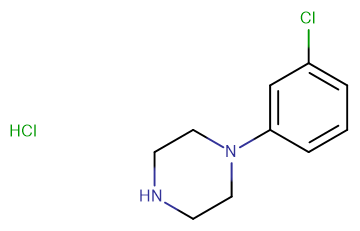
1-(3-Chlorophenyl)piperazine hydrochloride
CAS No. 13078-15-4
1-(3-Chlorophenyl)piperazine hydrochloride( 3-Chlorophenylpiperazine | 3-CPP | mCPP )
Catalog No. M11230 CAS No. 13078-15-4
Used for synthesis of Etoperidone, trazodone, Nefazodone, etc.
Purity : >98% (HPLC)
 COA
Datasheet
HNMR
HPLC
MSDS
Handing Instructions
COA
Datasheet
HNMR
HPLC
MSDS
Handing Instructions
| Size | Price / USD | Stock | Quantity |
| 50MG | 45 | In Stock |


|
| 100MG | 59 | In Stock |
|
| 200MG | 106 | In Stock |
|
| 500MG | 170 | In Stock |
|
| 1G | Get Quote | In Stock |
|
Biological Information
-
Product Name1-(3-Chlorophenyl)piperazine hydrochloride
-
NoteResearch use only, not for human use.
-
Brief DescriptionUsed for synthesis of Etoperidone, trazodone, Nefazodone, etc.
-
DescriptionUsed for synthesis of Etoperidone, trazodone, Nefazodone, etc.
-
In Vitro——
-
In Vivo——
-
Synonyms3-Chlorophenylpiperazine | 3-CPP | mCPP
-
PathwayOthers
-
TargetOther Targets
-
RecptorOthers
-
Research Area——
-
Indication——
Chemical Information
-
CAS Number13078-15-4
-
Formula Weight233.14
-
Molecular FormulaC10H14Cl2N2
-
Purity>98% (HPLC)
-
SolubilityLimited solubility
-
SMILESCl.ClC1=CC=CC(=C1)N1CCNCC1
-
Chemical Name——
Shipping & Storage Information
-
Storage(-20℃)
-
ShippingWith Ice Pack
-
Stability≥ 2 years
Reference
1.Arbo MD, et al. Drug Alcohol Depend. 2012 May 1;122(3):174-85.
molnova catalog



related products
-
Clozic
Clozic exhibits reversible anti-proliferative effects and can be used in studies about serving as a potential anti-arthritic agent.
-
Cyclic somatostatin ...
Cyclic somatostatin Acetate is a cyclic tetradecapeptide regulating many endocrine and nervous system functions.
-
5-Chlorovaleronitril...
5-Chlorovaleronitrile can be used as a quantitative structure-toxicity model to predict the aquatic toxicity.
