


 Cart
Cart
 sales@molnova.com



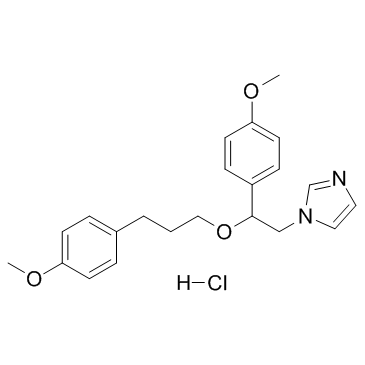
SKF-96365 hydrochloride
CAS No. 130495-35-1
SKF-96365 hydrochloride( —— )
Catalog No. M11222 CAS No. 130495-35-1
SKF-96365, an SOCE inhibitor, exhibits potent anti-neoplastic activity by inducing cell-cycle arrest and apoptosis in colorectal Y cells.
Purity : >98% (HPLC)
 COA
Datasheet
HNMR
HPLC
MSDS
Handing Instructions
COA
Datasheet
HNMR
HPLC
MSDS
Handing Instructions
| Size | Price / USD | Stock | Quantity |
| 1 mL x 10 mM in DMSO | 54 | In Stock |


|
| 5MG | 49 | In Stock |
|
| 10MG | 74 | In Stock |
|
| 25MG | 134 | In Stock |
|
| 50MG | 237 | In Stock |
|
| 100MG | 460 | In Stock |
|
| 200MG | 702 | In Stock |
|
| 500MG | 1088 | In Stock |
|
| 1G | Get Quote | In Stock |
|
Biological Information
-
Product NameSKF-96365 hydrochloride
-
NoteResearch use only, not for human use.
-
Brief DescriptionSKF-96365, an SOCE inhibitor, exhibits potent anti-neoplastic activity by inducing cell-cycle arrest and apoptosis in colorectal Y cells.
-
DescriptionSKF-96365, an SOCE inhibitor, exhibits potent anti-neoplastic activity by inducing cell-cycle arrest and apoptosis in colorectal Y cells. SKF-96365 can induces cytoprotective autophagy to delay apoptosis by preventing the release of cytochrome c (cyt c) from the mitochondria into the cytoplasm. Mechanistically, SKF-96365 treatment inhibited the calcium/calmodulin-dependent protein kinase IIγ (CaMKIIγ)/AKT signaling cascade in vitro and in vivo. Overexpression of CaMKIIγ or AKT abolished the effects of SKF-96365 on Y cells, suggesting a critical role of the CaMKIIγ/AKT signaling pathway in SFK-96365-induced biological effects. SKF-96365 inhibited hERG current in a concentration-dependent manner.
-
In VitroSKF-96365 exhibits potent anti-neoplastic activity by inducing cell-cycle arrest and apoptosis in colorectal cancer cells. SKF-96365 inhibits hERG current in a concentration-dependent manner. SKF-96365 can induces cytoprotective autophagy to delay apoptosis by preventing the release of cytochrome c (cyt c) from the mitochondria into the cytoplasm. Mechanistically, SKF-96365 treatment inhibits the calcium/calmodulin-dependent protein kinase IIγ (CaMKIIγ)/AKT signaling cascade. Overexpression of CaMKIIγ or AKT abolishes the effects of SKF-96365 on cancer cells, suggesting a critical role of the CaMKIIγ/AKT signaling pathway in SFK-96365-induced biological effects.
-
In VivoSKF-96365 inhibits CRC cell growth in vivo. SKF-96365 treatment results in a decrease of p-CaMKII and p-AKT as well as an increase in LC3-II, cleaved PARP, caspase-3, and caspase-9 in mice.
-
Synonyms——
-
PathwayMembrane Transporter/Ion Channel
-
TargetTRP/TRPV Channel
-
RecptorTRP
-
Research AreaCancer
-
Indication——
Chemical Information
-
CAS Number130495-35-1
-
Formula Weight402.91
-
Molecular FormulaC22H27ClN2O3
-
Purity>98% (HPLC)
-
SolubilityWater: 100 mM
-
SMILESCOC1=CC=C(C=C1)CCCOC(CN2C=CN=C2)C3=CC=C(C=C3)OC.Cl
-
Chemical Name——
Shipping & Storage Information
-
Storage(-20℃)
-
ShippingWith Ice Pack
-
Stability≥ 2 years
Reference
1.Singh A, et al. Br J Pharmacol. 2010, 160(6):1464-1475.
molnova catalog



related products
-
AMG-9810
A potent, selective and competitive TRPV1 antagonist with IC50 of 24.5 and 85.6 nM for human and rat TRPV1, repectively.
-
Probenecid
The prototypical uricosuric agent. It inhibits the renal excretion of organic anions and reduces tubular reabsorption of urate.
-
Methyl Kakuol
Methyl Kakuol is an agonist of TRPA1 with an EC50 of 0.27 μM and can be used in studies about acting as an active ingredient in MBST constituent Asiasari Radix.
