


 Cart
Cart
 sales@molnova.com



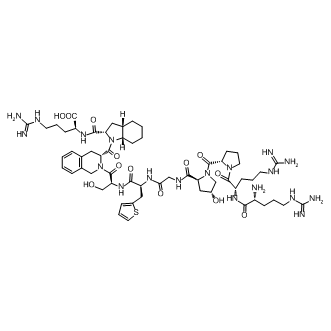
Icatibant
CAS No. 130308-48-4
Icatibant( HOE-140 | JE-049 )
Catalog No. M11215 CAS No. 130308-48-4
A selective and specific antagonist of bradykinin B2 receptor (B2R) with IC50 and Ki of 1.07 nM and 0.798 nM respectively.
Purity : >98% (HPLC)
 COA
Datasheet
HNMR
HPLC
MSDS
Handing Instructions
COA
Datasheet
HNMR
HPLC
MSDS
Handing Instructions
| Size | Price / USD | Stock | Quantity |
| 25MG | 981 | In Stock |


|
| 100MG | Get Quote | In Stock |
|
| 200MG | Get Quote | In Stock |
|
| 500MG | Get Quote | In Stock |
|
| 1G | Get Quote | In Stock |
|
Biological Information
-
Product NameIcatibant
-
NoteResearch use only, not for human use.
-
Brief DescriptionA selective and specific antagonist of bradykinin B2 receptor (B2R) with IC50 and Ki of 1.07 nM and 0.798 nM respectively.
-
DescriptionA selective and specific antagonist of bradykinin B2 receptor (B2R) with IC50 and Ki of 1.07 nM and 0.798 nM respectively; protects against memory impairment in mLFPI mice (10 nmol/kg); attenuates the brain edema, interleukin-1β, tumor necrosis factor-α, and nitric oxide metabolites content elicited by mLFPI.Other Indication Approved.
-
In VitroIcatibant (10-30 μM) potentiates angiotensin III, but not angiotensin II (contraction mediated by angiotensin AT1 receptors), and Lys-des-Arg9-bradykinin, but not des-Arg9-bradykinin (effects mediated by the bradykinin B1 receptors).
-
In VivoIcatibant (0.3, or 1.5 mg/kg, subcutaneous administration twice daily in mice) shows a significant preventive effect on ulcerative Colitis. Animal Model:Female mice of the CBA/J (H-2k) strain.Dosage:0.06, 0.3, or 1.5 mg/kg.Administration:Subcutaneous administration twice daily.Result:The length of the large intestine was 93.6±6.8 mm with the 1.5 mg/kg dosage and 94.0±4.1 mm with the 0.3 mg/kg dosage , showing a significant preventive effect on shortening.
-
SynonymsHOE-140 | JE-049
-
PathwayGPCR/G Protein
-
TargetBradykinin Receptor
-
RecptorBradykinin Receptor
-
Research AreaOther Indications
-
IndicationOther Disease
Chemical Information
-
CAS Number130308-48-4
-
Formula Weight1304.522
-
Molecular FormulaC59H89N19O13S
-
Purity>98% (HPLC)
-
Solubility10 mM in DMSO
-
SMILESN=C(N)NC(C(C1NCC2=C(C=CC=C2)C1)=O)CC[C@@H](C(O)=O)N(C([C@H](CO)N(C(CN(C([C@H]3N(C([C@H](CCCNC(N)=N)NC([C@@H](CCCNC(N)=N)N)=O)=O)CCC3)=O)C(C4NC[C@H](O)C4)=O)=O)C([C@H](CC5=CC=CS5)N)=O)=O)C(C6N[C@@]7([H])CCCC[C@@]7([H])C6)=O
-
Chemical NameL-Arginine, D-arginyl-L-arginyl-L-prolyl-(4R)-4-hydroxy-L-prolylglycyl-3-(2-thienyl)-L-alanyl-L-seryl-(3R)-1,2,3,4-tetrahydro-3-isoquinolinecarbonyl-(2S,3aS,7aS)-octahydro-1H-indole-2-carbonyl-
Shipping & Storage Information
-
Storage(-20℃)
-
ShippingWith Ice Pack
-
Stability≥ 2 years
Reference
1. Hock FJ, et al. Br J Pharmacol. 1991 Mar;102(3):769-73.
2. Ferreira AP, et al. Psychopharmacology (Berl). 2014 May;231(9):1935-48.
3. Asghar AU, et al. Eur J Pharmacol. 2000 Jun 9;398(1):131-8.
molnova catalog



related products
-
Bradykinin (1-6)
Bradykinin (1-6) is an amino-truncated Bradykinin peptide. Bradykinin (1-6) is a stable metabolite of Bradykinin, cleaved by carboxypeptidase Y (CPY).Bradykinin (1-6) is a fragment of bradykinin. Bradykinin activates pain receptors. It induces smooth muscle contractions and activates Ca2+-dependent nitric oxide synthetase.
-
[Des-Arg9]-Bradykini...
[Des-Arg9]-Bradykinin is an?agonist of Bradykinin (B1) receptor that displays selectivity for B1 over B2 receptors.
-
Bombinakinin M
Potent bradykinin receptor agonist. Highly selective for mammalian arterial smooth muscle bradykinin receptors, displaying ~ 50-fold greater potency than bradykinin. Elicits dose-dependent contractile effects in smooth muscle of guinea pig ileum (EC50 = 4.0 nM).
