


 Cart
Cart
 sales@molnova.com



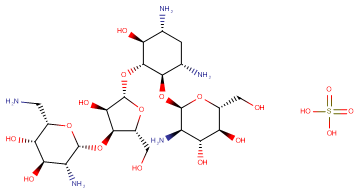
Paromomycin Sulfate
CAS No. 1263-89-4
Paromomycin Sulfate( —— )
Catalog No. M11105 CAS No. 1263-89-4
Paromomycin Sulfate is an aminoglycoside antibiotics inhibiting protein synthesis in non-resistant cells by binding to 16S ribosomal RNA.
Purity : >98% (HPLC)
 COA
Datasheet
HNMR
HPLC
MSDS
Handing Instructions
COA
Datasheet
HNMR
HPLC
MSDS
Handing Instructions
| Size | Price / USD | Stock | Quantity |
| 100MG | Get Quote | In Stock |


|
| 200MG | Get Quote | In Stock |
|
| 500MG | Get Quote | In Stock |
|
| 1G | 37 | In Stock |
|
Biological Information
-
Product NameParomomycin Sulfate
-
NoteResearch use only, not for human use.
-
Brief DescriptionParomomycin Sulfate is an aminoglycoside antibiotics inhibiting protein synthesis in non-resistant cells by binding to 16S ribosomal RNA.
-
DescriptionParomomycin Sulfate is an aminoglycoside antibiotics inhibiting protein synthesis in non-resistant cells by binding to 16S ribosomal RNA.(In Vitro):Paromomycin sulfate (500 μg/ml) reduces intracellular parasitic forms by 97.2% compared to control in Caco-2 cells and reduces the percentage of intracellular C. parvum forms by 99.5% in HCT-8 cells.(In Vivo):Paromomycin sulfate (oral gavage; 50 mg/kg-200 mg/kg; once daily; for five consecutive days two weeks post infection) reduces the number of oocyst per gram of feces and intestine. It shows minimal focal inflammation in only 20% of the sections at 50 mg/kg from the intestines of mice infected with C. parvum and only 10% of focal inflammation at 200 mg/kg.
-
In VitroParomomycin sulfate (500 μg/ml) reduces intracellular parasitic forms by 97.2% compared to control in Caco-2 cells and reduces the percentage of intracellular C. parvum forms by 99.5% in HCT-8 cells.
-
In VivoParomomycin sulfate (oral gavage; 50 mg/kg-200 mg/kg; once daily; for five consecutive days two weeks post infection) reduces the number of oocyst per gram of feces and intestine. It shows minimal focal inflammation in only 20% of the sections at 50 mg/kg from the intestines of mice infected with C. parvum and only 10% of focal inflammation at 200 mg/kg. Animal Model:Male Swiss albino miceDosage:50 mg/kg-200 mg/kg Administration:Oral gavage; 50 mg/kg-200 mg/kg; once daily; for five consecutive days two weeks post infectionResult:Was against cryptosporidiosis in vivo.
-
Synonyms——
-
PathwayGPCR/G Protein
-
TargetAntibacterial
-
Recptor16S rRNA
-
Research AreaInfection
-
Indication——
Chemical Information
-
CAS Number1263-89-4
-
Formula Weight713.71
-
Molecular FormulaC23H47N5O18S
-
Purity>98% (HPLC)
-
SolubilityWater: 100 mg/mL (140.11 mM)
-
SMILESC1[C@H]([C@@H]([C@H]([C@@H]([C@H]1N)O[C@@H]2[C@@H]([C@H]([C@@H]([C@H](O2)CO)O)O)N)O[C@H]3[C@@H]([C@@H]([C@H](O3)CO)O[C@@H]4[C@@H]([C@H]([C@@H]([C@@H](O4)CN)O)O)N)O)O)N.OS(=O)(=O)O
-
Chemical Name——
Shipping & Storage Information
-
Storage(-20℃)
-
ShippingWith Ice Pack
-
Stability≥ 2 years
Reference
1.Davidson RN, et al. ParomomycinTrans R Soc Trop Med Hyg, 2009, 103(7), 653-660.
molnova catalog



related products
-
Gentamycin sulfate
Gentamycin Sulfate is a broad-spectrum, aminoglycoside antibiotic used for cell culture which inhibits protein synthesis in sensitive organisms.
-
LL-3858
A novel anti-TB agent that has an MIC range of 0.06-0.5 ug/mL.
-
FtsZ inhibitor C109
FtsZ inhibitor C109 (Compound 10126109) is a broad spectrum antibacterial compound that inhibits the cell division protein FtsZ, inhibits the FtsZ GTPase activity with IC50 of 8.2 uM.
