


 Cart
Cart
 sales@molnova.com



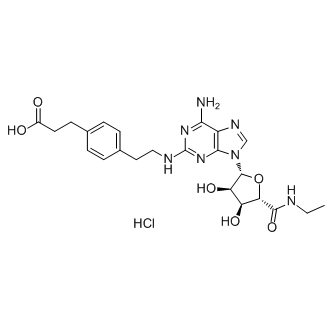
CGS 21680 hydrochloride
CAS No. 124431-80-7
CGS 21680 hydrochloride( CGS-21680 Hydrochloride | CGS21680 Hydrochloride )
Catalog No. M10989 CAS No. 124431-80-7
CGS 21680 is a specific adenosine A2A subtype receptor agonist with Ki of 27 nM.
Purity : >98% (HPLC)
 COA
Datasheet
HNMR
HPLC
MSDS
Handing Instructions
COA
Datasheet
HNMR
HPLC
MSDS
Handing Instructions
| Size | Price / USD | Stock | Quantity |
| 1 mL x 10 mM in DMSO | 87 | In Stock |


|
| 2MG | 46 | In Stock |
|
| 5MG | 74 | In Stock |
|
| 10MG | 111 | In Stock |
|
| 25MG | 226 | In Stock |
|
| 50MG | 402 | In Stock |
|
| 100MG | 593 | In Stock |
|
| 200MG | Get Quote | In Stock |
|
| 500MG | Get Quote | In Stock |
|
| 1G | Get Quote | In Stock |
|
Biological Information
-
Product NameCGS 21680 hydrochloride
-
NoteResearch use only, not for human use.
-
Brief DescriptionCGS 21680 is a specific adenosine A2A subtype receptor agonist with Ki of 27 nM.
-
DescriptionCGS 21680 is a specific adenosine A2A subtype receptor agonist with Ki of 27 nM; significantly upregulates CD39 and CD73 expression, accelerates the ATP hydrolysis and adenosine generation; reduces the number of infiltrated granulocytes into the ischemic tissue in rat model of transient cerebral ischemia.Hypertension Discontinued.
-
In VitroCGS21680 significantly upregulates CD39 and CD73 expression. CGS21680 accelerates the adenosine triphosphate (ATP) hydrolysis and adenosine generation. CGS21680 (10 nM) alone shows only small survival activity, but the activity is significantly enhanced by the addition of a phosphodiesterase inhibitor, IBMX. The survival activity of CGS21680 on cultured motoneurons is exerted by mixed effects of the adenylate cyclase-cAMP-PKA pathway and the transactivation of neurotrophin receptors.
-
In VivoCGS21680 (1 mg/kg/i.p.) intervention promotes the development of EAN. CGS21680 exacerbates experimental autoimmune neuritis in Lewis rats induced with bovine peripheral myelin. The exacerbation is accompanied with reduced CD4+ Foxp3+ T cells, increased CD4+ CXCR5+ T cells, B cells, dendritic cells and antigen-specific autoantibodies, which is possibly due to the inhibition of IL-2 induced by CGS21680. CGS21680 (0.1 mg/kg, i.p.) transiently increases heart frequency but does not modify blood pressure of rat, and does not modify either heart frequency or blood pressure at 0.01 mg/kg. Following transient MCAo, CGS21680 at both doses protects from neurological deficit from the first day up to 7 days thereafter. At this time, it has reduced microgliosis, astrogliosis and improved myelin organization in the striatum and cytoarchitecture of the ischemic cortex and striatum. Two days after transient MCAo, CGS21680 has reduced the number of infiltrated granulocytes into the ischemic tissue.
-
SynonymsCGS-21680 Hydrochloride | CGS21680 Hydrochloride
-
PathwayGPCR/G Protein
-
TargetAdenosine Receptor
-
RecptorA2
-
Research AreaCardiovascular Disease
-
IndicationHypertension
Chemical Information
-
CAS Number124431-80-7
-
Formula Weight535.9806
-
Molecular FormulaC23H30ClN7O6
-
Purity>98% (HPLC)
-
SolubilityDMSO: ≥ 20 mg/mL
-
SMILESCCNC(=O)C1C(C(C(O1)N2C=NC3=C(N=C(N=C32)NCCC4=CC=C(C=C4)CCC(=O)O)N)O)O.Cl
-
Chemical Name3-(4-(2-((6-amino-9-((2R,3R,4S,5S)-5-(ethylcarbamoyl)-3,4-dihydroxytetrahydrofuran-2-yl)-9H-purin-2-yl)amino)ethyl)phenyl)propanoic acid hydrochloride
Shipping & Storage Information
-
Storage(-20℃)
-
ShippingWith Ice Pack
-
Stability≥ 2 years
Reference
1. Nekooeian AA, et al. Br J Pharmacol. 1998 Apr;123(8):1666-72.
2. Phillis JW, et al. Brain Res. 1990 Feb 19;509(2):328-30.
3. Komaki S, et al. Neurosci Lett. 2012 Jul 26;522(1):21-4.
4. Melani A, et al. Brain Res. 2014 Mar 10;1551:59-72.
molnova catalog



related products
-
KFM19
KFM19 is a potent and selective adenosine receptor (A1-receptor) antagonist (IC50 : 50 nM) for the study of neurological disorders.
-
SCH 412348
SCH 412348 is a potent and highly selective A2A receptor competitive antagonist with Ki of 0.6 nM.
-
Ciforadenant
A potent, orally active, adenosine A2A receptor antagonist that is being investigated in solid tumors as a single agent and in combination with the anti-PD-L1 antibody atezolizumab.
