


 Cart
Cart
 sales@molnova.com



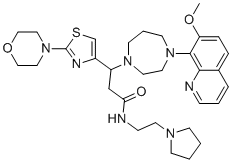
CCX-777
CAS No. 1226686-36-7
CCX-777( CCX 777 | CCX777 )
Catalog No. M10867 CAS No. 1226686-36-7
A small-molecule partial agonist of CXCR7 (ACKR3).
Purity : >98% (HPLC)
 COA
Datasheet
HNMR
HPLC
MSDS
Handing Instructions
COA
Datasheet
HNMR
HPLC
MSDS
Handing Instructions
| Size | Price / USD | Stock | Quantity |
| 5MG | 336 | In Stock |


|
| 50MG | 1782 | In Stock |
|
| 100MG | 2250 | In Stock |
|
| 200MG | Get Quote | In Stock |
|
| 500MG | Get Quote | In Stock |
|
| 1G | Get Quote | In Stock |
|
Biological Information
-
Product NameCCX-777
-
NoteResearch use only, not for human use.
-
Brief DescriptionA small-molecule partial agonist of CXCR7 (ACKR3).
-
DescriptionA small-molecule partial agonist of CXCR7 (ACKR3).
-
In Vitro——
-
In Vivo——
-
SynonymsCCX 777 | CCX777
-
PathwayGPCR/G Protein
-
TargetChemokine Receptor
-
RecptorChemokine Receptor
-
Research Area——
-
Indication——
Chemical Information
-
CAS Number1226686-36-7
-
Formula Weight593.791
-
Molecular FormulaC31H43N7O3S
-
Purity>98% (HPLC)
-
SolubilityIn Vitro:?DMSO : 50 mg/mL (84.21 mM)
-
SMILESO=C(NCCN1CCCC1)CC(N2CCN(C3=C4N=CC=CC4=CC=C3OC)CCC2)C5=CSC(N6CCOCC6)=N5
-
Chemical Name3-(4-(7-methoxyquinolin-8-yl)-1,4-diazepan-1-yl)-3-(2-morpholinothiazol-4-yl)-N-(2-(pyrrolidin-1-yl)ethyl)propanamide
Shipping & Storage Information
-
Storage(-20℃)
-
ShippingWith Ice Pack
-
Stability≥ 2 years
Reference
1. Gustavsson M, et al. Nat Commun. 2017 Jan 18;8:14135.
2. Zabel BA, et al. J Immunol. 2009 Sep 1;183(5):3204-11.
molnova catalog



related products
-
AZ084
AZ084 (AZ-084) is a potent, selective, allosteric, orally available CCR8 antagonist with Ki of 0.9 nM.
-
ML 604086
ML 604086 (ML604086) is a potent, selective CCR8 inhibitor that inhibits CCL1 mediated chemotaxis and increases in intracellular Ca2+ concentrations with IC50 of 1.3?uM and 1.0?uM respectively in cellular assays.
-
C-021
C-021 is a potent and orally bioavailable CCR4 antagonist with IC50 of 0.14 uM and 0.039 uM for inhibition of chemotaxis in human and mouse, respectively.
