


 Cart
Cart
 sales@molnova.com



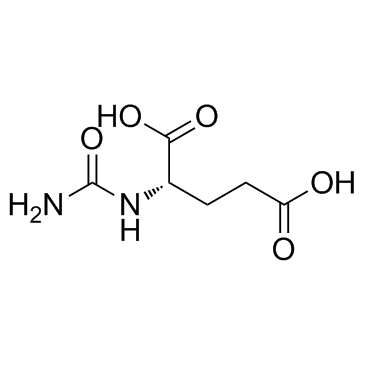
Carbaglu
CAS No. 1188-38-1
Carbaglu( Carglumic Acid )
Catalog No. M10646 CAS No. 1188-38-1
Carglumic acid is an orphan drug used for the treatment of hyperammonaemia in patients with N-acetylglutamate synthase deficiency. This rare genetic disorder results in elevated blood levels of ammonia, which can eventually cross the blood-brain barrier and cause neurologic problems, cerebral edema, coma, and death.
Purity : >98% (HPLC)
 COA
Datasheet
HNMR
HPLC
MSDS
Handing Instructions
COA
Datasheet
HNMR
HPLC
MSDS
Handing Instructions
| Size | Price / USD | Stock | Quantity |
| 1 mL x 10 mM in DMSO | 52 | In Stock |


|
| 100MG | Get Quote | In Stock |
|
| 200MG | 45 | In Stock |
|
| 500MG | 83 | In Stock |
|
| 1G | Get Quote | In Stock |
|
Biological Information
-
Product NameCarbaglu
-
NoteResearch use only, not for human use.
-
Brief DescriptionCarglumic acid is an orphan drug used for the treatment of hyperammonaemia in patients with N-acetylglutamate synthase deficiency. This rare genetic disorder results in elevated blood levels of ammonia, which can eventually cross the blood-brain barrier and cause neurologic problems, cerebral edema, coma, and death.
-
DescriptionCarglumic acid is an orphan drug used for the treatment of hyperammonaemia in patients with N-acetylglutamate synthase deficiency. This rare genetic disorder results in elevated blood levels of ammonia, which can eventually cross the blood-brain barrier and cause neurologic problems, cerebral edema, coma, and death. Carglumic acid was approved by the U.S. Food and Drug Administration (FDA) on 18 March 2010.(In Vitro):Carglumic acid suppresses cell viability in the pancreatic ductal adenocarcinoma cell lines, triple-negative breast cancer cell lines, hepatoma cell lines, and human non-small cell lung carcinoma cell lines in a dose-dependent manner. The 50% inhibitory concentration (IC50) of Carglumic acid against those cell lines is between 5 and 7.5 mM. The results show that Carglumic acid does not induce complete cell cycle arrest. Instead, there are more sub-G1 cells among Carglumic acid-treated AsPC1 and MDA-MB-231 cells than among untreated cells. In AsPC1 and HPDE-E6E7 cells, the IC50s of Carglumic acid are 5 mM and over 10 mM, respectively . In MDA-MB-231 and MCF-12A cells, the IC50s of Carglumic acid are 5 mM and 6 mM, respectively. (In Vivo):The results show that Carglumic acid, but not the vehicle control, markedly inhibits tumor growth. In the orthotopic pancreatic cancer model, tumor growth inhibition by Carglumic acid on day 21 is 80% (P<0.01). In the orthotopic triple-negative breast cancer model, tumor growth inhibition by Carglumic acid on day 20 is 82% (P<0.01). These results indicate that Carglumic acid suppresses tumor growth in pancreatic cancer and triple-negative breast cancer. On day 20, mean tumor growth inhibition in orally and intravenously treated mice is 55% and 93%, respectively, relative to untreated mice (P<0.01).
-
In VitroCarglumic acid suppresses cell viability in the pancreatic ductal adenocarcinoma cell lines, triple-negative breast cancer cell lines, hepatoma cell lines, and human non-small cell lung carcinoma cell linesin a dose-dependent manner. The 50% inhibitory concentration (IC50) of Carglumic acid against those cell lines is between 5 and 7.5 mM. The results show that Carglumic acid does not induce complete cell cycle arrest. Instead, there are more sub-G1 cells among Carglumic acid-treated AsPC1 and MDA-MB-231 cells than among untreated cells. In AsPC1 and HPDE-E6E7 cells, the IC50s of Carglumic acid are 5 mM and over 10 mM, respectively . In MDA-MB-231 and MCF-12A cells, the IC50s of Carglumic acid are 5 mM and 6 mM, respectively.
-
In VivoThe results show that Carglumic acid, but not the vehicle control, markedly inhibits tumor growth. In the orthotopic pancreatic cancer model, tumor growth inhibition by Carglumic acid on day 21 is 80% (P<0.01). In the orthotopic triple-negative breast cancer model, tumor growth inhibition by Carglumic acid on day 20 is 82% (P<0.01). These results indicate that Carglumic acid suppresses tumor growth in pancreatic cancer and triple-negative breast cancer. On day 20, mean tumor growth inhibition in orally and intravenously treated mice is 55% and 93%, respectively, relative to untreated mice (P<0.01).
-
SynonymsCarglumic Acid
-
PathwayOthers
-
TargetOther Targets
-
RecptorCarbamoyl-phosphate synthase
-
Research Area——
-
Indication——
Chemical Information
-
CAS Number1188-38-1
-
Formula Weight190.15
-
Molecular FormulaC6H10N2O5
-
Purity>98% (HPLC)
-
SolubilityWater: 10 mM
-
SMILESO=C(O)[C@@H](NC(N)=O)CCC(O)=O
-
Chemical Name(2S)-2-(carbamoylamino)pentanedioic acid
Shipping & Storage Information
-
Storage(-20℃)
-
ShippingWith Ice Pack
-
Stability≥ 2 years
Reference
1.Carglumic acid. Prescrire Int. 2008 Apr;17(94):50-
molnova catalog



related products
-
Deferoxamine mesylat...
An iron chelator that binds iron and aluminium; increases HIF-1α transactivation in diabetes by preventing iron-catalyzed reactive oxygen stress.
-
YNT-185
YNT-185 is a nonpeptide, selective agonist of the orexin type-2 receptor (OX2R), with EC50 values of 0.028 μM for OX2R and 2.75 μM for OX1R.
-
[Ala3,11,18, Nle7] E...
[Ala3,11,18, Nle7] Endothelin-1, human
