


 Cart
Cart
 sales@molnova.com



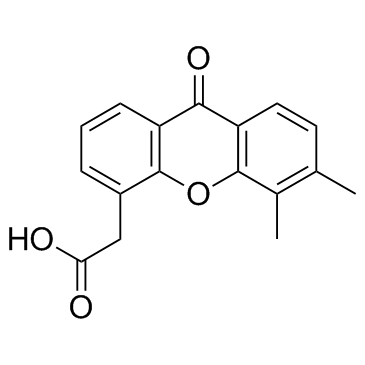
DMXAA
CAS No. 117570-53-3
DMXAA( ASA-404 | Vadimezan )
Catalog No. M10596 CAS No. 117570-53-3
A vascular disrupting agent (VDA) and competitive inhibitor of DT-diaphorase with Ki of 20 uM; activates STING dependent innate immune pathways.
Purity : >98% (HPLC)
 COA
Datasheet
HNMR
HPLC
MSDS
Handing Instructions
COA
Datasheet
HNMR
HPLC
MSDS
Handing Instructions
| Size | Price / USD | Stock | Quantity |
| 1 mL x 10 mM in DMSO | 82 | In Stock |


|
| 2MG | 33 | In Stock |
|
| 5MG | 53 | In Stock |
|
| 10MG | 85 | In Stock |
|
| 25MG | 176 | In Stock |
|
| 50MG | 276 | In Stock |
|
| 100MG | 415 | In Stock |
|
| 200MG | 600 | In Stock |
|
| 500MG | Get Quote | In Stock |
|
| 1G | Get Quote | In Stock |
|
Biological Information
-
Product NameDMXAA
-
NoteResearch use only, not for human use.
-
Brief DescriptionA vascular disrupting agent (VDA) and competitive inhibitor of DT-diaphorase with Ki of 20 uM; activates STING dependent innate immune pathways.
-
DescriptionA vascular disrupting agent (VDA) and competitive inhibitor of DT-diaphorase with Ki of 20 uM; activates STING dependent innate immune pathways.(In Vitro):Vadimezan (DMXAA), the vascular disrupting agent, is a murine agonist of the stimulator of interferon genes (STING) and also a potent inducer of type I IFNs and other cytokines. Vadimezan (DMXAA) has no detrimental effect on 344SQ-ELuc cell viability. It is found that Vadimezan-mediated up regulation of the NF-κB pathway as shown by increased p65 phosphorylation in M2 macrophages. Results demonstrate that Vadimezan (DMXAA)-treated cells are protected from VSV-induced cytotoxicity at all MOIs in contrast to medium-pretreated macrophages. Vadimezan (DMXAA) effectively inhibits growth of both strains of influenza, demonstrating the potential of Vadimezan for treatment of drug-resistant strains of human influenza. (In Vivo):344SQ-ELuc NSCLC subcutaneous tumors respond dramatically to Vadimezan (DMXAA), with a marked decrease in bioluminescence (BLI) signals post-drug injection. Vadimezan (DMXAA) treatment of 344SQ-ELuc metastases yields no decrease in photon emission rates, with the tumors remaining histologically similar to controls after this treatment. As with the large subcutaneous tumors, Vadimezan (DMXAA) administration to mice with small subcutaneous tumors still leads to ~2-log decreases in photon emission at both 6 and 24 hours. In vivo, Vadimezan (DMXAA) is a more potent inducer of IFN-β mRNA and a relatively poor inducer of TNF-α mRNA. Vadimezan (DMXAA) administration leads to significantly less weight loss in influenza-infected mice.
-
In VitroVadimezan (DMXAA), the vascular disrupting agent, is a murine agonist of the stimulator of interferon genes (STING) and also a potent inducer of type I IFNs and other cytokines. Vadimezan (DMXAA) has no detrimental effect on 344SQ-ELuc cell viability. It is found that Vadimezan-mediated up regulation of the NF-κB pathway as shown by increased p65 phosphorylation in M2 macrophages. Results demonstrate that Vadimezan (DMXAA)-treated cells are protected from VSV-induced cytotoxicity at all MOIs in contrast to medium-pretreated macrophages. Vadimezan (DMXAA) effectively inhibits growth of both strains of influenza, demonstrating the potential of Vadimezan for treatment of drug-resistant strains of human influenza.
-
In Vivo344SQ-ELuc NSCLC subcutaneous tumors respond dramatically to Vadimezan (DMXAA), with a marked decrease in bioluminescence (BLI) signals post-drug injection. Vadimezan (DMXAA) treatment of 344SQ-ELuc metastases yields no decrease in photon emission rates, with the tumors remaining histologically similar to controls after this treatment. As with the large subcutaneous tumors, Vadimezan (DMXAA) administration to mice with small subcutaneous tumors still leads to ~2-log decreases in photon emission at both 6 and 24 hours. In vivo, Vadimezan (DMXAA) is a more potent inducer of IFN-β mRNA and a relatively poor inducer of TNF-α mRNA. Vadimezan (DMXAA) administration leads to significantly less weight loss in influenza-infected mice.
-
SynonymsASA-404 | Vadimezan
-
PathwayAutophagy
-
TargetAutophagy
-
RecptorDT-diaphorase
-
Research AreaCancer
-
Indication——
Chemical Information
-
CAS Number117570-53-3
-
Formula Weight282.2906
-
Molecular FormulaC17H14O4
-
Purity>98% (HPLC)
-
SolubilityDMSO: 6.5 mg/mL
-
SMILESO=C(O)CC1=CC=CC(C2=O)=C1OC3=C2C=CC(C)=C3C
-
Chemical Name9H-Xanthene-4-acetic acid, 5,6-dimethyl-9-oxo-
Shipping & Storage Information
-
Storage(-20℃)
-
ShippingWith Ice Pack
-
Stability≥ 2 years
Reference
1. Phillips RM. Biochem Pharmacol. 1999 Jul 15;58(2):303-10.
2. Prantner D, et al. J Biol Chem. 2012 Nov 16;287(47):39776-88.
3. Shirey KA, et al. J Leukoc Biol. 2011 Mar;89(3):351-7.
molnova catalog



related products
-
MRT68921 HCl
MRT68921 hydrochloride is a potent inhibitor of both ULK1 and ULK2 (IC50s: 2.9 and 1.1 nM respectively).
-
XST-14
XST-14 is a competitive and specific inhibitor of ULK1 (IC50: 26.6 nM).XST-14 blocks autophagy by inhibiting the phosphorylation of ULK1 downstream substrates.XST-14 induces apoptosis and inhibits the growth of HCC cells.
-
ATG7-IN-1
ATG7-IN-1 is a selective ATG7 inhibitor with an IC50 of 62 nM.
