


 Cart
Cart
 sales@molnova.com



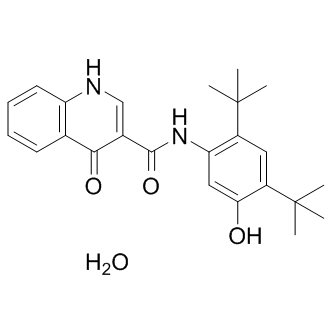
Ivacaftor hydrate
CAS No. 1134822-07-3
Ivacaftor hydrate( VX-770 hydrate | VX 770 hydrate | VX770 hydrate )
Catalog No. M10469 CAS No. 1134822-07-3
Ivacaftor (VX-770, VX770) is a potent, orally bioavailable CFTR potentiator, increases G551D- and F508del CFTR-mediated Cl- secretion with EC50 of 100 nM.
Purity : >98% (HPLC)
 COA
Datasheet
HNMR
HPLC
MSDS
Handing Instructions
COA
Datasheet
HNMR
HPLC
MSDS
Handing Instructions
| Size | Price / USD | Stock | Quantity |
| 5MG | 873 | Get Quote |


|
| 50MG | 1782 | Get Quote |
|
| 100MG | 2250 | Get Quote |
|
| 200MG | Get Quote | Get Quote |
|
| 500MG | Get Quote | Get Quote |
|
| 1G | Get Quote | Get Quote |
|
Biological Information
-
Product NameIvacaftor hydrate
-
NoteResearch use only, not for human use.
-
Brief DescriptionIvacaftor (VX-770, VX770) is a potent, orally bioavailable CFTR potentiator, increases G551D- and F508del CFTR-mediated Cl- secretion with EC50 of 100 nM.
-
DescriptionIvacaftor (VX-770, VX770) is a potent, orally bioavailable CFTR potentiator, increases G551D- and F508del CFTR-mediated Cl- secretion with EC50 of 100 nM; increases CFTR channel open probability (Po) in both the F508del processing mutation and the G551D gating mutation in recombinant cells, increases the Po of G551D CFTR by 6-fold, the Po of F508del- and wild-type CFTR by 5-fold and 2-fold, respectively; also potentiates CFTR-mediated Cl secretion in primary cultures of G551D/F508del HBE and F508del HBE; demonstrates potential for treatment of cystic fibrosis with certain mutations in CFTR gene (primarily the G551D mutation).Fibrosis Approved.
-
In VitroIvacaftor (10?μM) increases the PC secretion activity by 3-fold for ABCB4-G535D, 13.7-fold for ABCB4-G536R, 6.7-fold for ABCB4-S1076C, 9.4-fold for ABCB4-S1176L, and 5.7-fold for ABCB4-G1178S. Ivacaftor corrects the functional defect of ABCB4 mutants. Ivacaftor (10 μM) significantly increases CFTR activity in W1282X-expressing cells compared to R1162X CFTR cells. Ivacaftor shows no significant activity against 160 targets tested including the GABAA benzodiazepine receptor. Ivacaftor increases the chloride secretion with an EC50 of 0.236 ± 0.200 μM, a 10-fold shift in potency compared to the F508del HBEs. In recombinant cells, VX-770 increases CFTR channel open probability (Po) in both the F508del processing mutation and the G551D gating mutation. VX-770 increases forskolin-stimulated IT in temperature-corrected F508del-FRT cells by appr 6-fold with an EC50 of 25 nM.
-
In VivoIvacaftor (1-200 mg/kg, p.o.) exhibits good oral bioavailability in rat.
-
SynonymsVX-770 hydrate | VX 770 hydrate | VX770 hydrate
-
PathwayApoptosis
-
TargetCFTR
-
RecptorCFTR
-
Research AreaOther Indications
-
IndicationFibrosis
Chemical Information
-
CAS Number1134822-07-3
-
Formula Weight410.506
-
Molecular FormulaC24H30N2O4
-
Purity>98% (HPLC)
-
Solubility10 mM in DMSO
-
SMILESCC(C)(C)C1=CC(=C(C=C1NC(=O)C2=CNC3=CC=CC=C3C2=O)O)C(C)(C)C.O
-
Chemical Name3-Quinolinecarboxamide, N-[2,4-bis(1,1-dimethylethyl)-5-hydroxyphenyl]-1,4-dihydro-4-oxo-, hydrate (1:1)
Shipping & Storage Information
-
Storage(-20℃)
-
ShippingWith Ice Pack
-
Stability≥ 2 years
Reference
1. Van Goor F, et al. Proc Natl Acad Sci U S A. 2009 Nov 3;106(44):18825-30.
2. Accurso FJ, et al. N Engl J Med. 2010 Nov 18;363(21):1991-2003.
3. Yu W, et al. J Biol Chem. 2011 Jul 15;286(28):24714-25.
4. Hadida S, et al. J Med Chem. 2014 Dec 11;57(23):9776-95.
molnova catalog



related products
-
FDL169
FDL-169 is a novel and potent CFTR (Cystic fibrosis transmembrane conductance regulator) corrector for treating cystic fibrosis (CF) patients who carry the F508del mutation.
-
Olacaftor
Olacaftor (VX-440, VX440) is a next-generation CFTR corrector, shows the potential to enhance the amount of CFTR protein at the cell’s surface and for treatment of cystic fibrosis.
-
CFTR corrector 12
CFTR corrector 12 is a CFTR corrector that rescues all mutant proteins except M760R ABCA3, and can be used to study cystic fibrosis.
