


 Cart
Cart
 sales@molnova.com



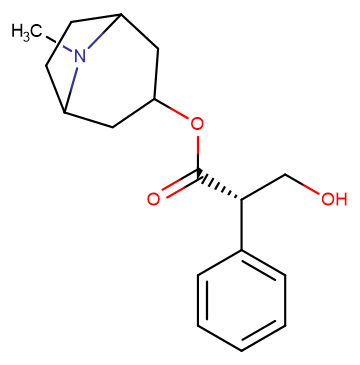
L-Hyoscyamine
CAS No. 101-31-5
L-Hyoscyamine( L-Hyoscyamine | (S)-Hyoscyamine )
Catalog No. M10077 CAS No. 101-31-5
L-Hyoscyamine is a chemical compound, a tropane alkaloid it is the levo-isomer to atropine.
Purity : >98% (HPLC)
 COA
Datasheet
HNMR
HPLC
MSDS
Handing Instructions
COA
Datasheet
HNMR
HPLC
MSDS
Handing Instructions
| Size | Price / USD | Stock | Quantity |
| 1 mL x 10 mM in DMSO | 60 | In Stock |


|
| 25MG | 58 | In Stock |
|
| 50MG | 91 | In Stock |
|
| 100MG | 148 | In Stock |
|
| 200MG | Get Quote | In Stock |
|
| 500MG | Get Quote | In Stock |
|
| 1G | Get Quote | In Stock |
|
Biological Information
-
Product NameL-Hyoscyamine
-
NoteResearch use only, not for human use.
-
Brief DescriptionL-Hyoscyamine is a chemical compound, a tropane alkaloid it is the levo-isomer to atropine.
-
DescriptionL-Hyoscyamine is a chemical compound, a tropane alkaloid it is the levo-isomer to atropine.(In Vivo):L-Hyoscyamine (Daturine; 5-20 mg/kg; iv) prolongs the migrating MMC cycle length.
-
In Vitro——
-
In VivoL-Hyoscyamine (Daturine; 5-20 mg/kg; iv) prolongs the migrating MMC cycle length. Animal Model:RatsDosage:5, 10, 20 mg/kg Administration:IV Result:Prolonged the migrating myoelectric complex (MMC) cycle length.
-
SynonymsL-Hyoscyamine | (S)-Hyoscyamine
-
PathwayEndocrinology/Hormones
-
TargetAChR
-
RecptorAChR
-
Research AreaNeurological Disease
-
Indication——
Chemical Information
-
CAS Number101-31-5
-
Formula Weight289.38
-
Molecular FormulaC17H23NO3
-
Purity>98% (HPLC)
-
SolubilityEthanol: 58 mg/mL (200.43 mM); DMSO: 58 mg/mL (200.43 mM)
-
SMILESO=C(OC1CC(N2C)CCC2C1)[C@@H](C3=CC=CC=C3)CO
-
Chemical Name(8-methyl-8-azabicyclo[3.2.1]octan-3-yl) (2S)-3-hydroxy-2-phenylpropanoate
Shipping & Storage Information
-
Storage(-20℃)
-
ShippingWith Ice Pack
-
Stability≥ 2 years
Reference
1. Schmeller T, et al. Pharmazie, 1995, 50(7), 493-495.
molnova catalog



related products
-
Benactyzine hydrochl...
Benactyzine hydrochloride is a centrally acting muscarinic antagonist.
-
SEN 12333
α7 nicotinic acetylcholine receptor (nAChR) agonist.
-
Disopyramide
A class I anti-arrhythmic agent (one that interferes directly with the depolarization of the cardiac membrane and thus serves as a membrane-stabilizing agent) with a depressant action on the heart similar to that of guanidine.
