


 Cart
Cart
 sales@molnova.com



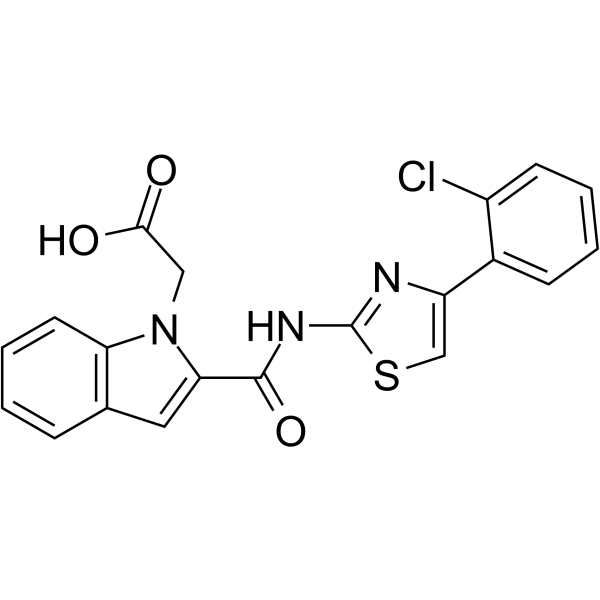
Lintitript
CAS No. 136381-85-6
Lintitript( SR 27897 )
Catalog No. M26740 CAS No. 136381-85-6
Lintitript is a selective antagonist of CCK1 with EC50s of 6 nM and 200 nM for CCK1 and CCK2. The Ki value is 0.2 nM for CCK1.
Purity : >98% (HPLC)
 COA
Datasheet
HNMR
HPLC
MSDS
Handing Instructions
COA
Datasheet
HNMR
HPLC
MSDS
Handing Instructions
| Size | Price / USD | Stock | Quantity |
| 2MG | 241 | Get Quote |


|
| 5MG | 372 | Get Quote |
|
| 10MG | 556 | Get Quote |
|
| 25MG | 887 | Get Quote |
|
| 50MG | 1197 | Get Quote |
|
| 100MG | 1611 | Get Quote |
|
| 200MG | Get Quote | Get Quote |
|
| 500MG | Get Quote | Get Quote |
|
| 1G | Get Quote | Get Quote |
|
Biological Information
-
Product NameLintitript
-
NoteResearch use only, not for human use.
-
Brief DescriptionLintitript is a selective antagonist of CCK1 with EC50s of 6 nM and 200 nM for CCK1 and CCK2. The Ki value is 0.2 nM for CCK1.
-
DescriptionLintitript is a selective antagonist of CCK1 with EC50s of 6 nM and 200 nM for CCK1 and CCK2. The Ki value is 0.2 nM for CCK1.(In Vitro):Lintitript inhibited the CCK 2 site in guinea pig cortex with an IC2 of 479 nM. lintitript (0.5 nM) increased the dissociation constant of CCK on CCKA receptors with Kds between 1.8 and 7.2 nM without altering the maximum number of receptors. lintitript antagonized CCK-stimulated isolated rat pancreatic follicles in (amylase release and CCK-induced gallbladder contraction in guinea pigs with pA2s of 7.50 and 9.57). lintitript inhibited the binding of [125I]CCK to the rat pancreatic CCK1 receptor site with IC50 of 0.58 nM in a concentration-dependent manner.(In Vivo):Lintitript (1 mg/kg, i.v.) completely reversed CCK-induced amylase secretion. lintitript inhibited CCK-induced gastric and gallbladder emptying in mice with ED50s of 3 μg/kg and 72 μg/kg. lintitript (p.o.) was active in the gallbladder emptying protocol of egg yolk-induced endogenous CCK release, with an ED50 of 27 μg/kg .
-
In VitroIn vitro, Lintitript (SR 27897) is a competitive antagonist of cholecystokinin (CCK)-stimulated amylase release in isolated rat pancreatic acini (pA2 = 7.50) and of CCK-induced guinea pig gall bladder contractions (pA2 = 9.57). Lintitript produces concentration dependent inhibition of [125I]CCK binding to CCK1 receptor sites in the rat pancreas (IC50 value of 0.58 nM) and also to CCK 2 sites in the guinea pig cortex (IC2 value of 479 nM). Lintitript inhibits [125I]gastrin binding to gastrin receptors. Lintitript (0.5 nM) increases the dissociation constant of CCK for the CCK A receptor (Kd = 1.8 to 7.2 nM) without modifying the maximum number of receptors (Bmax = 1800 to 1770 fmol/mg).
-
In VivoLintitript (SR 27897; 1 mg/kg, i.v.) completely reverses the CCK-induced amylase secretion. Lintitript also inhibits CCK-induced gastric and gallbladder emptying in mice (ED50s = 3 and 72 μg/kg, respectively). Lintitript is also very active (ED50 = 27 μg/kg p.o.) in the gall bladder emptying protocol with egg yolk as an inducer of endogenous CCK release.
-
SynonymsSR 27897
-
PathwayGPCR/G Protein
-
TargetCholecystokinin Receptor
-
RecptorFungal
-
Research Area——
-
Indication——
Chemical Information
-
CAS Number136381-85-6
-
Formula Weight411.86
-
Molecular FormulaC20H14ClN3O3S
-
Purity>98% (HPLC)
-
SolubilityIn Vitro:?DMSO : 100 mg/mL (242.80 mM)
-
SMILESOC(=O)Cn1c(cc2ccccc12)C(=O)Nc1nc(cs1)-c1ccccc1Cl
-
Chemical Name——
Shipping & Storage Information
-
Storage(-20℃)
-
ShippingWith Ice Pack
-
Stability≥ 2 years
Reference
1.Vetter ND, et al. A previously unrecognized kanosamine biosynthesis pathway in Bacillus subtilis. J Am Chem Soc. 2013 Apr 24;135(16):5970-3.
molnova catalog



related products
-
A-65186
A-65186 is an A-type glutamatergic cholecystokinin (CCK) antagonist used to study inflammation and gastrointestinal tract injury.
-
Ceruletide
Ceruletide is a potent agonist of cholecystokinin receptor and it also is a safe and effective cholecystokinetic agent. It has a direct spasmogenic effect on the gallbladder muscle and bile ducts.Ceruletide is same as biologically and chemically to the human gastrointestinal hormones cholecystokinin-pancreozymin (CCK) and gastrin II.
-
Methyl Linoleate
Methyl linoleate has antioxidant activity.
