


 Cart
Cart
 sales@molnova.com



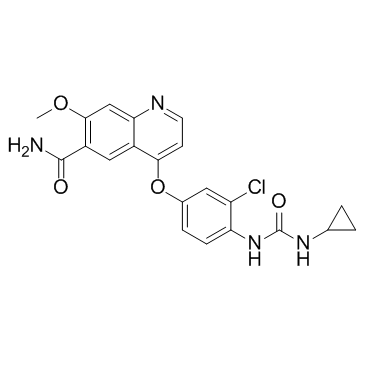
Lenvatinib
CAS No. 417716-92-8
Lenvatinib( E7080 | E-7080 | E 7080 )
Catalog No. M14427 CAS No. 417716-92-8
Lenvatinib (E7080) is a multitargeted kinase inhibitor with IC50s of 4/5.2/22/46 nM for VEGFR2/VEGFR3/VEGFR1/FGFR1 in cell free assays.
Purity : >98% (HPLC)
 COA
Datasheet
HNMR
HPLC
MSDS
Handing Instructions
COA
Datasheet
HNMR
HPLC
MSDS
Handing Instructions
| Size | Price / USD | Stock | Quantity |
| 5MG | 38 | In Stock |


|
| 10MG | 52 | In Stock |
|
| 50MG | 111 | In Stock |
|
| 100MG | 168 | In Stock |
|
| 200MG | Get Quote | In Stock |
|
| 500MG | Get Quote | In Stock |
|
| 1G | Get Quote | In Stock |
|
Biological Information
-
Product NameLenvatinib
-
NoteResearch use only, not for human use.
-
Brief DescriptionLenvatinib (E7080) is a multitargeted kinase inhibitor with IC50s of 4/5.2/22/46 nM for VEGFR2/VEGFR3/VEGFR1/FGFR1 in cell free assays.
-
DescriptionLenvatinib (E7080) is a multitargeted kinase inhibitor with IC50s of 4/5.2/22/46 nM for VEGFR2/VEGFR3/VEGFR1/FGFR1 in cell free assays; also inhibits PDGFR, Kit with IC50< 100 nM; suppresses the phosphorylation of VEGF receptor-2 and FGF receptor 1 and inhibits proliferation of endothelial cellin vitro; orally active.Kidney Cancer Approved(In Vitro):Lenvatinib (E7080) has IC50s of 4, 5.2, 22 nM for VEGFR2 (KDR), VEGFR3 (Flt-4), and VEGFR1 (Flt-1), respectively. Lenvatinib inhibits PDGFRα, PDGFRβ, FGFR1, and KIT with IC50s of 51, 39, 46, and 100 nM, respectively.(In Vivo):Lenvatinib (E7080) (100 mg/kg, p.o.) significantly inhibits local tumor growth at the m.f.p., and at the end of treatment, Lenvatinib mesylate also significantly inhibits metastasis to both regional lymph nodes and distant lung.Lenvatinib (E7080) inhibits the growth of H146 tumor at 30 and 100 mg/kg (BID, QDx21) in a dose-dependent manner and causes tumor regression at 100 mg/kg in H146 xenograft model. IHC analysis with anti-CD31 antibody shows that lenvatinib at 100 mg/kg decreases microvessel density more than anti-VEGF antibody and STI571 treatment.
-
In VitroLenvatinib (E7080) has IC50s of 4, 5.2, 22 nM for VEGFR2 (KDR), VEGFR3 (Flt-4), and VEGFR1 (Flt-1), respectively. Lenvatinib inhibits PDGFRα, PDGFRβ, FGFR1, and KIT with IC50s of 51, 39, 46, and 100 nM, respectively.
-
In VivoLenvatinib (E7080) (100 mg/kg, p.o.) significantly inhibits local tumor growth at the m.f.p., and at the end of treatment, Lenvatinib mesylate also significantly inhibits metastasis to both regional lymph nodes and distant lung.Lenvatinib (E7080) inhibits the growth of H146 tumor at 30 and 100 mg/kg (BID, QDx21) in a dose-dependent manner and causes tumor regression at 100 mg/kg in H146 xenograft model. IHC analysis with anti-CD31 antibody shows that lenvatinib at 100 mg/kg decreases microvessel density more than anti-VEGF antibody and STI571 treatment.
-
SynonymsE7080 | E-7080 | E 7080
-
PathwayAngiogenesis
-
TargetVEGFR
-
RecptorFGFR1|PDGFRβ|VEGFR1/FLT1|VEGFR2/KDR|VEGFR3/FLT4
-
Research AreaCancer
-
IndicationKidney Cancer
Chemical Information
-
CAS Number417716-92-8
-
Formula Weight426.853
-
Molecular FormulaC21H19ClN4O4
-
Purity>98% (HPLC)
-
Solubility10 mM in DMSO
-
SMILESCOC1=CC2=NC=CC(OC3=CC(Cl)=C(NC(=O)NC4CC4)C=C3)=C2C=C1C(N)=O
-
Chemical Name6-Quinolinecarboxamide, 4-[3-chloro-4-[[(cyclopropylamino)carbonyl]amino]phenoxy]-7-methoxy-
Shipping & Storage Information
-
Storage(-20℃)
-
ShippingWith Ice Pack
-
Stability≥ 2 years
Reference
1. Matsui J, et al. Int J Cancer. 2008 Feb 1;122(3):664-71.
2. Matsui J, et al. Clin Cancer Res. 2008 Sep 1;14(17):5459-65.
3. Ikuta K, et al. Clin Cancer Res. 2009 Dec 1;15(23):7229-37.
molnova catalog



related products
-
R1530
R1530 is a multikinase inhibitor with antineoplastic and antiangiogenesis activities.
-
Apatinib Mesylate
Apatinib (YN968D1) is a multitargeted tyrosine kinase inhibitor (TKI) that inhibits VEGFR-2 (Flk-1/KDR, IC50=1 nM), RET, c-Kit and c-Src (IC50=13, 429 and 530 nM respectively).
-
Pazopanib hydrochlor...
A potent, orally available, pan-VEGFR inhibitor with IC50 of 10, 30, and 47 nM for VEGFR-1, -2, and -3, respectively.
