


 Cart
Cart
 sales@molnova.com



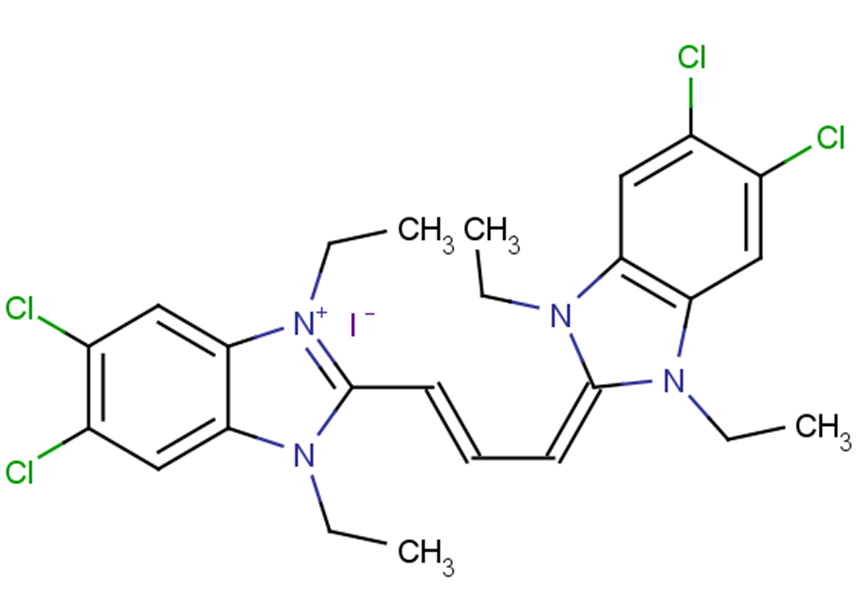
JC-1
CAS No. 3520-43-2
JC-1( CBIC2 )
Catalog No. M22703 CAS No. 3520-43-2
JC-1 is a fluorescent lipophilic carbocyanine dye. It has been used to measure mitochondrial membrane potential. JC 1 can be used in a probe for measuring mitochondrial membrane potential by flow cytometry. JC-1 fluorescence is usually excited by the 488 nm laser wavelength common in flow cytometers. JC-1 (2.5 μM) exposed to murine L1210 lymphoblasts, can be detected the presence of both cytoplasmic JC-1 monomer and mitochondrial J-aggregates in these cells.
Purity : >98% (HPLC)
 COA
Datasheet
HNMR
HPLC
MSDS
Handing Instructions
COA
Datasheet
HNMR
HPLC
MSDS
Handing Instructions
| Size | Price / USD | Stock | Quantity |
| 2MG | 77 | In Stock |


|
| 5MG | 145 | In Stock |
|
| 10MG | 239 | In Stock |
|
| 25MG | 402 | In Stock |
|
| 50MG | 584 | In Stock |
|
| 100MG | 830 | In Stock |
|
| 200MG | Get Quote | In Stock |
|
| 500MG | Get Quote | In Stock |
|
| 1G | Get Quote | In Stock |
|
Biological Information
-
Product NameJC-1
-
NoteResearch use only, not for human use.
-
Brief DescriptionJC-1 is a fluorescent lipophilic carbocyanine dye. It has been used to measure mitochondrial membrane potential. JC 1 can be used in a probe for measuring mitochondrial membrane potential by flow cytometry. JC-1 fluorescence is usually excited by the 488 nm laser wavelength common in flow cytometers. JC-1 (2.5 μM) exposed to murine L1210 lymphoblasts, can be detected the presence of both cytoplasmic JC-1 monomer and mitochondrial J-aggregates in these cells.
-
DescriptionJC-1 is a fluorescent lipophilic carbocyanine dye. It has been used to measure mitochondrial membrane potential. JC 1 can be used in a probe for measuring mitochondrial membrane potential by flow cytometry. JC-1 fluorescence is usually excited by the 488 nm laser wavelength common in flow cytometers. JC-1 (2.5 μM) exposed to murine L1210 lymphoblasts, can be detected the presence of both cytoplasmic JC-1 monomer and mitochondrial J-aggregates in these cells. Fluorescent labeling of mitochondria with either JC-1 (1 μg/mL, 15 min), reveals that are distributed irregularly, resulting in regions of high and low mitochondrial content within astrocytes. JC-1 is avidly accumulated in sensitive K562 cells where it displays both a green cytoplasmic and red mitochondrial fluorescence. JC-1 is poorly accumulated in resistant K562 cells, which displays only a slight green fluorescence. JC-1 has been shown to interact with α-synuclein at the acidic C-terminal region with a Kd of 2.6 μM. JC-1 itself does not accelerate the protein aggregation of α-synuclein in the absence of iron, insted, it decelerates the aggregation process by extending the lag phase approx.
-
In Vitro——
-
In Vivo——
-
SynonymsCBIC2
-
PathwayOthers
-
TargetOther Targets
-
RecptorOthers
-
Research Area——
-
Indication——
Chemical Information
-
CAS Number3520-43-2
-
Formula Weight652.23
-
Molecular FormulaC25H27Cl4IN4
-
Purity>98% (HPLC)
-
SolubilityDMSO:14 mg/mL(21.46 mM)
-
SMILES[I-].CCN1\C(=C/C=C/c2n(CC)c3cc(Cl)c(Cl)cc3[n+]2CC)N(CC)c2cc(Cl)c(Cl)cc12
-
Chemical Name——
Shipping & Storage Information
-
Storage(-20℃)
-
ShippingWith Ice Pack
-
Stability≥ 2 years
Reference
1. A Perelman, et al. JC-1: alternative excitation wavelengths facilitate mitochondrial membrane potential cytometry. Cell Death Dis. 2012 Nov 22;3:e430.
molnova catalog



related products
-
γ-Glu-Tyr
γ-Glu-Tyr (gamma-Glutamyltyrosine) is a kokumi peptide with competitive inhibition of dipeptidyl peptidase-IV (DPP-IV) and is used in the study of diabetes mellitus.
-
Z-F-R-AMC
Z-F-R-AMC
-
H-Trp-Met-Asn-Phe-NH...
H-Trp-Met-Asn-Phe-NH2
