


 Cart
Cart
 sales@molnova.com



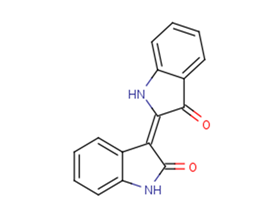
Indirubin
CAS No. 479-41-4
Indirubin( Indirubin | C.I. 73200, Couroupitine B, NSC 105327 )
Catalog No. M18602 CAS No. 479-41-4
Indirubin is a potent cyclin-dependent kinases and GSK-3β inhibitor with IC50 of about 5 uM and 0.6 uM.
Purity : >98% (HPLC)
 COA
Datasheet
HNMR
HPLC
MSDS
Handing Instructions
COA
Datasheet
HNMR
HPLC
MSDS
Handing Instructions
| Size | Price / USD | Stock | Quantity |
| 5MG | 41 | In Stock |


|
| 10MG | 55 | In Stock |
|
| 25MG | 91 | In Stock |
|
| 50MG | 149 | In Stock |
|
| 100MG | 259 | In Stock |
|
| 200MG | 337 | In Stock |
|
| 500MG | Get Quote | In Stock |
|
| 1G | Get Quote | In Stock |
|
Biological Information
-
Product NameIndirubin
-
NoteResearch use only, not for human use.
-
Brief DescriptionIndirubin is a potent cyclin-dependent kinases and GSK-3β inhibitor with IC50 of about 5 uM and 0.6 uM.
-
DescriptionIndirubin is a potent and selective CDK inhibitor. Indirubin is the active ingredient of Danggui Longhui Wan, a mixture of plants that is used in traditional Chinese medicine to treat chronic diseases. Indirubin has been used to treat the symptoms of leukemia. Further biological explorations revealed the ability of indirubin to bind cyclin-dependent kinases and 6-bromoindirubin, extracted from mollusks, to bind glycogen synthase kinase-3. Studies have shown that Indirubin can help keep cancer cells from reproducing in rats. Indirubin also appears to reduce inflammation by inhibiting part of the immune response.(In Vitro):Indirubin (Couroupitine B) significantly inhibits Td-EC proliferation, migration, invasion, and angiogenesis.(In Vivo):Indirubin (Couroupitine B) (12.5 mg/kg, 25 mg/kg; intraperitoneal injected; once a day for 14 days) may reduce the pathological alterations in a dose-dependent manner.
-
In VitroIndirubin (Couroupitine B) significantly inhibits Td-EC proliferation, migration, invasion, and angiogenesis.Cell Proliferation Assay Cell Line:Human umbilical vein endothelial cells (HUVEC) line; tumor-derived endothelial cells (Td-EC).Concentration:5, 10μMIncubation Time:24, 48, 72 hours Result:Inhibited Td-EC proliferation in a dose- and time-dependent manner. Cell Invasion Assay Cell Line:Human umbilical vein endothelial cells (HUVEC) line; tumor-derived endothelial cells (Td-EC).Concentration:5μM Incubation Time:overnight Result:Inhibited Td-EC migration, invasion, and angiogenesis.
-
In VivoIndirubin (Couroupitine B) (12.5 mg/kg, 25 mg/kg; intraperitoneal injected; once a day for 14 days) may reduce the pathological alterations in a dose-dependent manner. Animal Model:Male mice (C57BL/6) Dosage:12.5 mg/kg, 25 mg/kg Administration:Indirubin (12.5 mg/kg, 25 mg/kg; intraperitoneal injected; once a day for 14 days)Result:Attenuated alterations of lung structure induced by BLM.
-
SynonymsIndirubin | C.I. 73200, Couroupitine B, NSC 105327
-
PathwayOthers
-
TargetOther Targets
-
RecptorGSK-3β , CDK2/CyclinA , CDK5/p35 , CDK1/CyclinB , C-Raf
-
Research AreaCancer
-
Indication——
Chemical Information
-
CAS Number479-41-4
-
Formula Weight262.26
-
Molecular FormulaC16H10N2O2
-
Purity>98% (HPLC)
-
SolubilityDMSO : ≥ 41 mg/mL; 156.33 mM
-
SMILESC1=CC=C2C(=C1)/C(=C\3/C(=O)C4=CC=CC=C4N3)/C(=O)N2
-
Chemical Name3-(1,3-Dihydro-3-oxo-2H-indol-2-ylidene)-1,3-dihydro-2H-indol-2-one
Shipping & Storage Information
-
Storage(-20℃)
-
ShippingWith Ice Pack
-
Stability≥ 2 years
Reference
1. Hoessel R, et al. Nat Cell Biol, 1999, 1(1), 60-67.
molnova catalog



related products
-
Citric acid monohydr...
Citric Acid Monohydrate is a tricarboxylic acid found in citrus fruits. Citric acid is used as an excipient in pharmaceutical preparations due to its antioxidant properties. It maintains stability of active ingredients and is used as a preservative.
-
Neurokinin A
Neurokinin A (NKA), formerly known as Substance K, is a neurologically active peptide translated from the pre-protachykinin gene.
-
E-I-L-D-V, human, bo...
EILDV (human, bovine, rat) is an analogue of the active pentapeptide. EILDV (human, bovine, rat) has active tripeptide amino acid sequence LDV that is conserved in human, bovine, rat. EILDV (human, bovine, rat) can be used for the research of cell adhesion.
