


 Cart
Cart
 sales@molnova.com



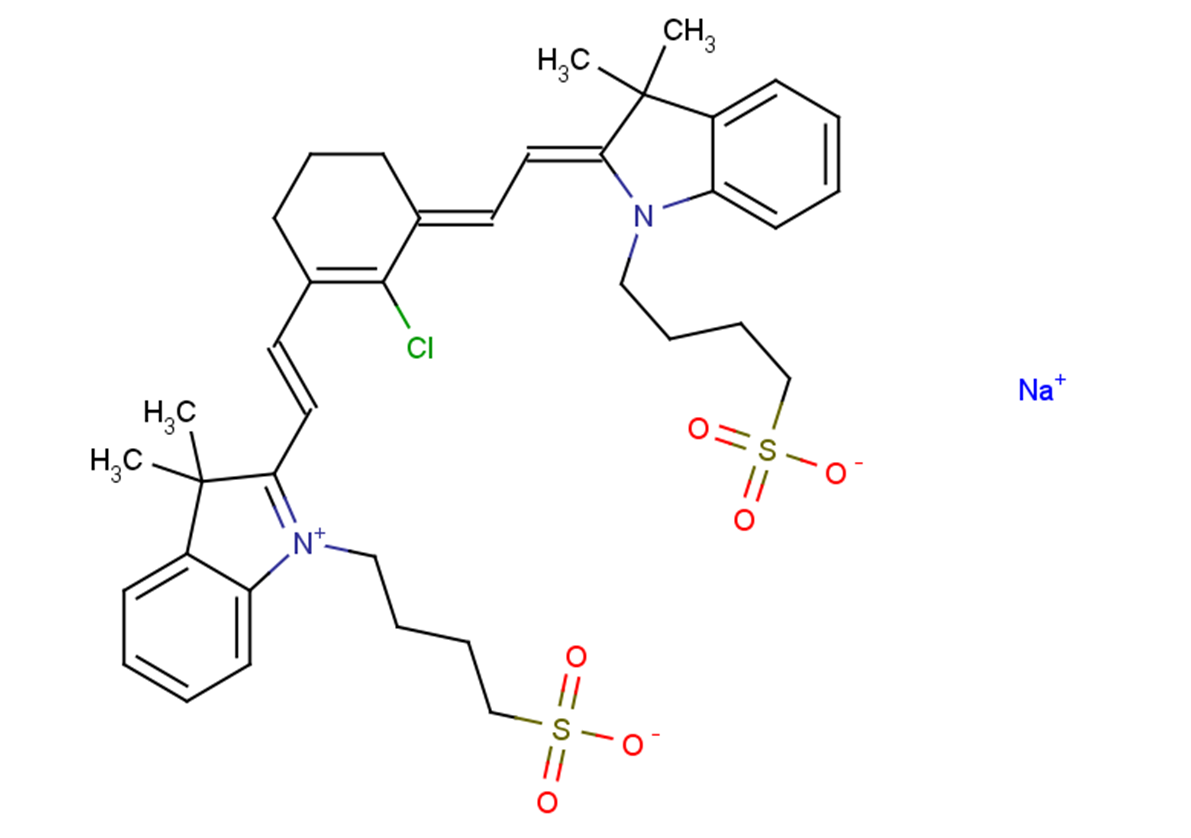
IR-783
CAS No. 115970-66-6
IR-783( —— )
Catalog No. M23337 CAS No. 115970-66-6
IR 783 is a heptamethine cyanine fluorescent probe for in vivo imaging of tumor cells.
Purity : >98% (HPLC)
 COA
Datasheet
HNMR
HPLC
MSDS
Handing Instructions
COA
Datasheet
HNMR
HPLC
MSDS
Handing Instructions
| Size | Price / USD | Stock | Quantity |
| 5MG | 45 | In Stock |


|
| 10MG | 68 | In Stock |
|
| 25MG | 104 | In Stock |
|
| 50MG | 152 | In Stock |
|
| 100MG | Get Quote | In Stock |
|
| 200MG | Get Quote | In Stock |
|
| 500MG | Get Quote | In Stock |
|
| 1G | Get Quote | In Stock |
|
Biological Information
-
Product NameIR-783
-
NoteResearch use only, not for human use.
-
Brief DescriptionIR 783 is a heptamethine cyanine fluorescent probe for in vivo imaging of tumor cells.
-
DescriptionIR 783 is a heptamethine cyanine fluorescent probe for in vivo imaging of tumor cells. It displays excitation/emission maxima of 633/780 nm, respectively.
-
In Vitro——
-
In Vivo——
-
Synonyms——
-
PathwayOthers
-
TargetOther Targets
-
RecptorOthers
-
Research Area——
-
Indication——
Chemical Information
-
CAS Number115970-66-6
-
Formula Weight749.35
-
Molecular FormulaC38H46ClN2NaO6S2
-
Purity>98% (HPLC)
-
SolubilityDMSO:Soluble
-
SMILESClC1=C(/C=C/C2=[N+](C3=CC=CC=C3C2(C)C)CCCCS([O-])(=O)=O)CCC/C1=C\C=C4C(C)(C5=CC=CC=C5N\4CCCCS([O-])(=O)=O)C.[Na+]
-
Chemical Name——
Shipping & Storage Information
-
Storage(-20℃)
-
ShippingWith Ice Pack
-
Stability≥ 2 years
Reference
molnova catalog



related products
-
Neuromedin (U8), por...
Neuromedin U-8 (porcine) is a polypeptide that can be found by peptide screening. Peptide screening is a research tool that pools active peptides primarily by immunoassay. Peptide screening can be used for protein interaction, functional analysis, epitope screening, especially in the field of agent research and development.
-
Mal-amido-PEG7-acid
Mal-amido-PEG7-acid is a PEG-based PROTAC linker that can be used to synthesize PROTACs.
-
2-amino-4-methyl-1,3...
2-amino-4-methyl-1,3-thiazole-5-carbohydrazide is a compound used as a molecular building block.
