


 Cart
Cart
 sales@molnova.com



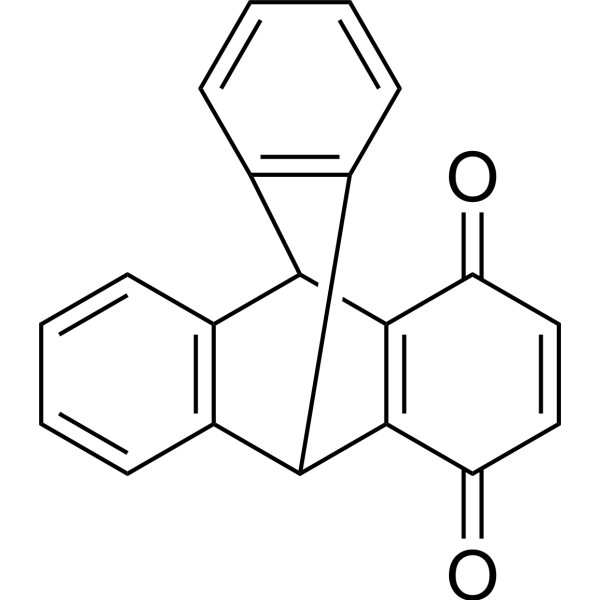
INCA-6
CAS No. 3519-82-2
INCA-6( Triptycene-1,4-quinone )
Catalog No. M27468 CAS No. 3519-82-2
INCA-6 is an inhibitor of Nuclear factor of activated T cells (NFAT) and calcineurin-NFAT signaling.
Purity : >98% (HPLC)
 COA
Datasheet
HNMR
HPLC
MSDS
Handing Instructions
COA
Datasheet
HNMR
HPLC
MSDS
Handing Instructions
| Size | Price / USD | Stock | Quantity |
| 5MG | 45 | Get Quote |


|
| 10MG | 77 | Get Quote |
|
| 25MG | 155 | Get Quote |
|
| 50MG | 299 | Get Quote |
|
| 100MG | 509 | Get Quote |
|
| 500MG | 1107 | Get Quote |
|
| 1G | Get Quote | Get Quote |
|
Biological Information
-
Product NameINCA-6
-
NoteResearch use only, not for human use.
-
Brief DescriptionINCA-6 is an inhibitor of Nuclear factor of activated T cells (NFAT) and calcineurin-NFAT signaling.
-
DescriptionINCA-6 is an inhibitor of Nuclear factor of activated T cells (NFAT) and calcineurin-NFAT signaling.(In Vitro):In human retinal microvascular endothelial cells, INCA-6 (1.0, 2.5 μM) significantly decreases VEGF and serum-induced proliferation without affecting baseline proliferation. In 3-Hz cells, INCA-6 (5 μM) prevents transient outward K+ current downregulation. INCA-6 (10 μM) significantly inhibits ATP-induced CXCL2 expression in rat primary microglia and BV-2 cells. INCA-6 (5 μM) protein expression and reduces SERCA2 transcript levels with and without thapsigargin.(In Vivo):INCA-6 (2.5, 5.0, and 25.0 μM; intravitreal) significantly reduces pathologic neovascularization in oxygen-induced retinopathy and decreases the severity of OIR in a dose dependent manner.
-
In VitroINCA-6 (5 μM; for 24-hour) prevents?transient outward K+?current (Ito)?downregulation in 3-Hz cells.Pre-treatment of BV-2 cells with INCA-6 (10 μM) significantly inhibits ATP-induced CXCL2 expression in BV-2 cells. INCA-6 also inhibits ATP-induced CXCL2 expression in rat primary microglia.?INCA-6 (5 μM) reduces SERCA2 transcript levels as well as protein expression, in the absence or in the presence of ?thapsigargin (TG).INCA-6 (1.0 and 2.5 μM; 24 hours?) treatment significantly decreases both VEGF and serum-induced human retinal microvascular endothelial cells (HRMEC) proliferation, but does not affect baseline proliferation. Cell Proliferation Assay Cell Line:Human retinal microvascular endothelial cells Concentration:0.5, 1.0, or 2.5 μM Incubation Time:24 hours Result:Significantly inhibited VEGF-induced proliferation at 1.0 and 2.5 μM concentrations.
-
In VivoINCA-6 (5.0, or 25.0 μM) treatment significantly reduces pathologic neovascularization in oxygen-induced retinopathy (OIR). Animal Model:Rats bearing OIR model Dosage:2.5, 5.0, or 25.0 μM Administration:Intravitreal injection on days 14(0) and 14(3)Result:Decreased the severity of OIR in a dose dependent manner. Significant inhibition was seen at 5.0 and 25.0 μM concentrations.
-
SynonymsTriptycene-1,4-quinone
-
PathwayOthers
-
TargetOther Targets
-
Recptorprostaglandin F2α
-
Research Area——
-
Indication——
Chemical Information
-
CAS Number3519-82-2
-
Formula Weight284.31
-
Molecular FormulaC20H12O2
-
Purity>98% (HPLC)
-
SolubilityIn Vitro:?DMSO : 2.86 mg/mL (10.06 mM)
-
SMILESO=C1C=CC(=O)C2=C1C3C=4C=CC=CC4C2C=5C=CC=CC53
-
Chemical Name——
Shipping & Storage Information
-
Storage(-20℃)
-
ShippingWith Ice Pack
-
Stability≥ 2 years
Reference
1.Baryla M, et al. Prostaglandin F(2α) stimulates adhesion, migration, invasion and proliferation of the human trophoblast cell line HTR-8/SVneo. Placenta. 2019 Feb;77:19-29.
molnova catalog



related products
-
3-Oxopomolic acid
Pomonic acid is a triterpenoid that significantly inhibits cholesterol ester accumulation and suppresses the acyl coenzyme A:cholesterol acyltransferase ( ACAT ) activity.
-
threo-7,9,9-Trihydro...
The herbs of Leucaena leucocephala.
-
Adropin (34-76) (hum...
Adropin (34-76) (human, mouse, rat) is a peptide that attenuates liver fibrosis and insulin resistance independent of obesity or food intake.
