


 Cart
Cart
 sales@molnova.com



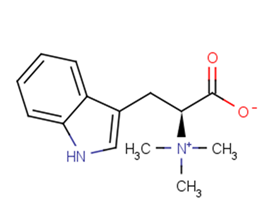
Hypaphorine
CAS No. 487-58-1
Hypaphorine( Hypaphorine | Hypaforin | L-Hypaphorine )
Catalog No. M18635 CAS No. 487-58-1
Hypaphorine is an indole-3-acetic acid antagonist which specifically compete with indole-3-acetic acid in binding to the indole-3-acetic acid-binding site in plant peroxidases.
Purity : >98% (HPLC)
 COA
Datasheet
HNMR
HPLC
MSDS
Handing Instructions
COA
Datasheet
HNMR
HPLC
MSDS
Handing Instructions
| Size | Price / USD | Stock | Quantity |
| 5MG | 248 | In Stock |


|
| 10MG | 419 | In Stock |
|
| 25MG | 689 | In Stock |
|
| 50MG | 963 | In Stock |
|
| 100MG | 1305 | In Stock |
|
| 500MG | 2592 | In Stock |
|
| 1G | Get Quote | In Stock |
|
Biological Information
-
Product NameHypaphorine
-
NoteResearch use only, not for human use.
-
Brief DescriptionHypaphorine is an indole-3-acetic acid antagonist which specifically compete with indole-3-acetic acid in binding to the indole-3-acetic acid-binding site in plant peroxidases.
-
DescriptionHypaphorine is an indole alkaloid, present in the fungus Pisolithus tinctorius in family Sclerodermataceae, that controls the elongation rate of root hairs.
-
In Vitro——
-
In Vivo——
-
SynonymsHypaphorine | Hypaforin | L-Hypaphorine
-
PathwayEndocrinology/Hormones
-
TargetAChR
-
RecptorOthers
-
Research AreaMetabolic Disease
-
Indication——
Chemical Information
-
CAS Number487-58-1
-
Formula Weight246.31
-
Molecular FormulaC14H18N2O2
-
Purity>98% (HPLC)
-
SolubilityIn Vitro:?H2O : 100 mg/mL (406.01 mM)
-
SMILESC[N+](C)(C)C(CC1=CNC2=CC=CC=C21)C(=O)[O-]
-
Chemical Name(S)-3-(1H-indol-3-yl)-2-(trimethylammonio)propanoate
Shipping & Storage Information
-
Storage(-20℃)
-
ShippingWith Ice Pack
-
Stability≥ 2 years
Reference
molnova catalog



related products
-
TTNPB
TTNPB, a potent RAR agonist, inhibits binding of [3H]tRA of human RARα (IC50: 5.1 nM), β (IC50: 4.5 nM), and γ (IC50: 9.3 nM), respectively.
-
Clothianidin
Clothianidin, an insecticide, acts as an agonist of acetylcholine to stimulate nAChR, thereby activating post-synaptic acetylcholine receptors but not inhibiting AChE.
-
3-Epioleanolic acid
3-Epioleanolic acid and oleanonic acid possess varying degrees of agonist activity on uterine smooth muscle with minor changes in the molecular structure affecting its intrinsic activity on uterine muscle.
