


 Cart
Cart
 sales@molnova.com



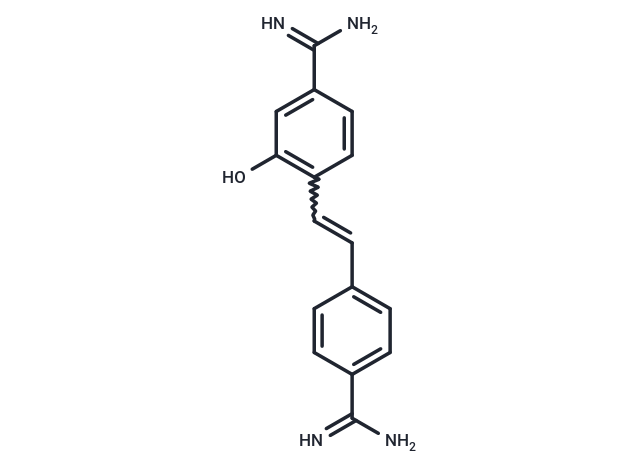
Hydroxystilbamidine
CAS No. 495-99-8
Hydroxystilbamidine( —— )
Catalog No. M37690 CAS No. 495-99-8
Hydroxystilbamidine ((E)-hydroxystilbamidine), a dye capable of binding to both DNA and RNA, has been found to be a powerful inhibitor of cellular ribonucleases.
Purity : >98% (HPLC)
 COA
Datasheet
HNMR
HPLC
MSDS
Handing Instructions
COA
Datasheet
HNMR
HPLC
MSDS
Handing Instructions
| Size | Price / USD | Stock | Quantity |
| 2MG | 296 | In Stock |


|
| 5MG | 425 | In Stock |
|
| 10MG | 626 | In Stock |
|
| 25MG | 908 | In Stock |
|
| 50MG | 1270 | In Stock |
|
| 100MG | 1701 | In Stock |
|
| 500MG | 3411 | In Stock |
|
| 1G | Get Quote | In Stock |
|
Biological Information
-
Product NameHydroxystilbamidine
-
NoteResearch use only, not for human use.
-
Brief DescriptionHydroxystilbamidine ((E)-hydroxystilbamidine), a dye capable of binding to both DNA and RNA, has been found to be a powerful inhibitor of cellular ribonucleases.
-
DescriptionHydroxystilbamidine, a dye capable of binding to both DNA and RNA, is a powerful inhibitor of cellular ribonucleases. Hydroxystilbamidine is a retrograde fluorescent tracer and a histochemical stain.
-
In Vitro——
-
In Vivo——
-
Synonyms——
-
PathwayOthers
-
TargetOther Targets
-
RecptorOthers
-
Research Area——
-
Indication——
Chemical Information
-
CAS Number495-99-8
-
Formula Weight280.32
-
Molecular FormulaC16H16N4O
-
Purity>98% (HPLC)
-
Solubility——
-
SMILESC(=CC1=CC=C(C(=N)N)C=C1)C2=C(O)C=C(C(=N)N)C=C2
-
Chemical Name——
Shipping & Storage Information
-
Storage(-20℃)
-
ShippingWith Ice Pack
-
Stability≥ 2 years
Reference
1. Folds JD, et al. Immunosuppression by hydroxystilbamidine isethionate, a lysosome-stabilizing, anti-proteolytic, antifungal drug. Infect Immun. 1975 Mar;11(3):441-4.?
molnova catalog



related products
-
2-Chloroindole
2-Chloroindole is a marine derived natural products found in Ptychodera flava.
-
4A/4B, 5A/5B Peptide
4A/4B, 5A/5B Peptide
-
Benzyl-PEG12-alcohol
Benzyl-PEG12-alcohol is a PEG-based linker for PROTACs, connecting two essential ligands to form PROTAC molecules. This linker facilitates selective protein degradation by utilizing the ubiquitin-proteasome system within cells.
