


 Cart
Cart
 sales@molnova.com



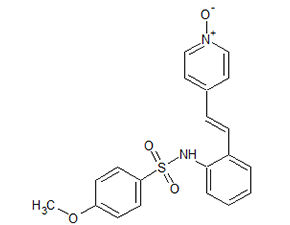
HMN-176
CAS No. 173529-10-7
HMN-176( HMN176 | HMN 176 | HMN-176 )
Catalog No. M17369 CAS No. 173529-10-7
HMN-176 is a stilbene derivative which inhibits mitosis, interfering with polo-like kinase-1 (plk1).
Purity : >98% (HPLC)
 COA
Datasheet
HNMR
HPLC
MSDS
Handing Instructions
COA
Datasheet
HNMR
HPLC
MSDS
Handing Instructions
| Size | Price / USD | Stock | Quantity |
| 1 mL x 10 mM in DMSO | 68 | In Stock |


|
| 2MG | 48 | In Stock |
|
| 5MG | 76 | In Stock |
|
| 10MG | 116 | In Stock |
|
| 25MG | 188 | In Stock |
|
| 50MG | 343 | In Stock |
|
| 100MG | 511 | In Stock |
|
| 200MG | Get Quote | In Stock |
|
| 500MG | 1107 | In Stock |
|
| 1G | Get Quote | In Stock |
|
Biological Information
-
Product NameHMN-176
-
NoteResearch use only, not for human use.
-
Brief DescriptionHMN-176 is a stilbene derivative which inhibits mitosis, interfering with polo-like kinase-1 (plk1).
-
DescriptionHMN-176 is an active metabolite of the synthetic antitumor compound HMN-214. HMN-176 shows potent cytotoxicity toward various human tumor cell lines, and in mitotic cells, it causes cell cycle arrest at M phase through the destruction of spindle polar bodies, followed by the induction of DNA fragmentation. However, no direct interactions of HMN-176 with tubulin are observed. Moreover, in animal models, it was observed that oral administration of the prodrug HMN-214 caused no significant nerve toxicity, a severe side effect often associated with microtubule binding agents such as Taxol and VCR.3 In Phase I clinical trials, HMN-214 has caused sensory neuropathy and ileus in some patients. However, the grade and frequency of these adverse effects were much lower than those of typical microtubule binding agents. As expected from the mechanism of action of HMN-214 (induction of G2-M arrest in dividing cells), the main adverse effect was neutropenia.
-
In VitroHMN-176 (2.5 μM) greatly increases the duration of mitosis in hTERT-RPE1 and CFPAC-1 Cell lines. The effect of HMN-176 on spindle morphology does not appear to be related to effects on microtubule polymerization. HMN-176 (2.5, 0.25, and 0.025 μM) inhibits aster formation in a concentration dependent manner. HMN-176 (0.1, 1.0, or 10.0 μg/mL) demonstrates inhibitory effects in multiple tumors, with notable activity seen in breast, nonsmall-cell lung, and ovarian cancer specimens. HMN-176 demonstrates activity towards 63% of the breast (5/8), 67% of the non-small cell lung (4/6), and 57% of the ovarian (4/7) tumor specimens treated with 10.0 μg/mL. HMN-176 shows potent cytotoxicity, with a mean IC50 value of 118 nM. HMN-176 displays similar cytotoxicity against tumors with various characteristics from different organs. Treatment with 3 μM HMN-176 suppresses the expression of MDR1 mRNA by 56%. HMN-176 has no significant effect on the residual promoter activity.
-
In VivoAfter p.o. of HMN-214 to male rats, the prodrug is not detected in the plasma, while plasma levels of HMN-176 peaks at 2 h and gradually decreases thereafter.
-
SynonymsHMN176 | HMN 176 | HMN-176
-
PathwayOthers
-
TargetOther Targets
-
RecptorOthers
-
Research AreaCancer
-
Indication——
Chemical Information
-
CAS Number173529-10-7
-
Formula Weight382.43
-
Molecular FormulaC20H18N2O4S
-
Purity>98% (HPLC)
-
SolubilityIn Vitro:?DMSO : 30 mg/mL (78.45 mM)
-
SMILESO=S(=O)(c1ccc(OC)cc1)Nc1ccccc1/C=C/c1cc[n+](cc1)[O-]
-
Chemical Name(E)-4-(2-(4-methoxyphenylsulfonamido)styryl)pyridine 1-oxide
Shipping & Storage Information
-
Storage(-20℃)
-
ShippingWith Ice Pack
-
Stability≥ 2 years
Reference
1. DiMaio MA, et al. Mol Y Ther. 2009 Mar;8(3):592-601.
molnova catalog



related products
-
Allocryptopine
Allocryptopine has certain effects on anti-injury for hepatocyte, ameliorating liver function, and prohibiting hepatic fibrosis; it increases mRNA levels of cytochromes P450 1A in human hepatocytes and HepG2 cells independently of AhR.
-
Trans-Anethole
Anethole (anise camphor) is an organic compound that is widely used as a flavoring substance.
-
Feruloylputrescine h...
Feruloylputrescine hydrochloride
