


 Cart
Cart
 sales@molnova.com



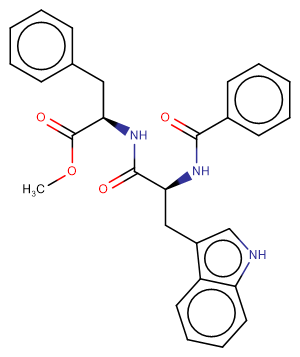
HCH6-1
CAS No. 1435265-06-7
HCH6-1( —— )
Catalog No. M21567 CAS No. 1435265-06-7
HCH6-1 is a competitive Formyl peptide receptor 1 (FPR1) antagonist.
Purity : >98% (HPLC)
 COA
Datasheet
HNMR
HPLC
MSDS
Handing Instructions
COA
Datasheet
HNMR
HPLC
MSDS
Handing Instructions
| Size | Price / USD | Stock | Quantity |
| 2MG | 76 | Get Quote |


|
| 5MG | 129 | Get Quote |
|
| 10MG | 203 | Get Quote |
|
| 25MG | 376 | Get Quote |
|
| 50MG | 563 | Get Quote |
|
| 100MG | 800 | Get Quote |
|
| 200MG | Get Quote | Get Quote |
|
| 500MG | Get Quote | Get Quote |
|
| 1G | Get Quote | Get Quote |
|
Biological Information
-
Product NameHCH6-1
-
NoteResearch use only, not for human use.
-
Brief DescriptionHCH6-1 is a competitive Formyl peptide receptor 1 (FPR1) antagonist.
-
DescriptionHCH6-1 is a competitive Formyl peptide receptor 1 (FPR1) antagonist.
-
In VitroIn a cell-impermeable cytochrome c reduction assay, HCH6-1 significantly inhibits superoxide anion generation in fMLF (FPR1 agonist)-activated neutrophils with anIC50 of 0.32 μM. HCH6-1 has fewer inhibitory effects in WKYMVm (dual FPR1/FPR2 agonist)- and MMK1 (FPR2 agonist)-activated neutrophils, with IC50s of 4.98±0.27 μM and 17.68±2.77 μM, respectively.HCH6-1 does not induce LDH release even at 30 μM, so it does not have cytotoxic effects in human neutrophils. HCH6-1 does not alter the level of xanthine/xanthine oxidase superoxide anion and DPPH radical in cell-free systems.HCH6-1 significantly inhibits elastase release in fMLF-activated neutrophils, with an IC50 of 0.57 μM. However, in neutrophils triggered by WKYMVm or MMK1, HCH6-1 inhibits elastase release at higher concentrations, with IC50s of 5.22±0.69 μM and 10.00±0.65 μM, respectively.
-
In VivoHCH6-1 (intraperitoneal injection; 50 mg/kg; 1 h before LPS spray or 30 min after LPS spray) alone does not induce airspace inflammation. HCH6-1 pretreatment reduces inflammatory cell infiltration and distortion of pulmonary architecture in the presence of LPS. HCH6-1 posttreatment shows inhibitory effects on neutrophil accumulation and lung damage in LPS-induced ALI mice. Animal Model:C57BL/6 mice (20-25 g, 7-8 weeks old)Dosage:50 mg/kg Administration:Intraperitoneal injection; 50 mg/kg; 1 h before LPS spray or 30 min after LPS spray Result:Ameliorated ALI in LPS-induced mice.HCH6-1-mediated decreasing of neutrophil recruitment serves as a protective mechanism in ALI mice.
-
Synonyms——
-
PathwayOthers
-
TargetOther Targets
-
Recptorformyl peptide receptor (FPR)
-
Research Area——
-
Indication——
Chemical Information
-
CAS Number1435265-06-7
-
Formula Weight469.53
-
Molecular FormulaC28H27N3O4
-
Purity>98% (HPLC)
-
SolubilityDMSO:250 mg/mL (532.45 mM; Need ultrasonic)
-
SMILESCOC(=O)[C@@H](Cc1ccccc1)NC(=O)[C@H](Cc1c[nH]c2ccccc12)NC(=O)c1ccccc1
-
Chemical Name——
Shipping & Storage Information
-
Storage(-20℃)
-
ShippingWith Ice Pack
-
Stability≥ 2 years
Reference
1.Yang SC et al. Dipeptide HCH6-1 inhibits neutrophil activation and protects against acute lung injury by blocking FPR1. Free Radic Biol Med. 2017 May;106:254-269
molnova catalog



related products
-
AOB2796
AOB2796 is a novel PAR2 agonist; activated PAR2 signaling in cellular proliferation assays, phosphatidylinositol hydrolysis assays, and Ca(2+) mobilization assays, with potencies ranging from 200 to 1000 nM.
-
Ophiopogonin B
Ophiopogonin B has antitumor activity and is a prospective inhibitor of PI3K/Akt.
-
N3-C4-NHS ester
N3-C4-NHS ester is a non cleavable ADC linker used in the synthesis of antibody-drug conjugates (ADCs).
