


 Cart
Cart
 sales@molnova.com



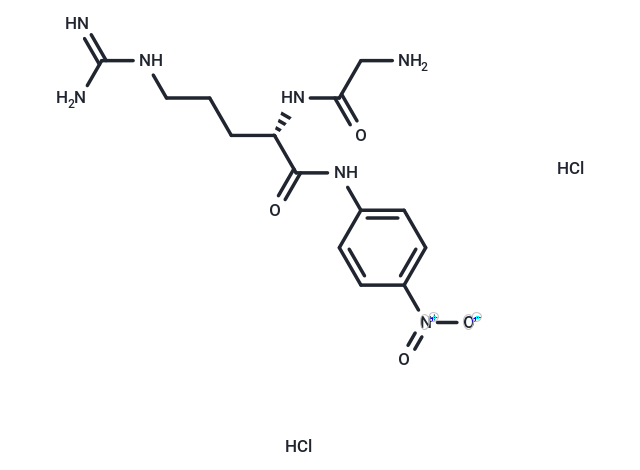
H-Gly-Arg-pNA dihydrochloride
CAS No. 125455-61-0
H-Gly-Arg-pNA dihydrochloride( —— )
Catalog No. M34903 CAS No. 125455-61-0
H-Gly-Arg-pNA dihydrochloride (H-Gly-Arg-Pna 2HCl) belongs to the class of peptides that bind to 1,2 thrombin and can be quantified by colorimetric detection at 405 nm as a measure of thrombin activity.
Purity : >98% (HPLC)
 COA
Datasheet
HNMR
HPLC
MSDS
Handing Instructions
COA
Datasheet
HNMR
HPLC
MSDS
Handing Instructions
| Size | Price / USD | Stock | Quantity |
| 5MG | 323 | In Stock |


|
| 10MG | 475 | In Stock |
|
| 25MG | 774 | In Stock |
|
| 50MG | 1051 | In Stock |
|
| 100MG | 1423 | In Stock |
|
| 200MG | Get Quote | In Stock |
|
| 500MG | Get Quote | In Stock |
|
| 1G | Get Quote | In Stock |
|
Biological Information
-
Product NameH-Gly-Arg-pNA dihydrochloride
-
NoteResearch use only, not for human use.
-
Brief DescriptionH-Gly-Arg-pNA dihydrochloride (H-Gly-Arg-Pna 2HCl) belongs to the class of peptides that bind to 1,2 thrombin and can be quantified by colorimetric detection at 405 nm as a measure of thrombin activity.
-
DescriptionH-Gly-Arg-pNA dihydrochloride (H-Gly-Arg-Pna 2HCl) belongs to the class of peptides that bind to 1,2 thrombin and can be quantified by colorimetric detection at 405 nm as a measure of thrombin activity.
-
In Vitro——
-
In Vivo——
-
Synonyms——
-
PathwayAutophagy
-
TargetThrombin
-
RecptorThrombin
-
Research Area——
-
Indication——
Chemical Information
-
CAS Number125455-61-0
-
Formula Weight424.28
-
Molecular FormulaC14H23Cl2N7O4
-
Purity>98% (HPLC)
-
Solubility——
-
SMILESN=C(N)NCCC[C@H](NC(CN)=O)C(NC1=CC=C(C=C1)[N+]([O-])=O)=O.Cl.Cl
-
Chemical Name——
Shipping & Storage Information
-
Storage(-20℃)
-
ShippingWith Ice Pack
-
Stability≥ 2 years
Reference
molnova catalog



related products
-
Ozagrel hydrochlorid...
Ozagrel HCl is a selective thromboxane A(2) (TXA(2)) synthetase inhibitor with IC50 of 11 nM for rabbit platelet.
-
Melagatran
Melagatran is an orally available, direct synthetic thrombin inhibitor that does not require endogenous cofactors other than thrombin and does not significantly interact with any other enzymes in the coagulation cascade or with the fibrinolytic enzymes.
-
NP-313
NP-313 (NSC-4264) is a potent antithrombotic agent that inhibits platelet aggregation and activation by inhibiting thromboxane A 2 synthesis and selectively inhibiting SOCC-mediated Ca2+ efflux.
