


 Cart
Cart
 sales@molnova.com



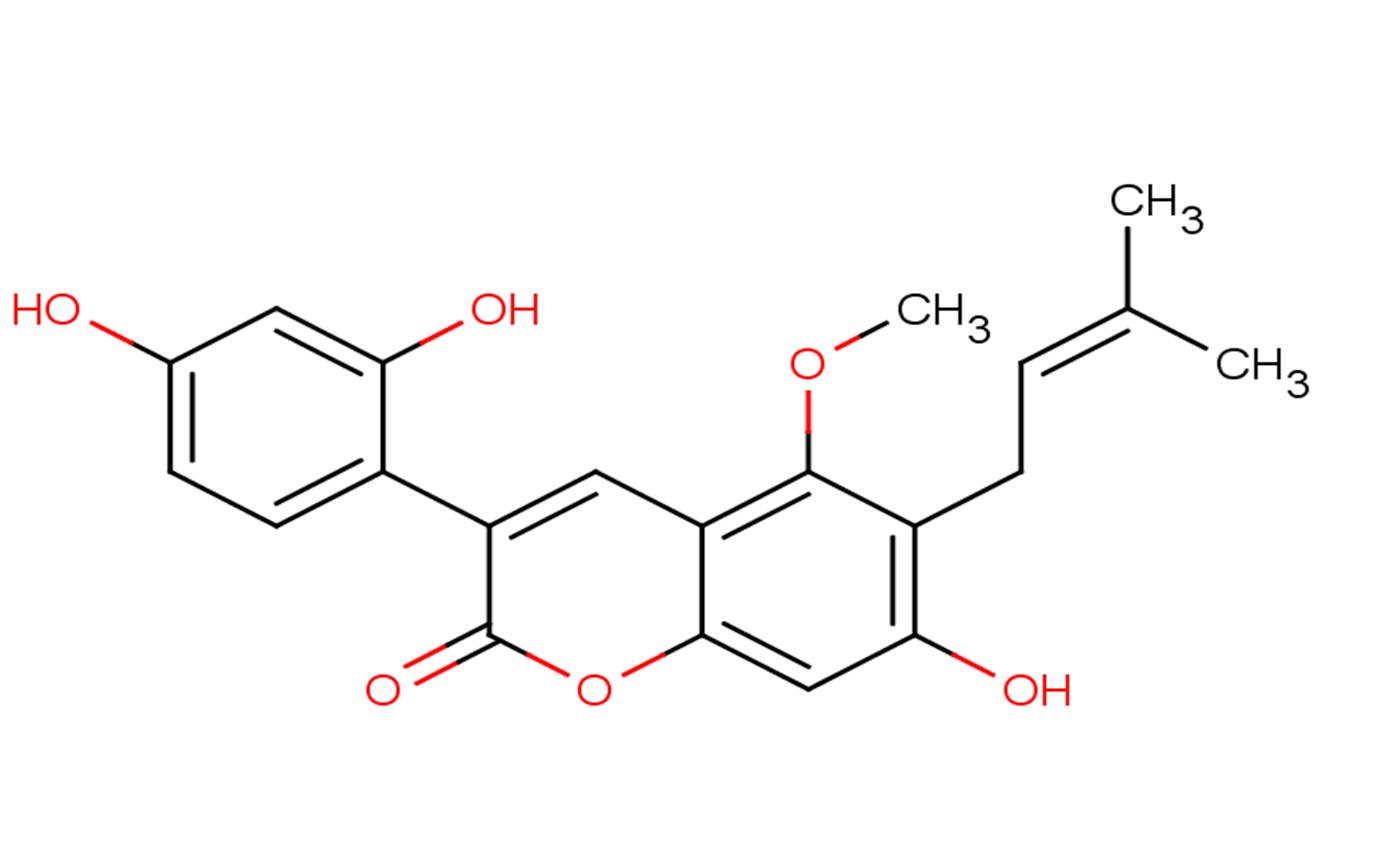
Glycycoumarin
CAS No. 94805-82-0
Glycycoumarin( —— )
Catalog No. M24999 CAS No. 94805-82-0
Glycycoumarin is an estrogen agonist, it shows moderate inhibitory effects against CYP1A2 and CYP2B6.
Purity : >98% (HPLC)
 COA
Datasheet
HNMR
HPLC
MSDS
Handing Instructions
COA
Datasheet
HNMR
HPLC
MSDS
Handing Instructions
| Size | Price / USD | Stock | Quantity |
| 5MG | 67 | In Stock |


|
| 10MG | 112 | In Stock |
|
| 25MG | 222 | In Stock |
|
| 100MG | Get Quote | In Stock |
|
| 200MG | Get Quote | In Stock |
|
| 500MG | Get Quote | In Stock |
|
| 1G | Get Quote | In Stock |
|
Biological Information
-
Product NameGlycycoumarin
-
NoteResearch use only, not for human use.
-
Brief DescriptionGlycycoumarin is an estrogen agonist, it shows moderate inhibitory effects against CYP1A2 and CYP2B6.
-
DescriptionGlycycoumarin is an estrogen agonist, it shows moderate inhibitory effects against CYP1A2 and CYP2B6.
-
In VitroGlycycoumarin, (25 μM; 24 h) combining with ABT-737 (12.5 μM) synergistically, induces cell death in multiple types of liver cancer cell HepG2.Glycycoumarin is highly effective against alcoholic liver disease, nonalcoholic fatty liver disease, acetaminophen-induced hepatotoxicity, and liver cancer through mechanisms involved in activation of Nrf2 antioxidant system, stimulation of AMPK-mediated energy homeostasis, induction of autophagy degradation process, and inhibiting oncogenic kinase T-lymphokine-activated killer cell-originated protein kinase activity. Cell Viability Assay Cell Line:HepG2, SMMC-7721, and Huh-7 Concentration:10, 20, 25, 30, and 40 μM Incubation Time:24 hours Result:Induced cell death in multiple types of liver cancer cell lines in a dose-dependent manner.
-
In VivoGlycycoumarin (30 μM-0.3 nM; 5 min) has an inhibitory effect on smooth muscle contraction induced by various types of stimulants through the inhibition of PDEs, especially isozyme 3, followed by the accumulation of intracellular cAMP.Glycycoumarin (10 mg/kg; i.p.; once daily for 4 d) enhances tumor growth inhibition in HepG2 xenograft model in mice and shows synergistical effect with ABT-737 (HY-50907). Animal Model:Male ICR mice (aged 6 weeks, weight 25-30 g)Dosage:30 μM-0.3 nM, 5 min Administration:Result:Inhibited the contraction induced by various types of stimulants, such as CCh, KCI, BaCI(2), and A23187 (calcium ionophore III). Enhanced the relaxation induced by forskolin on CCh-evoked contraction and also enhances the relaxation effect of rolipram. Associated with dose-dependent accumulation of cAMP.Animal Model:HepG2 cancer cells xenograft model in male BALB/c athymic nude mice (6-7 weeks old)Dosage:10 mg/kg Administration:Intraperitoneal injection; once daily for 4 days; ABT-737 group was given 100 mg/kg i.p.Result:Inhibited tumor growth and resulted a reduction of the final tumor weight by 17%.
-
Synonyms——
-
PathwayAutophagy
-
TargetAutophagy
-
RecptorAutophagy|JNK|P450
-
Research Area——
-
Indication——
Chemical Information
-
CAS Number94805-82-0
-
Formula Weight368.37
-
Molecular FormulaC21H20O6
-
Purity>98% (HPLC)
-
SolubilityDMSO:Soluble
-
SMILESO=C1C(C2=CC=C(O)C=C2O)=CC3=C(OC)C(C/C=C(C)\C)=C(O)C=C3O1
-
Chemical Name——
Shipping & Storage Information
-
Storage(-20℃)
-
ShippingWith Ice Pack
-
Stability≥ 2 years
Reference
1.Glycycoumarin exerts anti-liver cancer activity by directly targeting T-LAK cell-originated protein kinase.Oncotarget. 2016 Oct 4;7(40):65732-65743.
molnova catalog



related products
-
Talarozole
Talarozole is an oral systemic all-trans retinoic acid metabolism blocking agent (RAMBA). Talarozole inhibits both CYP26A1 and CYP26B1 with IC50s of 5.4 and 0.46 nM respectively.Talarozole for the treatment of acne psoriasis and other keratinization disorders.
-
LC3-mHTT-IN-AN1
LC3-mHTT-IN-AN1 (Compound AN1) is a mHTT-LC3 linker compound, which interacts with both mutant huntingtin protein (mHTT) and LC3B but not with wtHTT or irrelevant control proteins.
-
XST-14
XST-14 is a competitive and specific inhibitor of ULK1 (IC50: 26.6 nM).XST-14 blocks autophagy by inhibiting the phosphorylation of ULK1 downstream substrates.XST-14 induces apoptosis and inhibits the growth of HCC cells.
