


 Cart
Cart
 sales@molnova.com



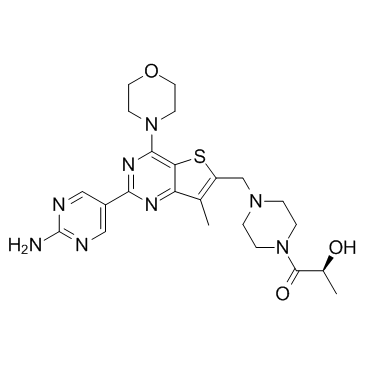
GDC-0980
CAS No. 1032754-93-0
GDC-0980( Apitolisib | GNE 390 | GDC0980 | RG 7422 )
Catalog No. M10158 CAS No. 1032754-93-0
GDC-0980 (Apitolisib, GNE 390, RG 7422) is a potent, selective, orally available class I PI3K/mTOR inhibitor with IC50 of 5 nM/27 nM/7 nM/14 nM for PI3Kα/β/δ/γ, inhibits mTOR inhibitor with Ki of 17 nM.
Purity : >98% (HPLC)
 COA
Datasheet
HNMR
HPLC
MSDS
Handing Instructions
COA
Datasheet
HNMR
HPLC
MSDS
Handing Instructions
| Size | Price / USD | Stock | Quantity |
| 2MG | 34 | In Stock |


|
| 5MG | 52 | In Stock |
|
| 10MG | 79 | In Stock |
|
| 25MG | 143 | In Stock |
|
| 50MG | 232 | In Stock |
|
| 100MG | 381 | In Stock |
|
| 200MG | Get Quote | In Stock |
|
| 500MG | Get Quote | In Stock |
|
| 1G | Get Quote | In Stock |
|
Biological Information
-
Product NameGDC-0980
-
NoteResearch use only, not for human use.
-
Brief DescriptionGDC-0980 (Apitolisib, GNE 390, RG 7422) is a potent, selective, orally available class I PI3K/mTOR inhibitor with IC50 of 5 nM/27 nM/7 nM/14 nM for PI3Kα/β/δ/γ, inhibits mTOR inhibitor with Ki of 17 nM.
-
DescriptionGDC-0980 (Apitolisib, GNE 390, RG 7422) is a potent, selective, orally available class I PI3K/mTOR inhibitor with IC50 of 5 nM/27 nM/7 nM/14 nM for PI3Kα/β/δ/γ, inhibits mTOR inhibitor with Ki of 17 nM; displays remarkably selective for several other members of the closely related PIKK family kinases, including C2alpha, C2beta, VPS34 I, PI4Kalpha, PI4Kbeta and DNA-PK; potently inhibits signal transduction downstream of both PI3K and mTOR, reduces viability in multiple cancer cell lines by cell-cycle inhibition and induction of apoptosis (prostate IC50<200 nM, NSCLC lines <200 nM); potently inhibits tumor growth in xenograft models with activated PI3K, loss of LKB1 or PTEN.Breast Cancer Phase 2 Clinical(In Vitro):Apitolisib (GDC-0980) is remarkably selective for several other members of the closely related PIKK family kinases: C2alpha IC50=1300 nM; C2beta IC50=7 94 nM; VPS34 IC50=2000 nM; PI4Kalpha >10 μM; PI4Kbeta >10 μM; DNA-PK Kiapp=623 nM, respectively. A recent study shows that Apitolisib (GDC-0980) reduces cancer cell viability by inhibiting cell-cycle procession and inducing apoptosis with most potency in prostate (IC50 < 200 nM 50%), <500 nM 100%), breast (IC50 <200 nM 37%, <500 nM 78%) and NSCLC lines (IC50 <200 nM 29%, <500 nM 88%) and less potency in pancreatic (IC50 <200 nM 13%, <500 nM 67%) and melanoma cell lines (IC50 <200 nM 0%, <500 nM 33%).(In Vivo):Apitolisib (GDC-0980) (1 mg/kg, p.o.) demonstrats significant efficacy in mouse xenografts and is currently in phase I clinical trials for cancer. Clearance and PPB are low, and Apitolisib (GDC-0980) shows dose-proportional exposure from 5 mg/kg dosed in PEG to 50 mg/kg dosed in suspension in MCT, a finding attributed partially to the compound’s good solubility. Apitolisib (GDC-0980) (5 mg/kg, p.o.) results in greater than 50% TGI in 15 of the 20 xenograft models. The difference in tumor response to Apitolisib (GDC-0980) treatment correlates with the duration of knockdown of pAkt/tAkt.
-
In VitroApitolisib (GDC-0980) is remarkably selective for several other members of the closely related PIKK family kinases: C2alpha IC50=1300 nM; C2beta IC50=7 94 nM; VPS34 IC50=2000 nM; PI4Kalpha >10 μM; PI4Kbeta >10 μM; DNA-PK Kiapp=623 nM, respectively. A recent study shows that Apitolisib (GDC-0980) reduces cancer cell viability by inhibiting cell-cycle procession and inducing apoptosis with most potency in prostate (IC50 < 200 nM 50%), <500 nM 100%), breast (IC50 <200 nM 37%, <500 nM 78%) and NSCLC lines (IC50 <200 nM 29%, <500 nM 88%) and less potency in pancreatic (IC50 <200 nM 13%, <500 nM 67%) and melanoma cell lines (IC50 <200 nM 0%, <500 nM 33%).
-
In VivoApitolisib (GDC-0980) (1 mg/kg, p.o.) demonstrats significant efficacy in mouse xenografts and is currently in phase I clinical trials for cancer. Clearance and PPB are low, and Apitolisib (GDC-0980) shows dose-proportional exposure from 5 mg/kg dosed in PEG to 50 mg/kg dosed in suspension in MCT, a finding attributed partially to the compound’s good solubility. Apitolisib (GDC-0980) (5 mg/kg, p.o.) results in greater than 50% TGI in 15 of the 20 xenograft models. The difference in tumor response to Apitolisib (GDC-0980) treatment correlates with the duration of knockdown of pAkt/tAkt.
-
SynonymsApitolisib | GNE 390 | GDC0980 | RG 7422
-
PathwayPI3K/Akt/mTOR signaling
-
TargetPI3K
-
RecptormTOR|p110α|p110β|p110γ|p110δ
-
Research AreaCancer
-
IndicationBreast Cancer
Chemical Information
-
CAS Number1032754-93-0
-
Formula Weight498.6011
-
Molecular FormulaC23H30N8O3S
-
Purity>98% (HPLC)
-
Solubility10 mM in DMSO
-
SMILESC[C@H](O)C(N1CCN(CC2=C(C)C3=NC(C4=CN=C(N)N=C4)=NC(N5CCOCC5)=C3S2)CC1)=O
-
Chemical Name1-Propanone, 1-[4-[[2-(2-amino-5-pyrimidinyl)-7-methyl-4-(4-morpholinyl)thieno[3,2-d]pyrimidin-6-yl]methyl]-1-piperazinyl]-2-hydroxy-, (2S)-
Shipping & Storage Information
-
Storage(-20℃)
-
ShippingWith Ice Pack
-
Stability≥ 2 years
Reference
1. Wallin JJ, et al. Mol Cancer Ther. 2011 Dec;10(12):2426-36.
2. Sutherlin DP, et al. J Med Chem. 2011 Nov 10;54(21):7579-87.
3. Spoerke JM, Clin Cancer Res. 2012 Dec 15;18(24):6771-83.et al.
4. Makhov PB, et al. Mol Cancer Ther. 2012 Jul;11(7):1510-7.
molnova catalog



