


 Cart
Cart
 sales@molnova.com



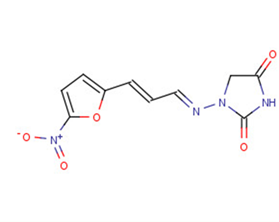
Furagin
CAS No. 1672-88-4
Furagin( NF 416 | NF416 | Akritoin | Furazidin )
Catalog No. M18108 CAS No. 1672-88-4
Furagin is a Nitrofuran derivative with anti-infective activity used for urinary tract infections.
Purity : >98% (HPLC)
 COA
Datasheet
HNMR
HPLC
MSDS
Handing Instructions
COA
Datasheet
HNMR
HPLC
MSDS
Handing Instructions
| Size | Price / USD | Stock | Quantity |
| 200MG | 33 | In Stock |


|
| 500MG | 53 | In Stock |
|
| 1G | 87 | In Stock |
|
Biological Information
-
Product NameFuragin
-
NoteResearch use only, not for human use.
-
Brief DescriptionFuragin is a Nitrofuran derivative with anti-infective activity used for urinary tract infections.
-
DescriptionFuragin is an anti-bacterial, nitrofurantoin analog. Furagin has the same efficacy in treating acute cystitis as ciprofloxacin, however the duration of therapy is longer.
-
In Vitro——
-
In Vivo——
-
SynonymsNF 416 | NF416 | Akritoin | Furazidin
-
PathwayEndocrinology/Hormones
-
TargetAChR
-
RecptorAntibacterial
-
Research AreaInfection
-
Indication——
Chemical Information
-
CAS Number1672-88-4
-
Formula Weight264.2
-
Molecular FormulaC10H8N4O5
-
Purity>98% (HPLC)
-
SolubilityDMSO : ≥ 33 mg/mL; 124.91 mM
-
SMILESC1C(=O)NC(=O)N1N=CC=CC2=CC=C(O2)[N+](=O)[O-]
-
Chemical Name1-(((1E,2Z)-3-(5-nitrofuran-2-yl)allylidene)amino)imidazolidine-2,4-dione
Shipping & Storage Information
-
Storage(-20℃)
-
ShippingWith Ice Pack
-
Stability≥ 2 years
Reference
1.Mannisto P, et al. Pharmacokinetics of furagin, a new nitrofurantoin congener, on human volunteers. Int J Clin Pharmacol Biopharm. 1979 Jun;17(6):264-70.
molnova catalog



related products
-
Sodium Glucuronic Ac...
Sodium Glucuronic Acid is used in the treatment of hepatitis and liver cirrhosis.
-
Sanguinine
Sanguinine (O-Desmethyl galanthamine) is galanthamine-type alkaloid and it is an acetylcholinesterase (AChE) inhibitor, with an IC50 1.83 μM.
-
Sitogluside
Eleutheroside A (Daucosterol) has proliferation-enhancing activity, may be involved in the IGF1-AKT pathway.
