


 Cart
Cart
 sales@molnova.com



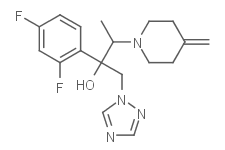
Efinaconazole
CAS No. 164650-44-6
Efinaconazole( KP103 | KP-103 | CTK5J2975 | AGJ95634 | Efinaconazole )
Catalog No. M17358 CAS No. 164650-44-6
Efinaconazole(KP-103) is an Azole Antifungal currently under development as a topical treatment for onychomycosis.
Purity : >98% (HPLC)
 COA
Datasheet
HNMR
HPLC
MSDS
Handing Instructions
COA
Datasheet
HNMR
HPLC
MSDS
Handing Instructions
| Size | Price / USD | Stock | Quantity |
| 5MG | 39 | In Stock |


|
| 10MG | 55 | In Stock |
|
| 25MG | 95 | In Stock |
|
| 50MG | 152 | In Stock |
|
| 100MG | 235 | In Stock |
|
| 500MG | 579 | In Stock |
|
| 1G | Get Quote | In Stock |
|
Biological Information
-
Product NameEfinaconazole
-
NoteResearch use only, not for human use.
-
Brief DescriptionEfinaconazole(KP-103) is an Azole Antifungal currently under development as a topical treatment for onychomycosis.
-
DescriptionEfinaconazole is a triazole antifungal. It is approved for use in Canada and the USA as a 10% topical solution for the treatment of onychomycosis (fungal infection of the nail). Efinaconazole acts as a 14α-demethylase inhibitor. Efinaconazole inhibits fungal lanosterol 14α-demethylase involved in the biosynthesis of ergosterol, a constituent of fungal cell membranes. Efinaconazole has been shown to be active against isolates of the following microorganisms, both in vitro and in clinical infections. Efinaconazole exhibits in vitro minimum inhibitory concentrations (MICs) of 0.06 μg/mL or less against most ( ≥ 90%) isolates of the following microorganisms: Trichophyton rubrum; Trichophyton mentagrophytes.(In Vivo):Topical Efinaconazole solution (0.25 to 1%) is dose-dependently effective in treating both dermatophytoses, for 10 guinea pigs with interdigital tinea pedis or tinea corporis is investigated. The follow up study performs on day-30 and day-9 posttreatment demonstrated that the relapse rates for 1% Efinaconazole-treated animals with tinea pedis and for those with tinea corporis are 20 and 30%, respectively. When a single dose of 1% Efinaconazole is applied to the back skin 48 hours before fungal inoculation, 9 of the 10 animals are protected from the dermatophytosis, suggesting that active Efinaconazole is retained in skin tissue for at least 48 hours after dosing.
-
In Vitro——
-
In VivoTopical Efinaconazole solution (0.25 to 1%) is dose-dependently effective in treating both dermatophytoses, for 10 guinea pigs with interdigital tinea pedis or tinea corporis is investigated. The follow up study performs on day-30 and day-9 posttreatment demonstrated that the relapse rates for 1% Efinaconazole-treated animals with tinea pedis and for those with tinea corporis are 20 and 30%, respectively. When a single dose of 1% Efinaconazole is applied to the back skin 48 hours before fungal inoculation, 9 of the 10 animals are protected from the dermatophytosis, suggesting that active Efinaconazole is retained in skin tissue for at least 48 hours after dosing.
-
SynonymsKP103 | KP-103 | CTK5J2975 | AGJ95634 | Efinaconazole
-
PathwayAngiogenesis
-
TargetPDGFR
-
RecptorAntifungle
-
Research AreaInfection
-
Indication——
Chemical Information
-
CAS Number164650-44-6
-
Formula Weight348.34
-
Molecular FormulaC18H22F2N4O
-
Purity>98% (HPLC)
-
SolubilityDMSO : ≥ 100 mg/mL;287.03 mM
-
SMILESC=C1CCN(CC1)[C@@H]([C@@](c1ccc(cc1F)F)(Cn1cncn1)O)C
-
Chemical Name(2R,3R)-2-(2,4-difluorophenyl)-3-(4-methylenepiperidin-1-yl)-1-(1H-1,2,4-triazol-1-yl)butan-2-ol
Shipping & Storage Information
-
Storage(-20℃)
-
ShippingWith Ice Pack
-
Stability≥ 2 years
Reference
1. Tatsumi Y, et al. Antimicrob Agents ChemOthers. 2013 May;57(5):2405-9.
molnova catalog



related products
-
Seralutinib
Seralutinib is an inhibitor of inhaled PDGFRα and PDGFRβ. It is used in the study for pulmonary arterial hypertension.
-
AC710
AC710 is a potent PDGFR inhibitor (Kds: 0.6, 1, 1.57, 1.3, 1 nM for FLT3, KIT, CSF1R, PDGFRα and PDGFRβ).
-
Rinucumab
Rinucumab (REGN 2176) is an anti-platelet-derived growth factor (PDGF) IgG4-like monoclonal antibody that acts by binding to the PDGF-β receptor and can be used to study age-related macular degeneration.
