


 Cart
Cart
 sales@molnova.com



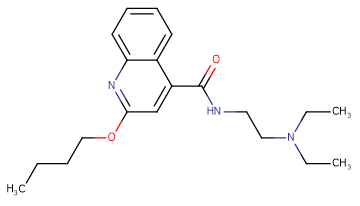
Dibucaine
CAS No. 85-79-0
Dibucaine( NSC 159055 )
Catalog No. M16224 CAS No. 85-79-0
Dibucaine is a local anesthetic of the amide type now generally used for surface anesthesia.
Purity : >98% (HPLC)
 COA
Datasheet
HNMR
HPLC
MSDS
Handing Instructions
COA
Datasheet
HNMR
HPLC
MSDS
Handing Instructions
| Size | Price / USD | Stock | Quantity |
| 500MG | 41 | In Stock |


|
| 1G | Get Quote | In Stock |
|
Biological Information
-
Product NameDibucaine
-
NoteResearch use only, not for human use.
-
Brief DescriptionDibucaine is a local anesthetic of the amide type now generally used for surface anesthesia.
-
DescriptionDibucaine is a local anesthetic of the amide type now generally used for surface anesthesia.(In Vitro):Dibucaine (Cinchocaine) reduces the degradation of BSA-gold complex in the reservosomes, which was not caused either by an inhibition of the whole proteolytic activity of the parasite or by a reduction on the expression levels of cruzipain. Dibucaine, a quaternary ammonium compound, inhibited SChE to a minimum within 2 min in a reversible manner. The inhibition was very potent. It had an IC(50) of 5.3 microM with BuTch or 3.8 microM with AcTch. The inhibition was competitive with respect to BuTch with a K(i) of 1.3 microM and a linear-mixed type (competitive/noncompetitive) with respect to AcTch with inhibition constants, K(i) and K(I) of 0.66 and 2.5 microM, respectively. Dibucaine possesses a butoxy side chain that is similar to the butryl group of BuTch and longer by an ethylene group from AcTch.
-
In VitroDibucaine (Cinchocaine) reduces the degradation of BSA-gold complex in the reservosomes, which was not caused either by an inhibition of the whole proteolytic activity of the parasite or by a reduction on the expression levels of cruzipain.Dibucaine, a quaternary ammonium compound, inhibited SChE to a minimum within 2 min in a reversible manner. The inhibition was very potent. It had an IC(50) of 5.3 microM with BuTch or 3.8 microM with AcTch. The inhibition was competitive with respect to BuTch with a K(i) of 1.3 microM and a linear-mixed type (competitive/noncompetitive) with respect to AcTch with inhibition constants, K(i) and K(I) of 0.66 and 2.5 microM, respectively. Dibucaine possesses a butoxy side chain that is similar to the butryl group of BuTch and longer by an ethylene group from AcTch.
-
In Vivo——
-
SynonymsNSC 159055
-
PathwayEndocrinology/Hormones
-
TargetAChR
-
RecptorAChR| CAM| Sodium Channel
-
Research AreaNeurological Disease
-
Indication——
Chemical Information
-
CAS Number85-79-0
-
Formula Weight343.46
-
Molecular FormulaC20H29N3O2
-
Purity>98% (HPLC)
-
SolubilityWater: 42 mg/L (at 21 °C)
-
SMILESCCCCOC1=NC2=CC=CC=C2C(=C1)C(=O)NCCN(CC)CC
-
Chemical Name2-butoxy-N-[2-(diethylamino)ethyl]quinoline-4-carboxamide
Shipping & Storage Information
-
Storage(-20℃)
-
ShippingWith Ice Pack
-
Stability≥ 2 years
Reference
1.Oka M, et al. Eur J Pharmacol. 2002 Oct 4;452(2):175-8
molnova catalog



related products
-
(+)-Pilocarpine hydr...
Pilocarpine hydrochloride is a nonselective muscarinic acetylcholine receptor agonist used to produce an experimental model of epilepsy.
-
4-Methylbenzylidene ...
4-Methylbenzylidene camphor is an ultraviolet light blocker used in cosmetics and sunscreen preparations specifically UV B radiation also has estrogenic activities.
-
Pregnenolone
A 21-carbon steroid, derived from CHOLESTEROL and found in steroid hormone-producing tissues.
