


 Cart
Cart
 sales@molnova.com



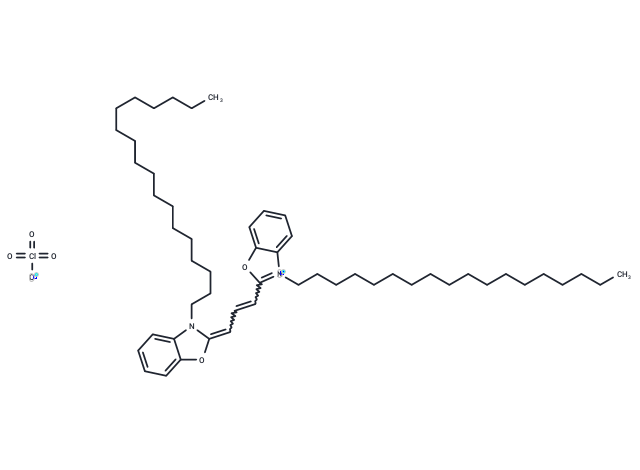
DiO
CAS No. 34215-57-1
DiO( —— )
Catalog No. M35206 CAS No. 34215-57-1
DiO (DiOC18(3)) is a fluorescent lipophilic tracer and can be widely used to label cells, organelles, liposomes, viruses, and lipoproteins.
Purity : >98% (HPLC)
 COA
Datasheet
HNMR
HPLC
MSDS
Handing Instructions
COA
Datasheet
HNMR
HPLC
MSDS
Handing Instructions
| Size | Price / USD | Stock | Quantity |
| 5MG | 63 | In Stock |


|
| 10MG | 92 | In Stock |
|
| 50MG | 252 | In Stock |
|
| 500MG | Get Quote | In Stock |
|
| 1G | Get Quote | In Stock |
|
Biological Information
-
Product NameDiO
-
NoteResearch use only, not for human use.
-
Brief DescriptionDiO (DiOC18(3)) is a fluorescent lipophilic tracer and can be widely used to label cells, organelles, liposomes, viruses, and lipoproteins.
-
DescriptionDiO is a long-chain carbocyanine dye. Carbocyanine dyes are widely used as Di to label cells, organelles, liposomes, viruses and lipoproteins.
-
In Vitro——
-
In Vivo——
-
Synonyms——
-
PathwayOthers
-
TargetOther Targets
-
RecptorOthers
-
Research Area——
-
Indication——
Chemical Information
-
CAS Number34215-57-1
-
Formula Weight881.71
-
Molecular FormulaC53H85ClN2O6
-
Purity>98% (HPLC)
-
SolubilityIn Vitro:?DMF : 10 mg/mL (11.34 mM; Ultrasonic)DMSO : 5 mg/mL (5.67 mM; Ultrasonic (<60°C)
-
SMILES[O-][Cl](=O)(=O)=O.CCCCCCCCCCCCCCCCCCN1C(Oc2ccccc12)=CC=Cc1oc2ccccc2[n+]1CCCCCCCCCCCCCCCCCC
-
Chemical Name——
Shipping & Storage Information
-
Storage(-20℃)
-
ShippingWith Ice Pack
-
Stability≥ 2 years
Reference
1. Gan WB, et al. Multicolor "DiOlistic" labeling of the nervous system using lipophilic dye combinations. Neuron. 2000 Aug;27(2):219-25.?
molnova catalog



related products
-
SC-202671
TCS JNK 5a is an effective, specific inhibitor of JNK3(pIC50= 6.7), JNK2(pIC50=6.5).
-
Oxyphyllacinol
Oxyphyllacinol has antidiarrheal activity.Oxyphyllacinol has been shown to treat dementia. Oxyphyllacinol was isolated from the S. nodiflora water fraction, while the S. nodiflora water fraction has been shown to have antioxidant and anti-aging activities, inducing mitochondrial activity and increasing ctt1 gene expression by regulating stress tolerance response.
-
ERCC1-XPF-IN-2
ERCC1-XPF-IN-2 is active in nucleotide excision repair, cisplatin enhancement and γH2AX assays. ERCC1-XPF-IN-2 is a potent inhibitor of ERCC1-XPF endonuclease with an IC 50 value of 0.6 μM .
