


 Cart
Cart
 sales@molnova.com



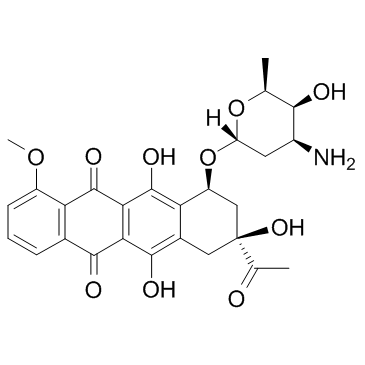
Daunorubicin
CAS No. 20830-81-3
Daunorubicin( RP13057 | Daunomycin | Rubidomycin )
Catalog No. M13246 CAS No. 20830-81-3
Daunorubicin is potent topoisomerase II (Topo II) inhibitor, interacts with DNA by intercalation and inhibition of macromolecular biosynthesis in cancer cells.
Purity : >98% (HPLC)
 COA
Datasheet
HNMR
HPLC
MSDS
Handing Instructions
COA
Datasheet
HNMR
HPLC
MSDS
Handing Instructions
| Size | Price / USD | Stock | Quantity |
| 100MG | Get Quote | In Stock |


|
| 200MG | Get Quote | In Stock |
|
| 500MG | Get Quote | In Stock |
|
| 1G | Get Quote | In Stock |
|
Biological Information
-
Product NameDaunorubicin
-
NoteResearch use only, not for human use.
-
Brief DescriptionDaunorubicin is potent topoisomerase II (Topo II) inhibitor, interacts with DNA by intercalation and inhibition of macromolecular biosynthesis in cancer cells.
-
DescriptionDaunorubicin is potent topoisomerase II (Topo II) inhibitor, interacts with DNA by intercalation and inhibition of macromolecular biosynthesis in cancer cells; Daunorubicin is a chemotherapy agent used to treat multiple cancer, secifically used for acute myeloid leukemia (AML), acute lymphocytic leukemia (ALL), chronic myelogenous leukemia (CML), and Kaposi's sarcoma; Daunorubicin and it's derivatives are widely used as payloads in antibody-drug conjugates (ADCs).Chemotherapeutic Agents Approved.
-
In VitroDaunorubicin (0-256 μg/mL, 30 min) inhibits DNA and RNA synthesis in sensitive and resistant Ehrlich ascites tumor cells.Daunorubicin (7 nM-1.9 μM, 72 h) shows chemosensitivity in Molt-4 cells and L3.6 cells. Daunorubicin (0.4 μM, 48 h) induces apoptotic and necrosis in L3.6 cells.Daunorubicin (0.4 μM, 120 min) induces ROS generation in L3.6 cells.Daunorubicin (2 μM, 24 h) induces autophagy in K562 cells (myeloid cell line). Cell Viability Assay Cell Line:Molt-4 cells (a human T-lymphoblastic leukemia cell line), L3.6 cells (metastatic human pancreatic cell line) Concentration:7 nM-1.9 μM Incubation Time:72 h Result:Inhibited cell viability with IC50 values of 40 nM (Molt-4) and 400 nM (L3.6).Apoptosis Analysis Cell Line:L3.6 cells Concentration:0.4 μM Incubation Time:24 h, 48 hResult:Induced necrosis without apoptosis at 24 h, induced both an apoptotic and extensive necrotic response at 48 h.Western Blot Analysis Cell Line:K562 cells Concentration:2 μM Incubation Time:24 h Result:Enabled the switch of LC3-I into LC3-II, accompanied with a significant increased expression level of LC3.
-
In VivoDaunorubicin (intravenous injection, 3 mg/kg, three times at 48 h intervals.) produces cardiotoxicity and nephrotoxicity in rats.Daunorubicin (intraperitoneal injection, 10 mg/kg) induces sister chromatid exchanges in mice. Animal Model:Male Sprague-Dawley rats Dosage:3 mg/kg Administration:Intravenous injection, three times at 48 h intervals.Result:Caused a significant increase in MDA (malondialdehyde) level in renal tissue, accompanied by a significant reduction in total GPx activity.Increased urinary protein excretion, serum creatinine, and BUN level.
-
SynonymsRP13057 | Daunomycin | Rubidomycin
-
PathwayAntibody Drug Conjugates (ADC)
-
TargetADC Cytotoxin
-
RecptorADC Cytotoxin
-
Research AreaCancer
-
IndicationChemotherapeutic
Chemical Information
-
CAS Number20830-81-3
-
Formula Weight527.5198
-
Molecular FormulaC27H29NO10
-
Purity>98% (HPLC)
-
Solubility10 mM in DMSO
-
SMILESCC1C(C(CC(O1)OC2CC(CC3=C2C(=C4C(=C3O)C(=O)C5=C(C4=O)C(=CC=C5)OC)O)(C(=O)C)O)N)O
-
Chemical Name5,12-Naphthacenedione, 8-acetyl-10-[(3-amino-2,3,6-trideoxy-α-L-lyxo-hexopyranosyl)oxy]-7,8,9,10-tetrahydro-6,8,11-trihydroxy-1-methoxy-, (8S,10S)-
Shipping & Storage Information
-
Storage(-20℃)
-
ShippingWith Ice Pack
-
Stability≥ 2 years
Reference
1. Latif ZA, et al. Cancer. 1980 Mar 15;45(6):1326-33.
2. Hurwitz E, et al. Int J Cancer. 1979 Oct 15;24(4):461-70.
3. Aboud-Pirak E, et al. Proc Natl Acad Sci U S A. 1989 May;86(10):3778-81.
molnova catalog



related products
-
alpha-Amanitin
α-Amanitin, an 8-Aa cyclic peptide, is an selective inhibitor of RNA polymerase II and III; a suitable toxic ADC payload for antibody-drug conjugates design.
-
AXC-666
AXC-666 is a TLR agonist and an immuno agonist that can be used to synthesize antibody drug couplers (ADCs).
-
Maytansinol
Maytansinol (Ansamitocin P-0) is a microtubule assembly inhibitor.
